Cultural brand building is the strategy of embedding a brand into culture through art and collaboration — to earn lasting commercial authority.
Table of Contents
What Is Cultural Brand Building?
Cultural Brand Building vs. Traditional Brand Building
Why Most Brand Activations Fail — and What to Do Instead
The Role of Cultural Collaborators
The End-to-End Process: Strategy to Execution
Business Outcomes: What to Realistically Expect
Cultural Brand Building vs. Cultural Washing
Who Is Cultural Brand Building For?
How to Get Started
The Infrastructure Behind Cultural Brand Building
What Is Cultural Brand Building?
Cultural brand building is the practice of constructing brand identity and market authority through deep, sustained engagement with culture — its artists, artisans, makers, rituals, and movements — rather than through advertising messages alone.
Where traditional brand building asks "how do we reach people?", cultural brand building asks "how do we matter to them?"
The distinction is not semantic. It is strategic. Brands that matter to people occupy a different position in the market than brands that merely reach them. They command higher price premiums, generate stronger advocacy, and are significantly harder to displace by competitors with bigger media budgets.
At Basa Studio, we define it this way:
Cultural brand building is the strategic integration of cultural depth — through curated collaborations with artists, artisans, and cultural innovators — into brand experiences, touchpoints, and communications, with the explicit goal of earning cultural authority and measurable business outcomes.
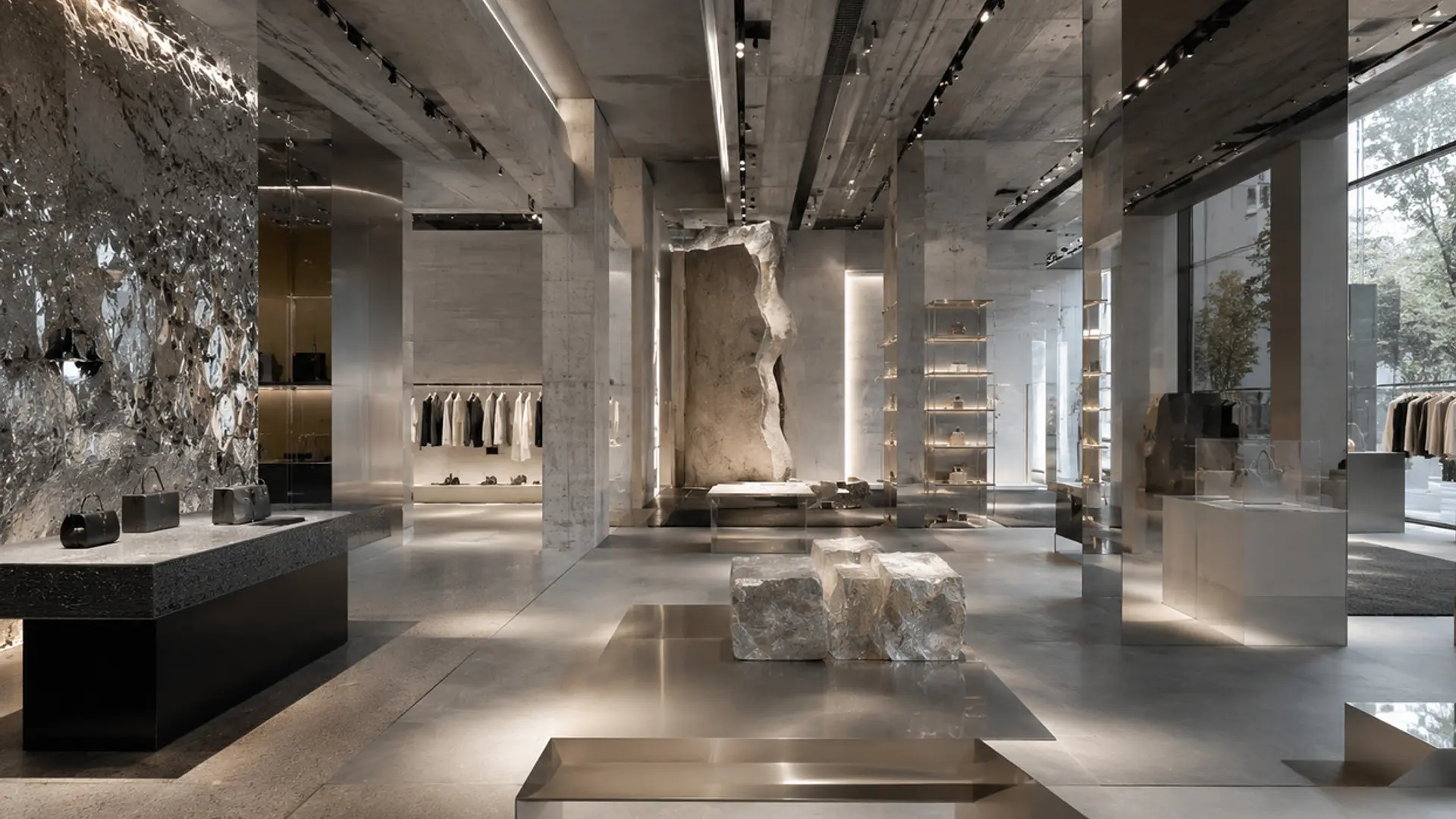
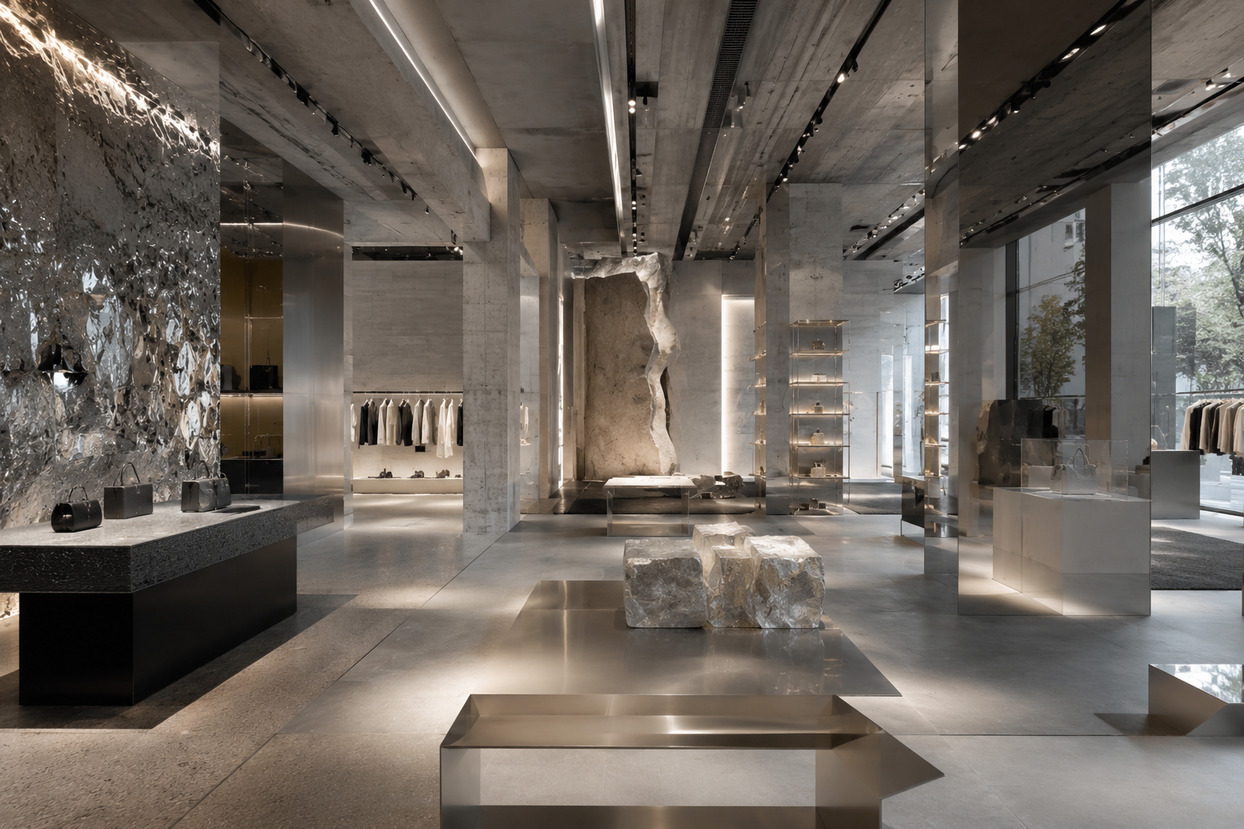
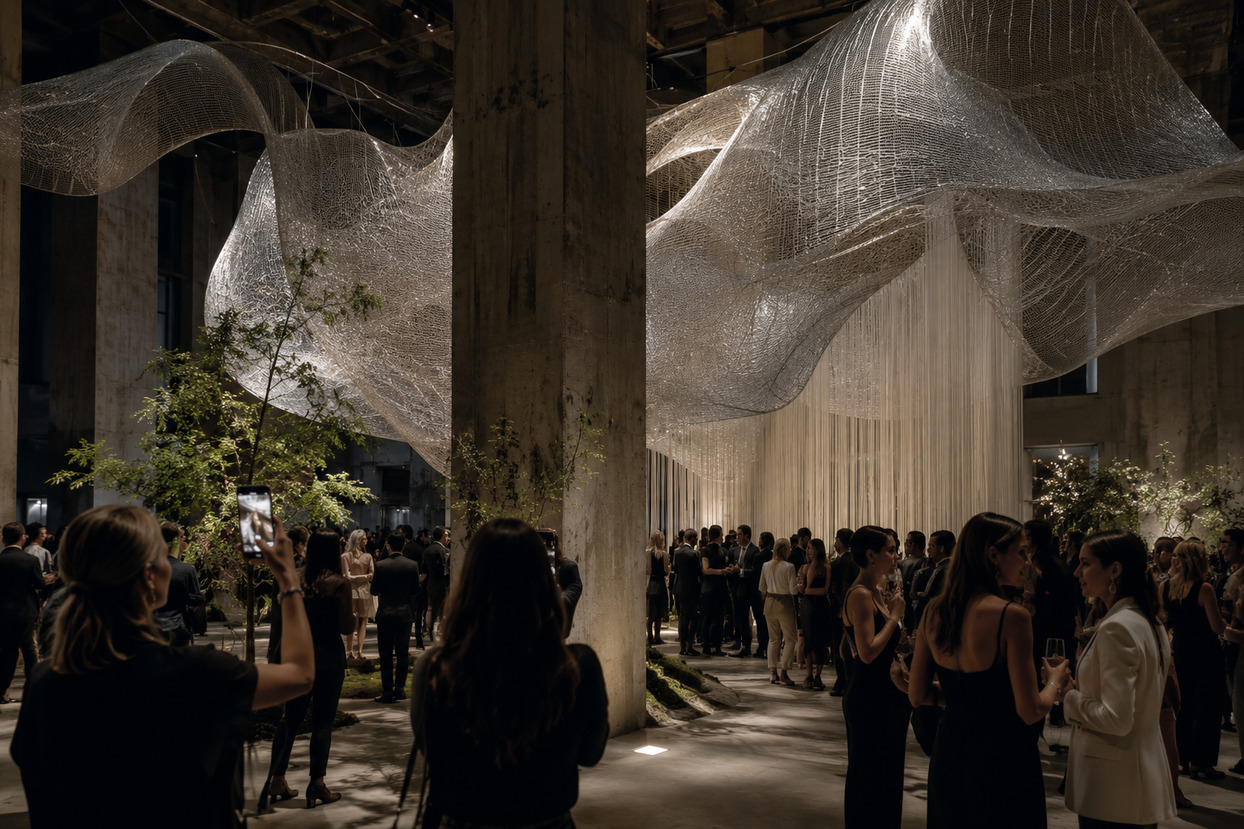
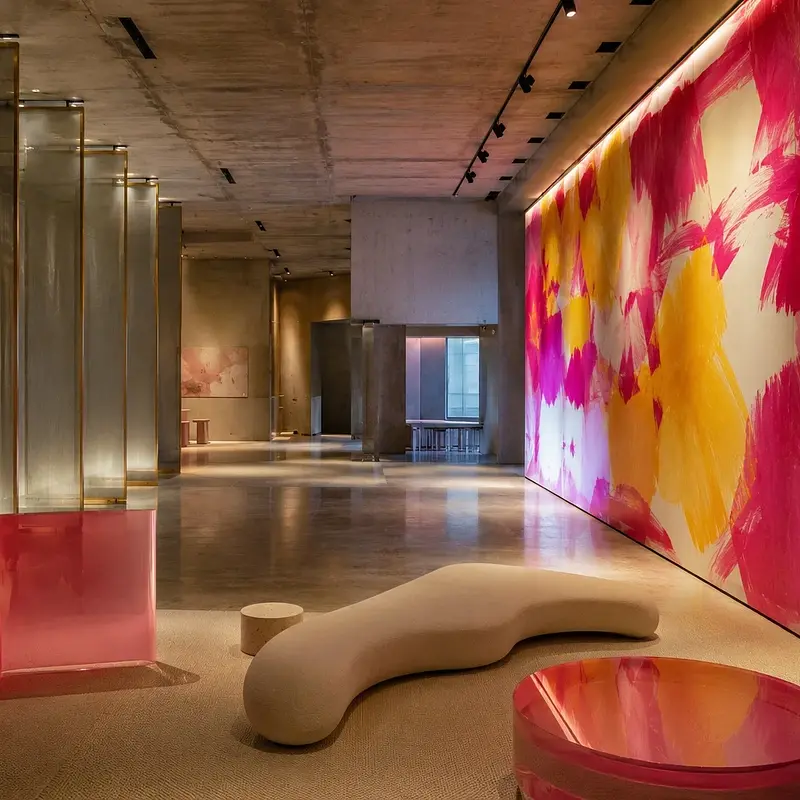
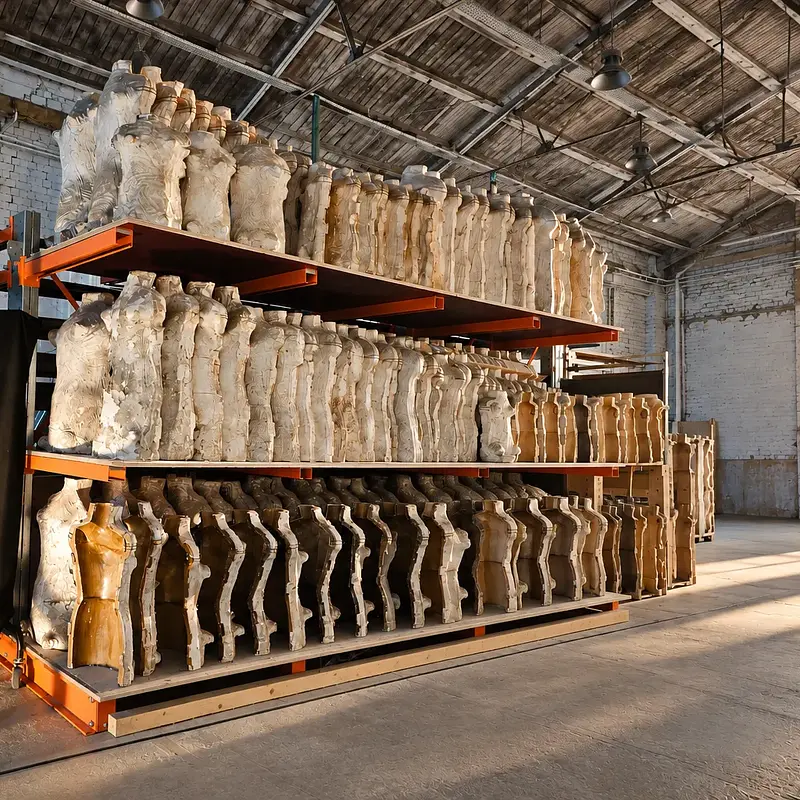
Cultural depth shows up in space, material, and detail — not in the campaign brief.
This definition contains three critical words: strategic, curated, and earning. Cultural brand building is not decorating campaigns with art. It is not commissioning murals because they photograph well. And it is not trend-chasing dressed up as creative ambition. It is a deliberate, process-driven approach to building a brand that people genuinely want to engage with — because it gives them something real.
Cultural Brand Building vs. Traditional Brand Building
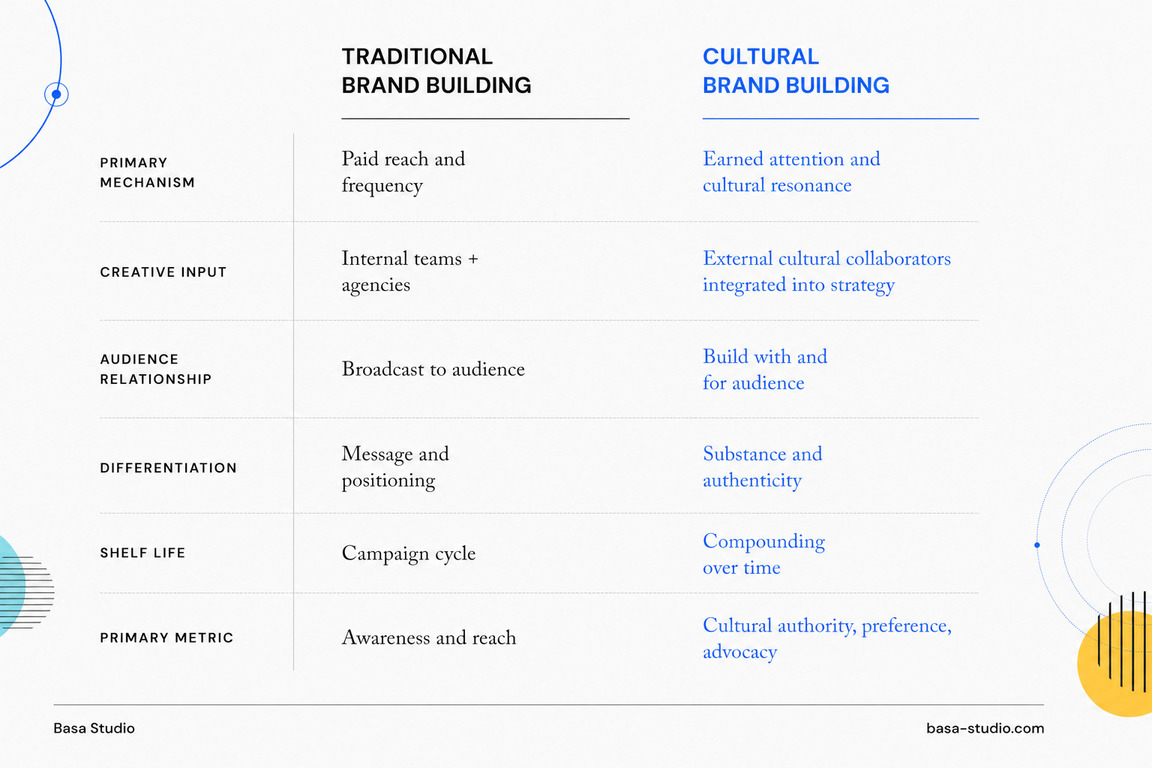
Traditional brand building is largely a distribution problem: build awareness at scale, repeat the message consistently, and win share of mind through frequency. It works — and at Basa, we are not dismissing it. But it has a ceiling.
The ceiling is cultural relevance. You can outspend every competitor and still feel like a brand people tolerate rather than one they choose. You can achieve near-universal awareness and still be replaceable. This is the strategic gap that cultural brand building addresses.
Traditional brand building optimises for visibility. Cultural brand building optimises for relevance that compounds.
The table above is not an argument for replacing one with the other. The most strategically sophisticated brands — LVMH maisons, Nike, Patagonia, Loewe — run both in parallel. What they understand is that traditional brand building amplifies what is already culturally resonant. Without cultural depth, amplification just makes the emptiness louder.
What "cultural branding" actually means — and what it doesn't
The term cultural branding has been used loosely enough that it has almost lost meaning. In academic and strategic contexts, it refers to brands that align themselves with cultural movements to gain relevance — a framework developed most rigorously by Douglas Holt, former marketing professor at Harvard Business School and Oxford, and one of the world's leading experts on branding and innovation. His How Brands Become Icons remains the definitive text on why cultural meaning — not product performance — is what makes certain brands irreplaceable.
What Basa Studio's practice adds to this is execution infrastructure. Cultural branding as a strategic concept tells you why to pursue cultural relevance. Cultural brand building as a practice tells you how — through which collaborators, at which touchpoints, through which process, and toward which measurable outcomes.
Why Most Brand Activations Fail — and What to Do Instead
If you have attended three brand activations in the past two years, the odds are high that at least two of them felt like marketing. Not experiences. Not cultural moments. Marketing.
The signs are recognizable: the activation exists to generate content, not to create meaning. The artist or performer was booked, not integrated. The brief was "make it feel cultural" rather than "build something that earns attention on its own terms." The ROI was measured in impressions, not in how people felt about the brand afterward.
This is the central failure mode of cultural marketing executed without cultural brand building strategy behind it.
The fix is not more budget. It is earlier integration. The cultural perspective — the artist's way of seeing, the artisan's material knowledge, the cultural innovator's audience instinct — needs to be in the room when the brief is written, not brought in to execute a brief that is already finalized.
Brands that get this right include:
Netflix — Netflix House, its permanent experiential venue format, builds immersive cultural destinations around its shows — not promotional pop-ups, but spaces designed to be worth visiting on their own terms.
YSL Beauty — thePush the Boundaries platform embedded the brand into creative movements by commissioning documentary work around artists, dancers, and musicians — figures chosen for their cultural edge, not their follower counts.
What these brands share is not budget. It is a commitment to substance over spectacle — and a process that integrates cultural thinking from the beginning.
The Role of Cultural Collaborators
Cultural collaborators — artists, artisans, and cultural innovators — are not the product of cultural brand building. They are the instrument through which cultural depth is created.
This distinction matters enormously. When brands treat cultural collaborators as the headline — "Brand X partners with Artist Y" — they are usually deploying borrowed cultural currency. When they integrate collaborators into the strategic and creative process from the beginning, they are building something that belongs to the brand.
Artists
Visual artists, photographers, illustrators, muralists, and performance artists bring a distinct way of seeing that is not available inside a marketing department. Their value is not decoration — it is perspective. A brand that commissions original work from an artist whose vision is genuinely aligned with what the brand stands for gets access to creative territory that cannot be produced by briefing a design agency. The work has authorship. Authorship creates meaning. Meaning earns attention.
Artisans
Craftspeople, material specialists, and makers bring something different: substance. In a market flooded with digital-first brand experiences, physical craft is increasingly rare and therefore increasingly valuable. An artisan-produced element in a packaging design, a spatial experience, or a product launch communicates quality in a register that renders are incapable of reaching. It is proof, not promise.
Cultural Innovators
This is the broadest category — it includes designers working at the intersection of culture and commerce, creative directors with strong cultural followings, cultural researchers, trend-adjacent thinkers, and community builders with genuine influence in specific subcultures. Their role is often strategic as much as creative: they help brands understand where culture is moving and how to position within it with credibility.
The right collaborator for any given brand depends on three things: strategic alignment (does their work and worldview intersect meaningfully with the brand's?), audience overlap (do they have genuine influence with the people the brand wants to reach?), and process compatibility (can they work within a structured brand context without losing what makes them distinctive?).
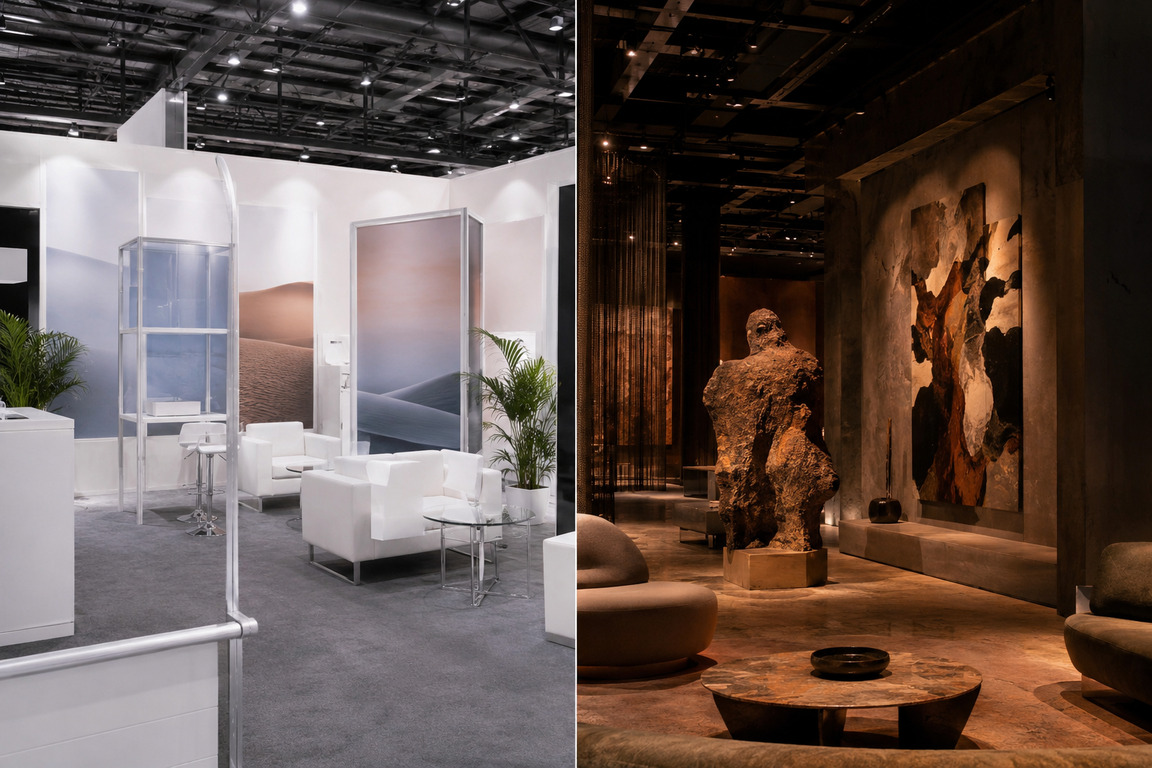
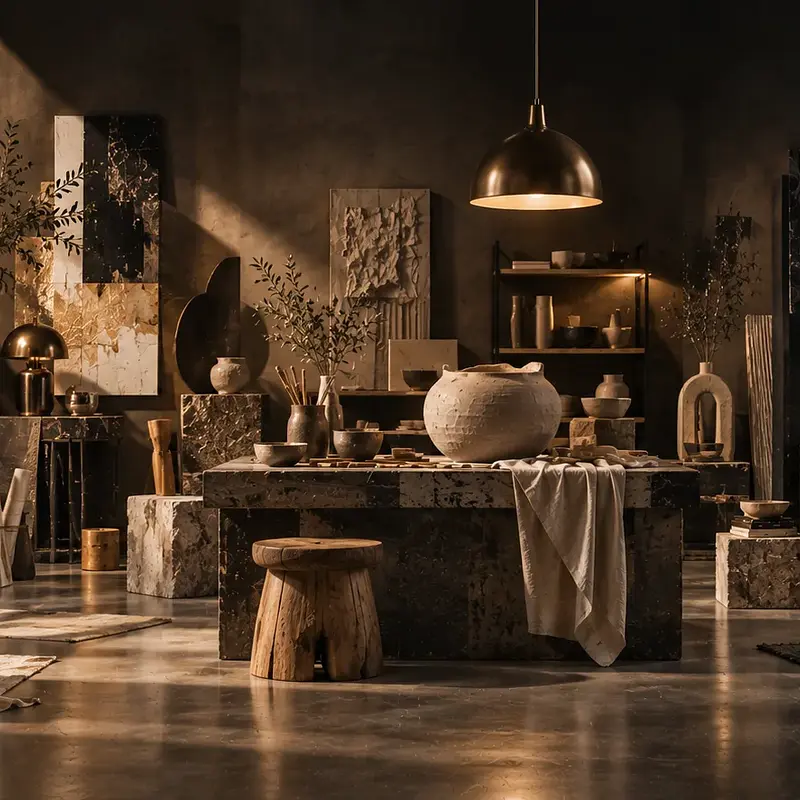
Craft communicates what renders cannot — substance over spectacle.
The End-to-End Process: Strategy to Execution
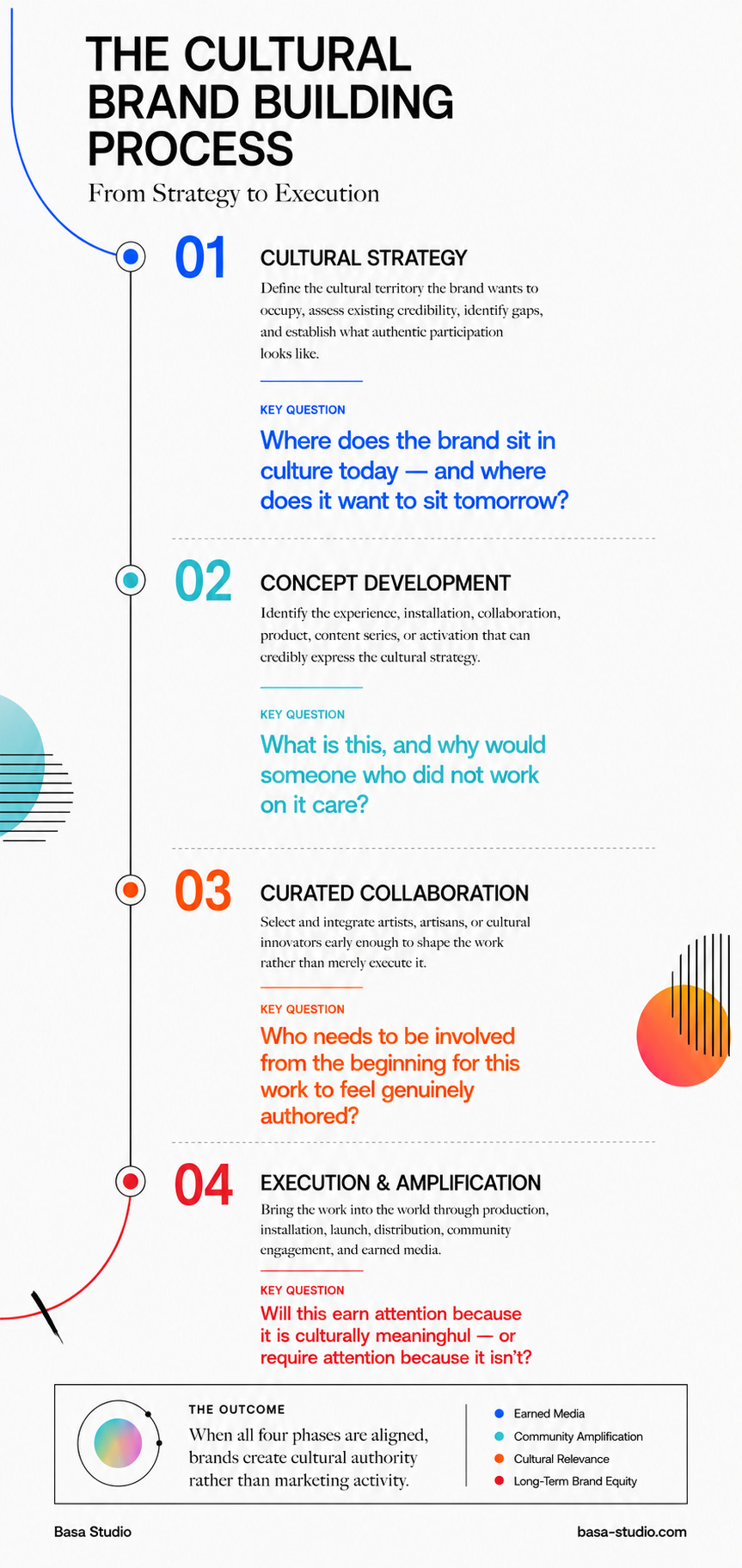
Cultural brand building is not a campaign format. It is a process — and the quality of that process is what separates brands that build genuine cultural authority from brands that produce well-intentioned activations that feel like marketing anyway.
The process has four phases:
Phase 1: Cultural Strategy
Before any collaborator is identified, a clear cultural strategy must be in place. This means: what cultural territory does the brand want to own or participate in? What is the brand's existing cultural credibility — and what are its gaps? Who is the audience, and what cultural signals do they read as authentic vs. performative?
This is not a mood board exercise. It is a strategic audit of where the brand sits in culture today, where it wants to sit, and what it would take to close that gap credibly. The clearest way to understand what a defined cultural territory looks like is to look at brands that have claimed one — and held it.
Patagonia doesn't sit in outdoor apparel — it sits in environmental activism. That's why telling customers not to buy their jacket was an obvious decision, not a brave one. Loewe under Jonathan Anderson positioned itself inside fine art and living craft, which is what produced the Loewe Foundation Craft Prize — a permanent international award for craftsmanship with no direct commercial purpose. And Red Bull, which has always occupied the culture of human performance at its limits, funded a man to jump from the edge of space.
Once you know where a brand sits in culture, its decisions stop looking bold and start looking inevitable.
Phase 2: Concept Development
With a cultural strategy defined, the concept phase identifies the specific form the brand experience will take — a spatial installation, a product collaboration, a content series, a live event, a packaging redesign. Crucially, this phase also identifies the right type of collaborator and begins the process of matching brand needs to cultural talent.
The concept must answer a simple test question: What is this, and why would someone who did not work on it care?
This is harder than it sounds. Most brand concepts fail this test because the honest answer is some version of "because the brand commissioned it" — meaning the work exists to serve the brand's communication needs, not to offer the audience anything genuinely valuable. A mural that exists because the brand wanted an Instagram backdrop. An installation that exists because the brief said "experiential." A collaboration that exists because the brand wanted cultural credibility by association.
Work that fails the test tends to be immediately recognisable as marketing. Work that passes it tends to earn attention on its own terms — people engage with it, share it, and remember it because it gave them something: an experience, a perspective, a moment of genuine craft or surprise. The brand is present, but it is not the reason the work is worth engaging with.
If the concept cannot answer the test question clearly, it is not ready — and commissioning it anyway is where most of the budget in cultural brand building gets wasted.
Phase 3: Curated Collaboration
The collaboration phase is where cultural depth is either built or squandered. Integration is the operative word. The collaborator is not executing a brief — they are co-authoring an outcome within a strategic frame. This requires a different kind of brief: one that shares the brand's strategic objectives clearly, gives the collaborator genuine creative latitude, and establishes the quality and cultural criteria the work must meet.
The best outcomes come from collaborators who have been selected for alignment, not just profile.
Timing is where most brands get this wrong. The conventional approach is to develop the strategy, lock the concept, define the deliverables — and then bring in a collaborator to execute. By that point, the creative decisions have already been made. The artist, artisan, or cultural innovator becomes a supplier, working to a specification they had no part in shaping. The output may be well-crafted, but it will not have cultural depth — because cultural depth is not a finish applied at the end of a process. It is the result of a perspective that shaped the work from the beginning.
The difference between a brand experience that feels authored and one that feels assembled is almost always a question of when the collaborator entered the room. The earlier they are integrated — into the strategic thinking, the concept development, the definition of what success looks like — the more their perspective becomes structural to the work rather than decorative. That is what makes the difference between cultural brand building and cultural decoration.
Phase 4: Execution and Amplification
Execution covers the physical and logistical reality of bringing the experience to life — whether that is an installation, a product, a spatial design, or a live activation. Amplification covers how the work reaches the audiences it was built for: owned channels, press, cultural media, community distribution.
At this phase, the quality of what was built in Phases 1–3 becomes visible. Work that has genuine cultural substance earns media coverage and social sharing because it is worth covering. Work that was assembled from trend references and borrowed aesthetics requires media spend to generate attention — and still rarely generates meaningful engagement.
Cultural brand building follows a four-phase process. Shortcuts in Phase 1 or 3 are where most activations lose their cultural credibility.
Business Outcomes: What to Realistically Expect
CMOs who present cultural brand building investment to their boards need to answer one question clearly: What do we get back?
The answer is more measurable than the question implies — but only if the right metrics are defined before the work begins, not after.
Short-term outcomes (0–12 months)
Earned media and press coverage — work with genuine cultural substance attracts editorial attention that paid campaigns cannot buy. A well-executed cultural installation or collaboration can generate coverage in cultural press, design media, and consumer publications that would cost multiples of its production budget to replicate through advertising
Social amplification from cultural communities — when work resonates in a specific cultural community, the sharing is organic and comes from voices the brand could not otherwise access
Experiential quality scores — if the activation includes a live audience, NPS (Net Promoter Score) and post-event sentiment data typically outperform traditional events significantly when the cultural depth is genuine
Work with genuine cultural substance earns the attention that paid campaigns cannot buy.
Medium-term outcomes (12–36 months)
Partnership and distribution leverage — cultural authority opens doors. Oatly is the clearest recent example: instead of buying shelf space, the brand embedded itself in café and barista culture first, building credibility through specialty coffee communities until supermarket retailers came to them. Consumer demand was already proven before the brand reached mainstream grocery — on cultural terms, not advertising terms.
Talent attraction — increasingly, brand culture is a talent acquisition lever. Brands known for genuine cultural engagement attract creative talent who would not otherwise consider a corporate role
Long-term outcomes (36+ months)
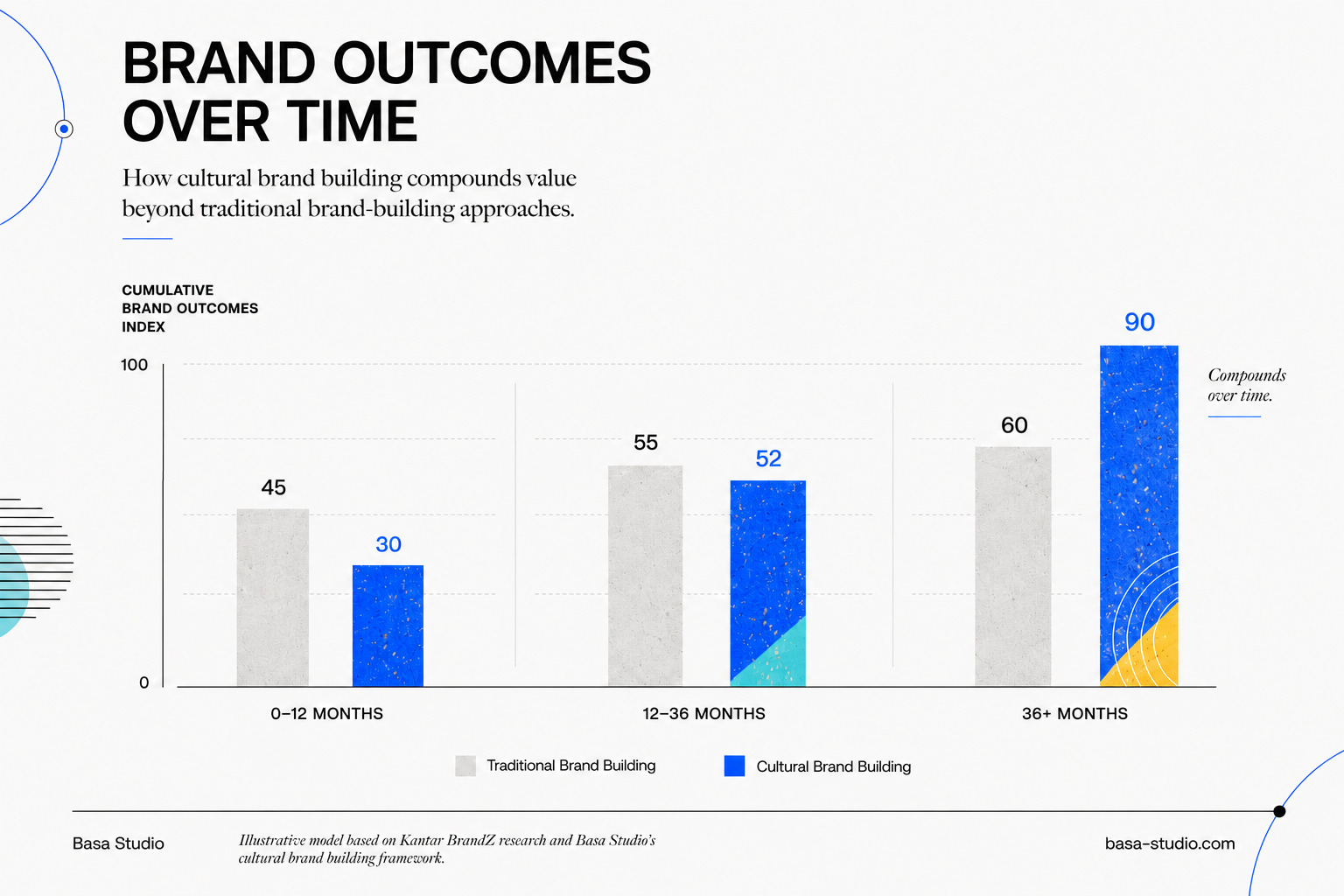
Brand preference shift — the metric that takes longest to move and compounds most significantly over time. Kantar, a leading marketing data and analytics company, found in its BrandZ research across 4.3 million consumers and 21,000 brands that culturally vibrant brands grow nearly six times faster than those that aren't — but cultural vibrancy is built through consistent engagement over time, not single activations.
Category authority — the brand becomes the reference point for cultural depth in its category. Supreme built this through decades of authentic immersion in New York skate, hip-hop, and art — so completely that winning the CFDA Menswear Designer of the Year in 2018, beating Tom Ford and Thom Browne, felt inevitable rather than surprising. Glossier built it in beauty by spending four years listening to its community before launching a single product — reaching a peak valuation of $1.8 billion built almost entirely on cultural trust rather than media spend, as reported by the Business of Fashion.
Pricing power — cultural authority supports premium pricing in a way that awareness alone does not. It signals quality of judgment, not just quality of product. The same Kantar research across 11,000 brands found that meaningful difference — not salience — accounts for 94% of a brand's pricing power, and that brand-driven consumers pay 37% more for brands they perceive as meaningfully different. Awareness gets a brand noticed. Cultural depth makes it worth paying more for.
Measuring the return on cultural brand building requires a metrics framework built for compounding returns, not campaign cycles.
Cultural brand building compounds over time. Traditional brand building plateaus. For legacy brands, culture is not a campaign strategy — it is the long-term growth strategy.
Cultural Brand Building vs. Cultural Washing
The risk of cultural brand building is cultural washing: the appearance of cultural engagement without the substance. It is the brand that installs a mural because murals are having a moment. The activation that casts artists as props. The campaign that references a subculture without understanding it.
Cultural washing fails commercially as well as ethically. The audiences brands most want to reach — culturally literate, premium consumers with high aesthetic standards — are precisely the audiences most capable of detecting inauthenticity. They do not just ignore it. They penalize it.
The difference between cultural brand building and cultural washing comes down to three tests:
1. The integration test. Was the cultural collaborator involved from the strategic phase, or added at the execution phase? Genuine integration produces work where the collaborator's perspective shaped the outcome. Decorative inclusion produces work where the collaborator's name is on something they had no meaningful influence over.
2. The substance test. Does the work stand on its own — would it earn attention if the brand name were removed from it? Or does it only exist as a vehicle for brand messaging? Work with cultural substance has value beyond its brand context. Washing does not.
3. The consistency test. Is this a one-time gesture or part of a sustained strategic commitment? Cultural authority is not built in a single activation. Brands that engage culturally once, opportunistically, and then return to standard programming are demonstrating that culture is not a strategic priority — it is a tactical tool deployed when convenient.
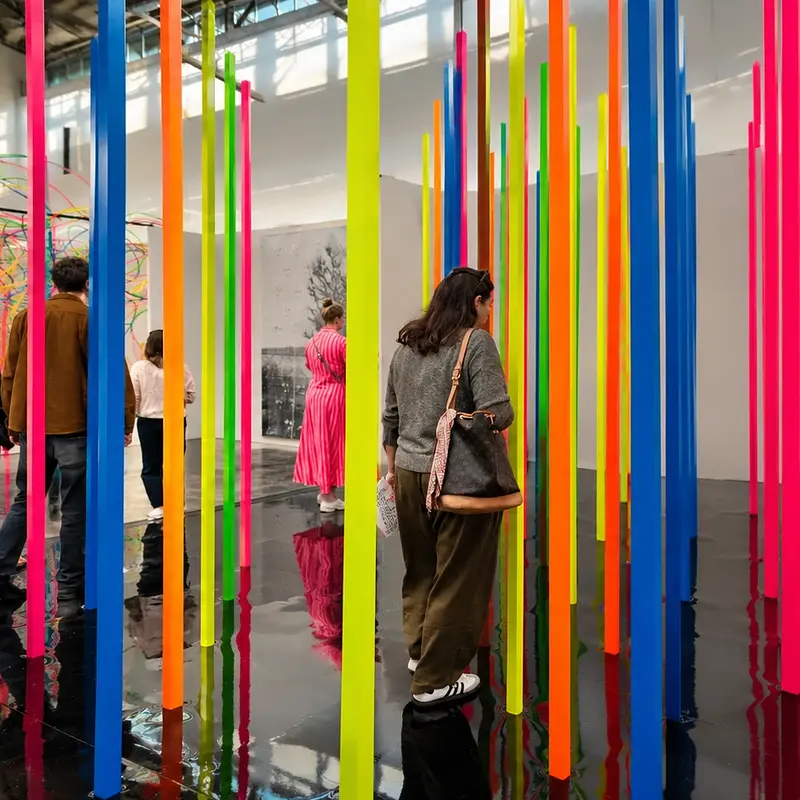
Cultural depth is visible in the details. So is its absence.
Who Is Cultural Brand Building For?
The short answer: premium brands for whom differentiation is a strategic priority and whose customers make choices based on values, identity, and taste as much as price or function.
In practice, this includes:
Luxury and premium consumer goods — this is the most natural home for cultural brand building, and the category where the ROI case is most developed. Brands in fashion, fragrance, jewelry, watches, spirits, and hospitality have the most to gain from cultural authority and the most to lose from cultural irrelevance.
Automotive — premium and luxury automotive brands operate in a category where product differentiation is increasingly difficult to sustain on technical grounds alone. Cultural brand building is how brands like Porsche, BMW, and Mercedes maintain desirability ahead of pure product cycles.
Technology and consumer electronics — premium tech brands (Apple being the canonical example, but also brands like Sonos, Bang & Olufsen, and Leica) have built significant brand value through cultural positioning. The challenge for tech brands is avoiding the trap of aestheticizing technology without earning cultural credibility.
Retail and lifestyle — brands operating in physical retail environments have a structural opportunity to build cultural depth through spatial design, rotating cultural programming, and in-store experiences that function as cultural destinations rather than shopping environments.
What cultural brand building is not suited for — pure commodity brands competing primarily on price; organizations whose primary audience has no significant cultural dimension to their purchase decisions; brands without the organizational patience to invest over a 12–36 month horizon.
How to Get Started
For CMOs and Marketing Directors considering cultural brand building as a strategic commitment, the entry point matters.
The most common mistake is starting with a project before establishing a strategy. Brands commission an activation, a mural, a collaboration — and then discover that without a cultural strategy behind it, the individual project cannot accumulate into authority. Each project starts from zero. Nothing compounds.
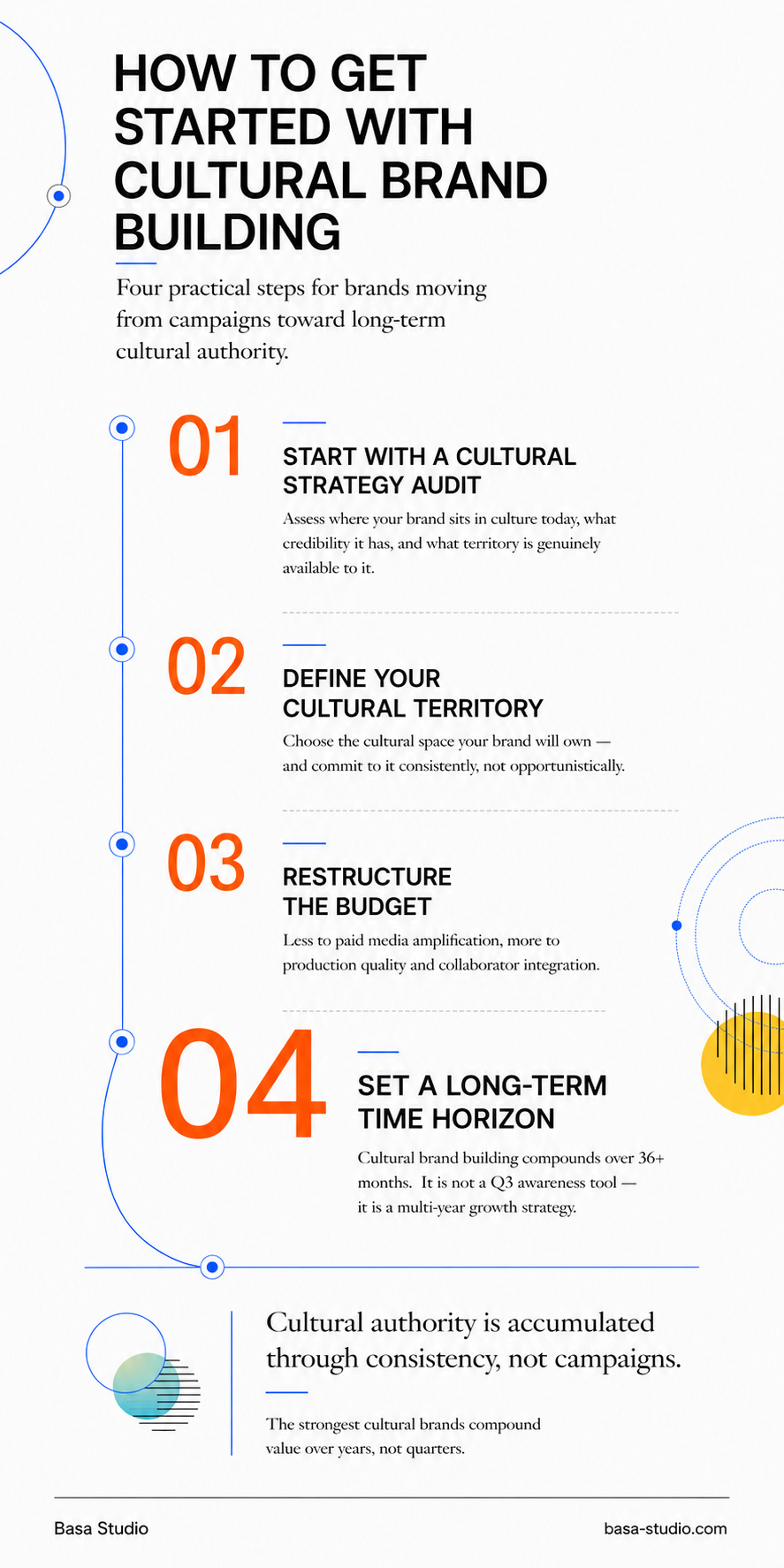
The better entry point is a cultural strategy audit: an honest assessment of where the brand currently sits in culture, what credibility it has, what gaps exist, and what kind of cultural territory is genuinely available to it. From that foundation, individual projects — at any budget level — begin to build toward something.
A second consideration is budget framing. Cultural brand building is not necessarily more expensive than traditional brand activation — but the budget is structured differently. Less goes to paid media amplification, more goes to production quality and collaborator integration. Less goes to high-frequency, low-depth touchpoints, more goes to fewer, higher-impact cultural moments.
A third consideration is time horizon. If the brief is "generate awareness for Q3," cultural brand building is probably not the right tool. If the brief is "build cultural authority in this category over the next three years," it may be the most efficient investment available.
Cultural brand building starts with strategic clarity, not a production brief.
The Infrastructure Behind Cultural Brand Building
Understanding cultural brand building as a strategy is one thing. Having the infrastructure to execute it consistently — at brand level, across markets and touchpoints — is another entirely.
This is where most brands hit a structural problem. The strategic ambition exists. The brief is written. But the internal team lacks either the cultural relationships to identify the right collaborators, or the production capability to bring the work to life without losing what made it interesting in the first place. The result is the gap between what was conceived and what gets built — and it is where cultural depth is most commonly lost.
Closing that gap requires two things working in parallel.
A curated collaborator network
The first is access to a network of artists, artisans, and cultural innovators whose output, values, and ways of working have been tested in brand contexts. Not a directory — a set of working relationships with practitioners selected for strategic alignment first, creative track record second. When the right collaborator is identified on that basis, the work feels integrated rather than commissioned.
This kind of network takes years to build and is not replicable by a brand team working alone. It is one of the core assets Basa Studio brings to every engagement.
An end-to-end process
The second is a structured process that runs from cultural strategy through to final execution without handing off between agencies at each phase. Cultural brand building is highly sensitive to handoffs — every time a brief passes between teams, something is at risk of being diluted. A turnkey partner with visibility across the entire workflow protects the integrity of the original cultural insight all the way through to what the audience actually experiences.
At Basa, strategy, concept development, collaborator integration, production, and amplification are managed as a single workflow — from strategy through execution, by a team that understands both the cultural and the commercial objectives from the outset.
The Strategic Case, in Summary
Cultural brand building is not a creative philosophy. It is a business strategy for brands that have decided to compete on cultural authority rather than spend alone.
It works because the audiences most valuable to premium brands — high-income, taste-driven, culturally literate — have developed sophisticated filters against advertising and low-substance activations. They respond to work that earns their attention. They remember brands that gave them something real. They choose brands that reflect a quality of judgment they respect.
The brands that have built the most durable positions in their categories have not done so by outspending competitors. They have done so by consistently producing cultural work that people genuinely value. That is not an accident of creative talent. It is the result of a repeatable strategic process.
Basa Studio creates brand experiences rooted in cultural depth. We work with CMOs and Marketing Directors at premium brands across Europe — integrating acclaimed artists, artisans, and cultural innovators into strategic brand work, from strategy through execution.
Related creative stories
Browse through other features, interviews and guides to discover creative brand collaborations, meet innovative artists and creators, find out how new artforms are energizing advertising, & more.
We're excited to hear from you! If you're looking for artistic solutions for your next creative marketing campaign, send us your briefing. We can also help create a killer concept if you're in an early ideation phase. Check out our services for more.
Send your briefing
About you
THANK YOU
Your inquiry has been sent
We have received your inquiry. We'll get back to you within 24-48 hours to discuss your project. If you need urgent assistance, reach us on WhatsApp: +49 176 432 64506. In the meantime, we invite you to explore our insights, case studies, and lessons from building culturally grounded brand experiences.
Please contact us by phone if you're not able to reach us via this form.
THANK YOU
We have received your inquiry. We'll get back to you within 24-48 hours to discuss your project. If you need urgent assistance, reach us on WhatsApp: +49 176 432 64506. In the meantime, we invite you to explore our insights, case studies, and lessons from building culturally grounded brand experiences.
We use cookies to help empower our artists and make them accessible to clients. Check out our Privacy Policy and Terms of Service to see how your data can make a difference.