Cultural strategy builds lasting brand equity. Trend chasing burns budget and arrives late. Here's what separates the leaders from the followers.
What "Cultural Marketing" Actually Means
Before drawing the line between strategy and trend-chasing, it's worth being precise about language. Cultural marketing is a term used loosely — sometimes to mean multicultural advertising, sometimes to mean brand activations with a creative edge. Neither definition captures what actually moves markets.
For the purposes of this article — and for how Basa Studio works — cultural marketing means this: the deliberate practice of embedding a brand into the living, evolving conversations of culture in order to build relevance, authority, and long-term equity. It is not about reflecting culture back at consumers. It is about contributing to it in ways that matter.
That distinction — reflecting versus contributing — is where cultural strategy and trend-based marketing part ways entirely.
The Trend Cycle Trap
Here is how trend-based marketing actually works in practice. A brand's social listening tool flags a rising aesthetic — a particular visual language, a subculture gaining traction, a sound associated with a specific community. The brand briefs an agency. The agency produces concepts. Rounds of approvals follow. Production runs. Media is planned and bought. The campaign launches.
By then, the culture has moved on.
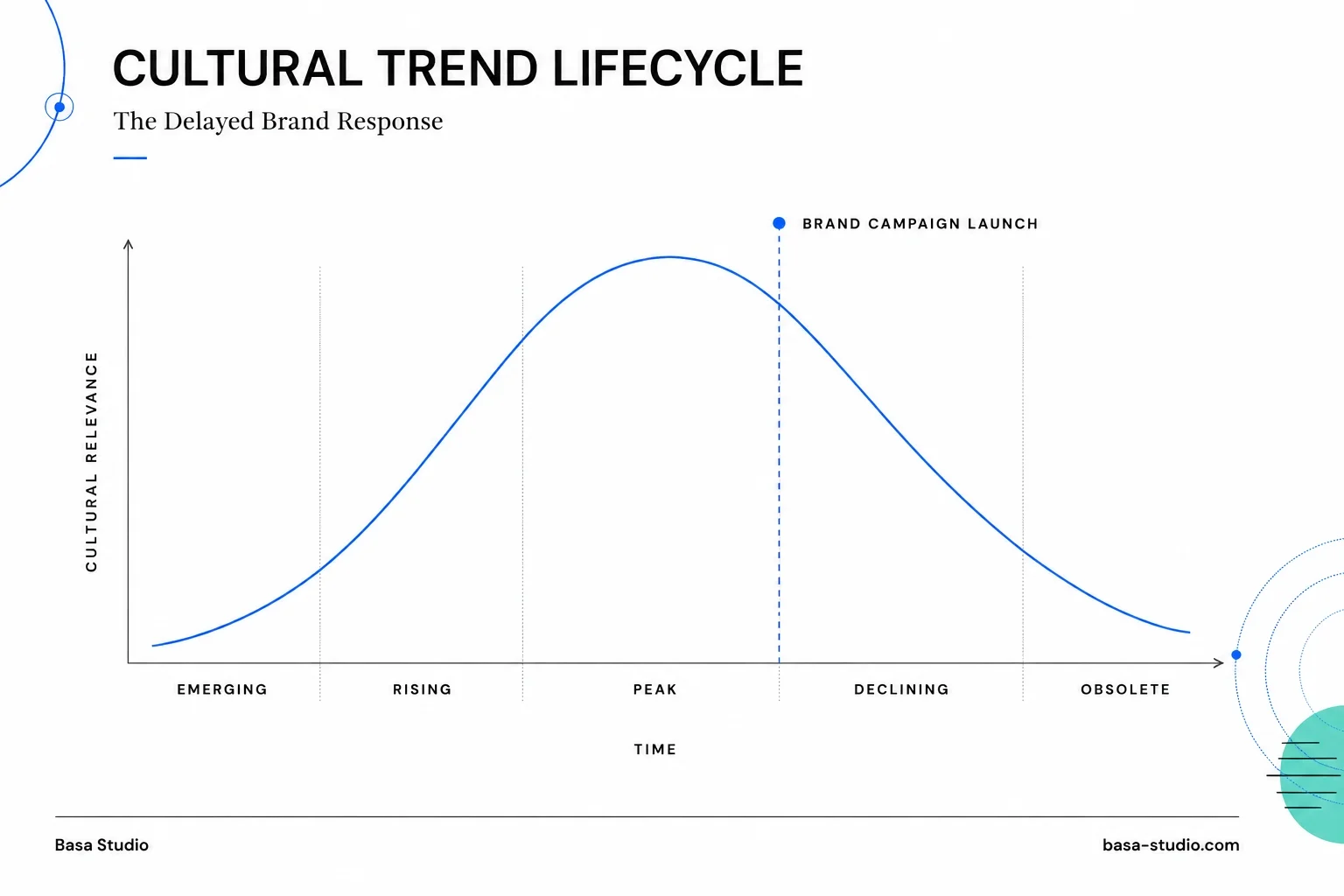
This is not a failure of execution. It is a structural problem. Trends, by definition, exist in the moment of their emergence. The window between "this is interesting" and "this is over" has compressed dramatically. What once gave brands six to twelve months of cultural relevance now gives them weeks — if they are early — or nothing, if they arrive after the peak.
The cost of being late is not just wasted media spend. It is worse: a brand that chases trends signals to its audience that it does not understand culture — it monitors it. Audiences, particularly at the premium end of the market, are extraordinarily fluent in this distinction. They know when they are being sold back their own subculture. And they punish it.
Most brand campaigns launch after cultural relevance has already peaked. The gap between insight and execution is where budget disappears.
Cultural Strategy: A Different Animal
Cultural strategy does not begin with trend monitoring. It begins with a point of view.
A brand operating from genuine cultural strategy has identified — with depth and specificity — which cultural territories are native to its identity. Not adjacent to what's trending. Native. These are the conversations, communities, craft traditions, and creative movements that the brand can enter with legitimate authority, because its history, values, or product philosophy genuinely intersects with them.
From that foundation, a cultural strategy answers three questions:
Which cultural territories do we own or can credibly claim? Not every brand can enter every conversation. Cultural strategy requires hard choices about where authority is genuine and where it is performative. A brand that tries to claim too many territories ends up owning none.
How do we contribute — not just appear? Showing up is not enough. Cultural leaders commission original work, fund emerging talent, create platforms, or change the material conditions of a creative community. They add something to the culture they enter. This is what transforms a brand from spectator to participant.
What does this look like at a five-year horizon, not a campaign cycle? Trend marketing thinks in campaign windows. Cultural strategy thinks in decades. The brands that win culturally do so because they have built a consistent, recognisable relationship with specific cultural territories — one that compounds over time rather than resets with every new brief.
Best Cultural Marketing Campaigns: What Winning Actually Looks Like
Cultural leadership is not a category reserved for heritage brands or unlimited budgets. The clearest examples span industries and eras — but share one structural feature: each brand staked a cultural position before the consensus confirmed it. They did not respond to culture. They shaped it.
Cultural leaders don't choose their territory based on what's trending. They choose it based on what they can credibly own.
1. Nike — Conviction as Cultural StrategyIndustry: Sportswear / Lifestyle
Nike's 1988 "Just Do It" campaign was not a reflection of existing consumer behaviour — it was a proposition about who athletes could be and what sport meant in everyday life. Its 2018 decision to build a campaign around Colin Kaepernick extended that same logic into far riskier territory. As MIT Sloan analysed at the time, the Kaepernick campaign moved Nike from a "wallpaper brand" — one that anyone and everyone wears — to a brand with a defined cultural point of view. Harvard Business School later documented it as a landmark case in brand activism, noting that Nike accepted the risk of alienating a significant consumer segment in order to hold its position. It held. The cultural bet paid.
What made it work: Nike did not react to the social justice conversation. It entered it with a collaborator whose story was consistent with the brand's founding logic — that sport is a platform for human potential, not just performance. The position preceded the moment. That is why it landed as conviction rather than opportunism.
2. Patagonia — When the Business Model Is the Cultural StrategyIndustry: Outdoor Apparel / Lifestyle
Most brands separate their marketing from their operations. Patagonia made that separation impossible. On Black Friday 2011 — the single most commercially intense day in the US retail calendar — Patagonia published a full-page ad in the New York Times featuring one of their highest-grossing fleece jackets beneath the headline "Don't Buy This Jacket," detailing the environmental cost of its production and explicitly discouraging purchase. This was not a stunt. It was the public expression of a philosophy Patagonia had been building structurally for decades: the 1% for the Planet commitment since 1985, the Common Threads recycling programme since 2005, repair facilities operating at industrial scale. By 2011, Patagonia had already built real repair, reuse, and recycling practices that made its anti-consumption messaging credible. The company’s ‘Don’t Buy This Jacket’ campaign is often cited as an example of how sustainability and brand strategy can reinforce each other, and Patagonia’s sales continued to grow afterward.
What made it work: Any other brand running that campaign would have been called out immediately as cynical. Patagonia could run that ad because the supply chain, the repair programme, the recycling infrastructure, and ultimately the ownership structure all said the same thing before the ad did. The campaign was the most visible expression of a position the company had already made structurally irreversible. That is the real test of cultural leadership — not whether you can say something bold, but whether everything behind you justifies saying it.
3. Apple — Claiming a Cultural Territory Before the Products ExistedIndustry: Technology
In 1997, Apple was two months from bankruptcy. Microsoft had just invested $150 million to keep it solvent. Its market share was collapsing. What Steve Jobs did next was not launch a product — it was claim a cultural territory. The "Think Different" campaign featured no product shots — just black-and-white portraits of Einstein, Gandhi, Picasso, Bob Dylan, Muhammad Ali — cultural figures who had changed their fields by refusing the consensus. As Branding Strategy Insider documented in the first-person account of the campaign's creative director, the brief was explicit: stop acting like a computer company and start acting like a company dedicated to creative thinking. As Harvard Gazette later analysed, Apple took the counterculture idea that computers were tools of corporate control and inverted it — positioning the Mac as the instrument of the individual against the system. The campaign won the 1998 Emmy Award for Best Commercial and the 2000 Grand Effie Award for most effective campaign in America — cultural equity that outlasted the campaign itself by nearly three decades.
What made it work: Apple did not wait for its products to earn cultural authority. It staked the claim first — then built products that justified it. The sequence matters. Most brands do it in reverse, and wonder why the culture never quite believes them.
Nike, Patagonia, and Apple each built cultural authority by owning a territory — not by following one.
What These Brands Share — And What You Can Learn From It
Reducing these examples to a checklist would miss the point. But there is a pattern worth naming — one that applies regardless of industry, budget, or geography.
Every brand above made cultural bets before the culture fully validated them. Nike backed athlete-as-activist when it was commercially risky and the outcome genuinely uncertain. Patagonia built an environmental business model when sustainability was a niche conviction, not an industry talking point. Apple staked a claim on creative rebellion at the precise moment the company was closest to collapse. In each case, the cultural position was not a response to market research. It was a declaration of intent.
Cultural leadership requires the conviction to move before the consensus. By definition, if you wait for a trend to confirm the direction, you are already following. The brands that matter culturally are the ones that understood their territory before the territory was fashionable — and held it when holding it was uncomfortable.
The second pattern is equally important: every one of these brands built their position structurally, not through campaigns. This distinction is critical and consistently underestimated. Nike's relationship with sport and social justice is embedded in who they sign, what they say publicly, and which moments they choose to enter. Patagonia's environmental position is built into its supply chain, its pricing architecture, its repair infrastructure, and its ownership structure — in 2022, Yvon Chouinard and his family transferred ownership of Patagonia to two new entities — the Patagonia Purpose Trust, which holds voting stock and governs the company, and the Holdfast Collective, a nonprofit that receives most of its profits to fund environmental work — a structure designed to make any reversal of the company's mission extremely difficult. Apple's claim on creative culture is embedded in product design philosophy, retail environment design, and every collaborator and ambassador decision the company makes.
None of these positions could be adopted in a campaign cycle. None of them could be credibly imitated by a competitor overnight. They took years — in some cases decades — of consistent, reinforcing decisions to become load-bearing enough to act as a platform for the kind of cultural statements these brands are known for. This is what separates cultural strategy from cultural marketing tactics. The tactics are visible. The strategy is what makes the tactics believable.
The Role of Cultural Intelligence in Building a Strategy That Lasts
Named examples are instructive, but they create a false impression if you stop there — that cultural leadership is primarily about finding the right campaign idea, briefing it well, and executing it cleanly. It is not. Every brand above invested heavily in understanding their cultural territory before they committed to it. That understanding — systematic, research-led, and honest about where authority is genuine and where it is aspirational — is what cultural intelligence means in practice.
Cultural intelligence is not social listening, which tracks what has already happened. It is not trend reports, which describe what is currently visible to everyone simultaneously. It is the systematic study of where culture is building — which communities are forming new meaning, which creative movements are gaining momentum beneath the surface, which conversations are generating energy before they peak and become mainstream. The distinction matters because cultural strategy must, by definition, move ahead of consensus. You cannot lead from behind.
In practice, cultural intelligence has three components:
1. A rigorous audit of the brand itself — its genuine history, the communities it emerged from, the craft traditions or creative movements it has authentic proximity to. This is not a brand values exercise. It is an honest assessment of where the brand has standing and where it does not.
2. A deep reading of the cultural landscape — not through trend dashboards, but through direct engagement with the communities, artists, artisans, and cultural innovators who are shaping the conversations that matter to the brand's territory.
3. The intersection — the specific places where a brand's genuine authority meets a cultural movement that is building, not peaking. That intersection is where a durable cultural strategy is built.
The process Basa Studio uses begins with exactly this kind of cultural mapping. From that map, a strategy emerges — not a campaign, but a long-term programme of cultural engagement that identifies which territories the brand can credibly claim, which collaborators carry authentic authority in those territories, and what contribution the brand can make that adds something real to the culture it is entering. The emphasis on contribution is not incidental. It is the mechanism by which brand presence becomes brand authority.
The output of that process is durable in a way that trend-based marketing is not. Trend-based marketing produces campaigns with a defined shelf life — planned obsolescence built into the brief. Cultural strategy produces brand equity with no expiry date. The compounding nature of cultural authority means that early, genuine investment pays disproportionate dividends over time. The brands that made cultural bets a decade ago are living on that equity today. The brands that chased trends a decade ago are starting over again, as they have every cycle since.
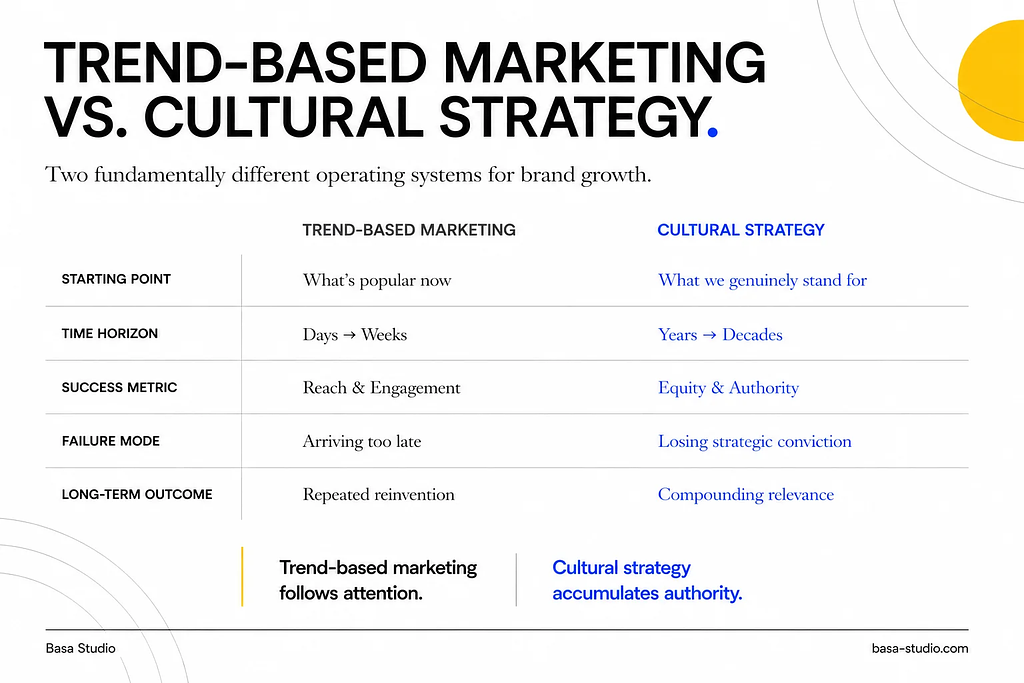
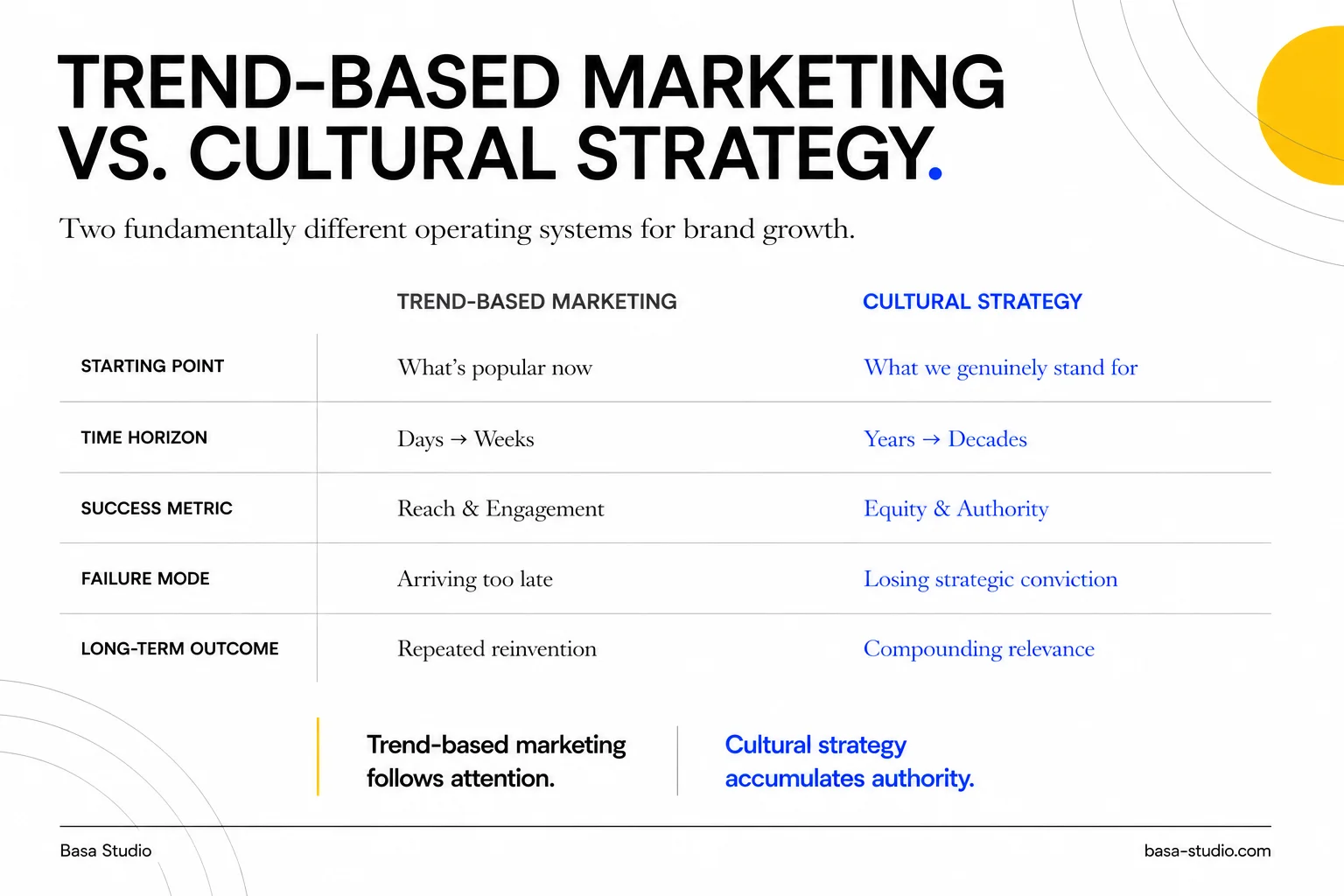
The difference between the two approaches comes into focus when you lay them side by side. Trend marketing starts from what is already visible in culture; cultural strategy starts from what the brand can credibly own. Trend marketing runs on campaign cycles; cultural strategy compounds over five to ten years. Where trend marketing measures reach and short-term sales lift, cultural strategy measures brand equity movement, earned media value, and customer lifetime value. The core risk of trend marketing is arriving late — and being seen to arrive late. The core risk of cultural strategy is moving early, before the data confirms the direction. But early movers capture the territory before it is contested. And unlike a campaign, cultural authority has no expiry date.
Trend-based marketing and cultural strategy operate on entirely different logics — and produce entirely different results.
The Bottom Line
The question is not whether your brand should engage with culture. At the premium end of any market, cultural relevance is not optional — it is table stakes. The question is whether you engage reactively or strategically.
Reactive engagement — trend chasing — will always cost more and deliver less. The production cycles are expensive, the windows are short, and the audience can tell the difference between a brand that belongs in a cultural conversation and one that has arrived late to it. Strategic engagement — building genuine cultural authority over time — is slower to show results and harder to brief. It requires conviction before the data confirms the direction. But it is the only approach that compounds, and compounding is where the real return lives.
Brands that lead culture do not have better trend radar than everyone else. They have a clearer point of view, deeper cultural relationships, and the patience to build something that lasts long after the campaign that announced it has ended.
Related creative stories
Browse through other features, interviews and guides to discover creative brand collaborations, meet innovative artists and creators, find out how new artforms are energizing advertising, & more.
We're excited to hear from you! If you're looking for artistic solutions for your next creative marketing campaign, send us your briefing. We can also help create a killer concept if you're in an early ideation phase. Check out our services for more.
Send your briefing
About you
THANK YOU
Your inquiry has been sent
We have received your inquiry. We'll get back to you within 24-48 hours to discuss your project. If you need urgent assistance, reach us on WhatsApp: +49 176 432 64506. In the meantime, we invite you to explore our insights, case studies, and lessons from building culturally grounded brand experiences.
Please contact us by phone if you're not able to reach us via this form.
THANK YOU
We have received your inquiry. We'll get back to you within 24-48 hours to discuss your project. If you need urgent assistance, reach us on WhatsApp: +49 176 432 64506. In the meantime, we invite you to explore our insights, case studies, and lessons from building culturally grounded brand experiences.
We use cookies to help empower our artists and make them accessible to clients. Check out our Privacy Policy and Terms of Service to see how your data can make a difference.