Twelve cities. Twelve local artists. One brand. This is how a Tommy Hilfiger brand activation campaign turned VIP events into cultural moments.
VIP Events Live or Die on One Question
Most VIP events give guests something to take home. This one gave them something to talk about.
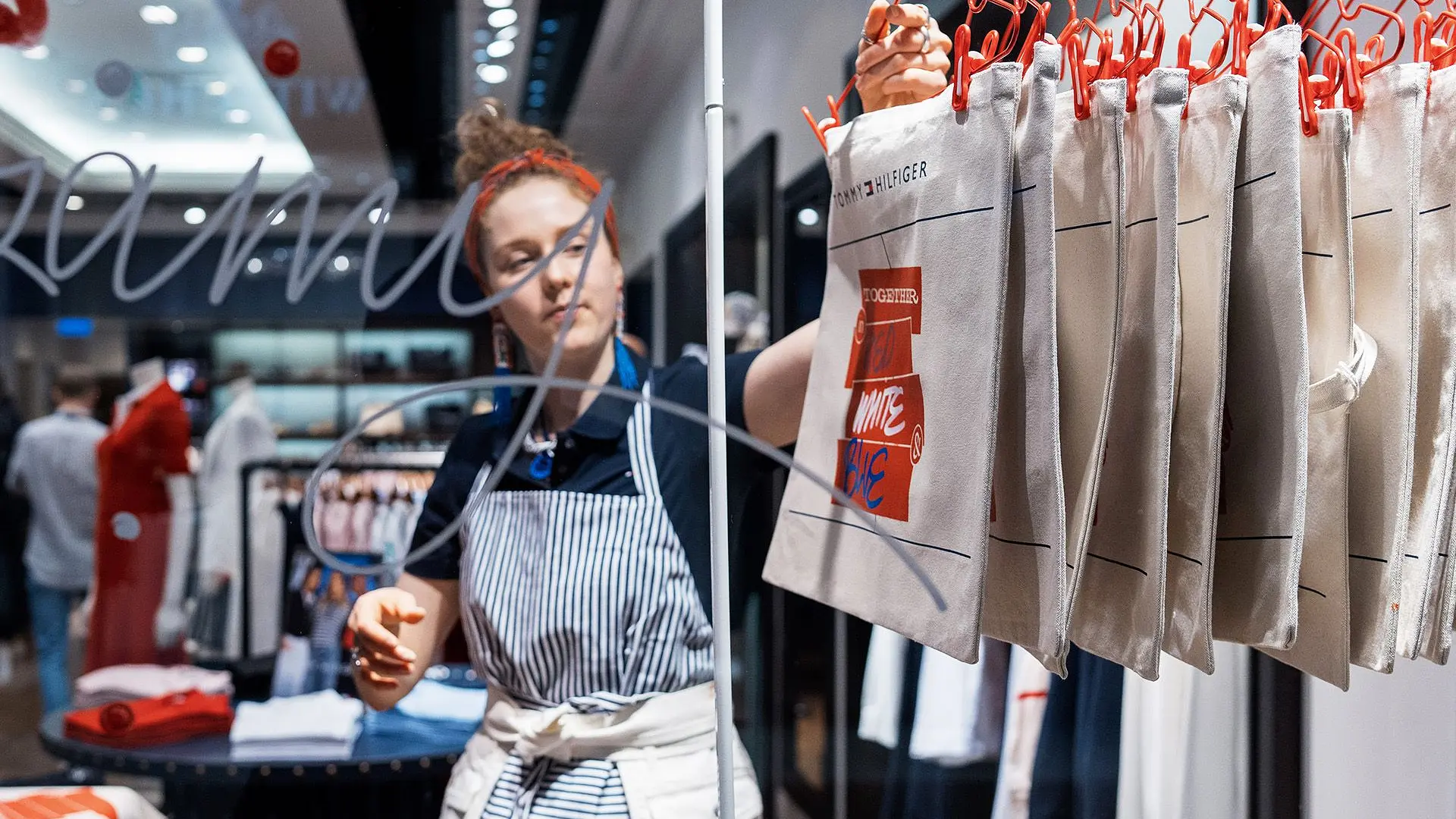
Tommy Hilfiger's member event series ran across two rounds and twelve cities — Germany, Poland, Austria, and Switzerland. At each stop, a local artist customised tote bags live, inside the store, in front of the guests who would leave with them. The brief demanded consistency across every city and genuine local character at each one. Those two requirements are easy to state and difficult to honour simultaneously. Most brand activation campaigns resolve the tension by sacrificing one for the other. This one didn't.
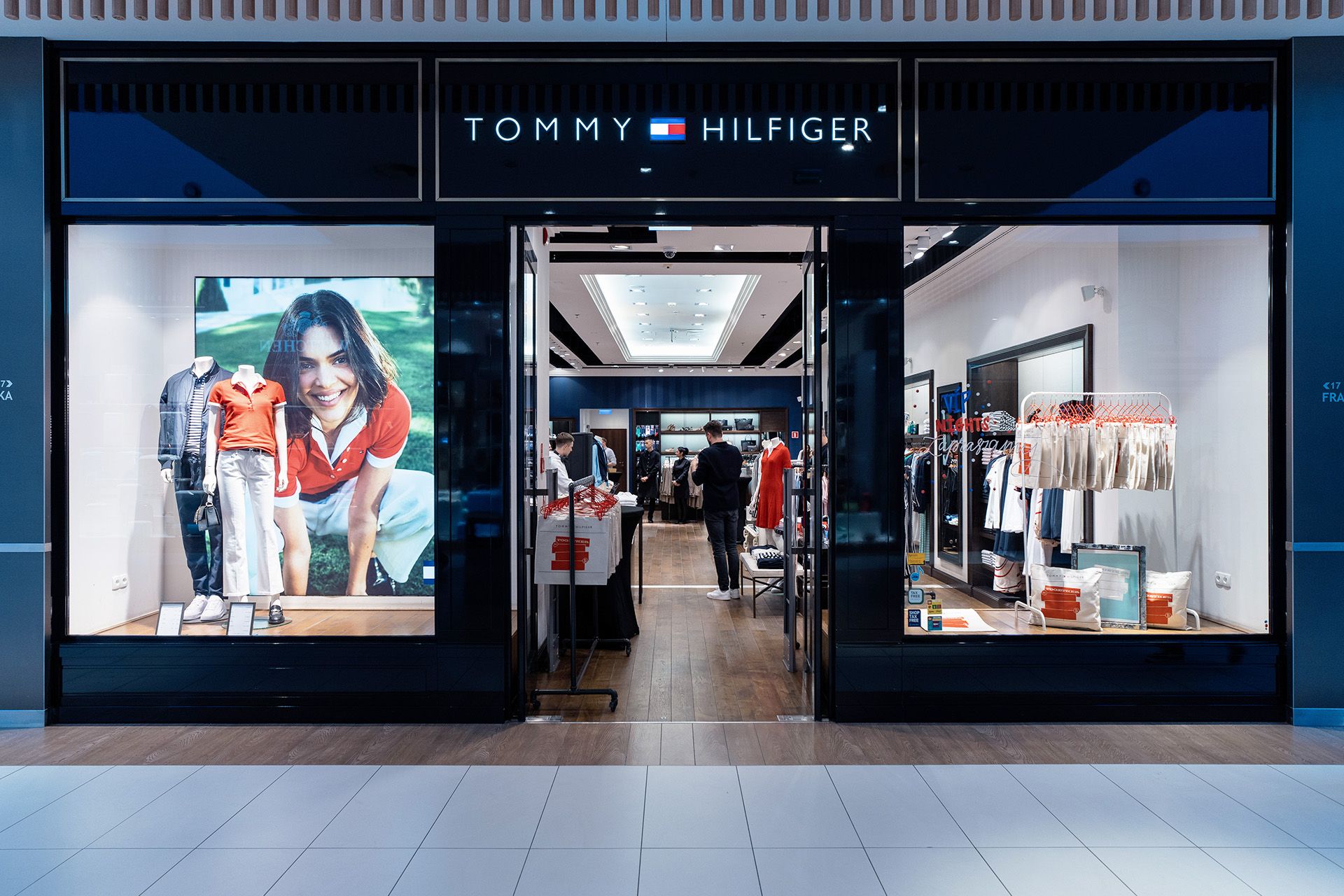
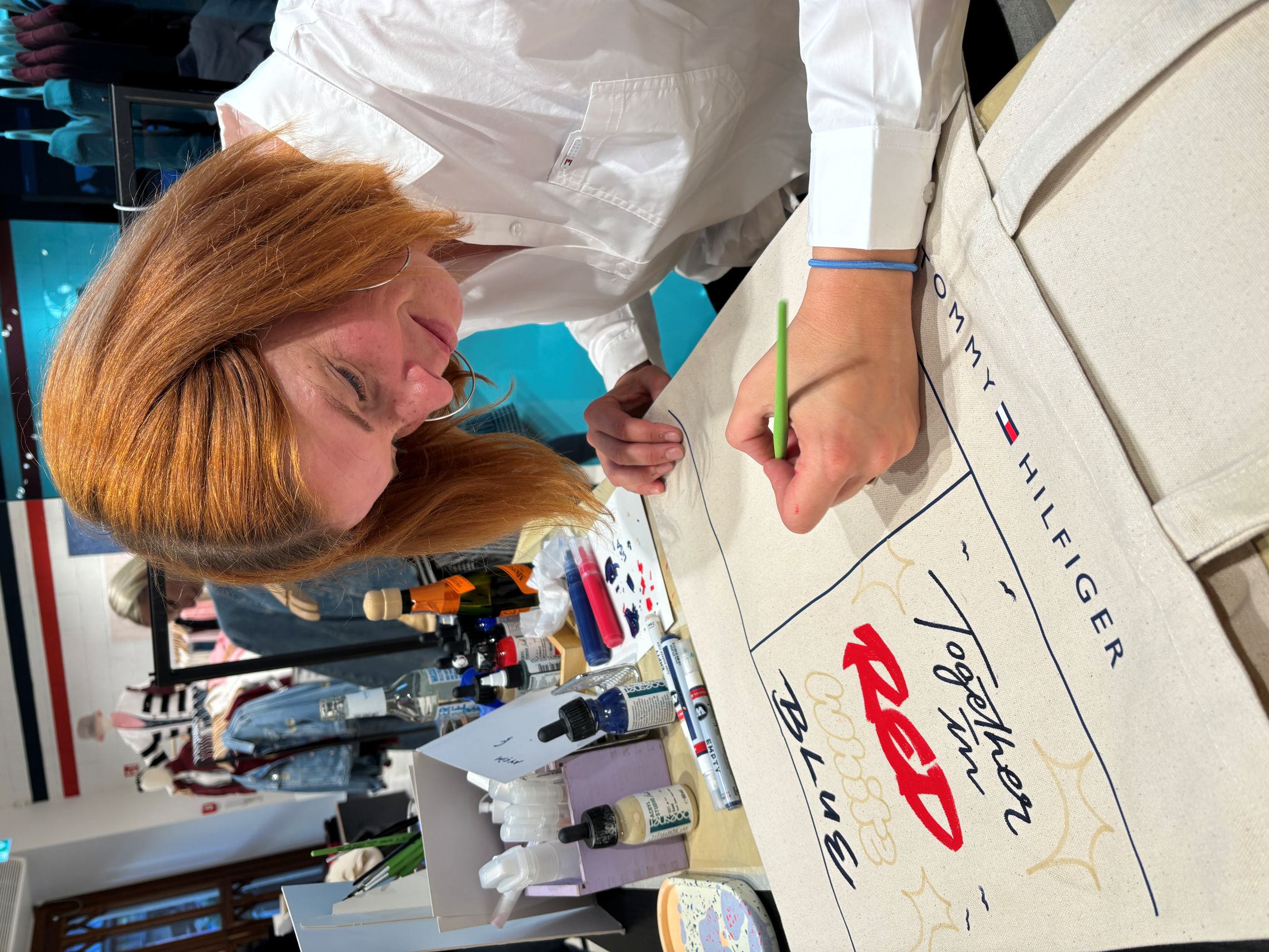
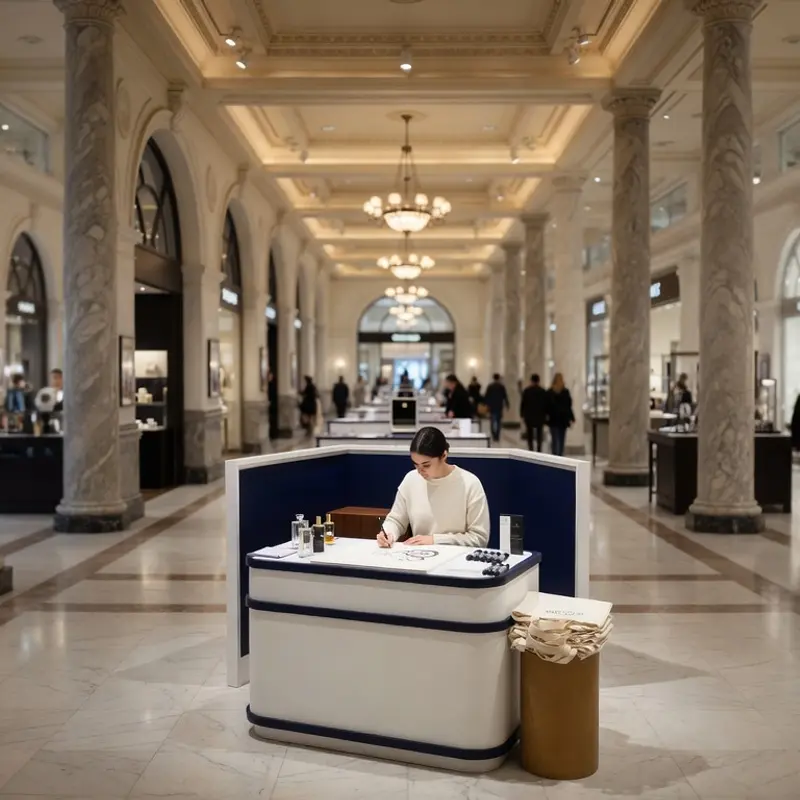
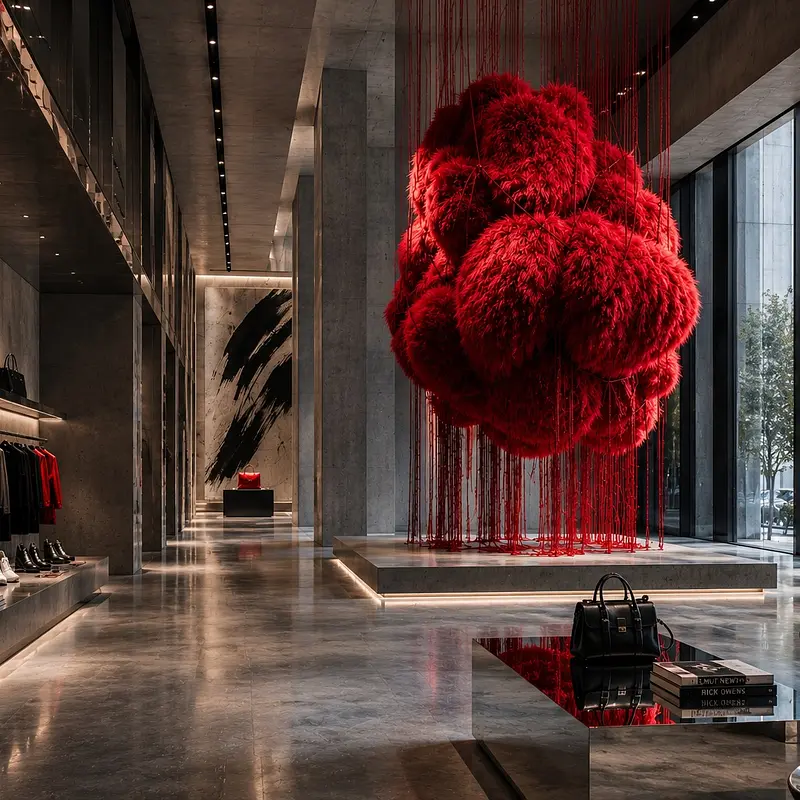
The Tommy Hilfiger retail environment at the heart of the activation, a flagship store setting designed to draw footfall and set the stage for a personalised brand experience. Photo: Eugenia Tynna.
A Specialist Partner for a Specific Problem
Basa Studio came onto the project as a specialist partner to Liganova — a global agency group with deep roots in brand and retail marketing and a long-standing relationship with PVH Corp. Where Liganova held the overall event strategy, Basa Studio held the cultural casting: finding the right artist in the right city to make each event feel locally rooted, not centrally produced.
The artist brief was precise. The work couldn't be too ornamental, too street-style, too detailed, or too generic. It had to be commercially accessible enough to appeal to a broad VIP guest list, adaptable enough to work within Tommy Hilfiger's visual identity, and artistically strong enough to carry a genuine signature. A catalogue hire would have produced wallpaper. The brief required something more considered than that.
Twelve Cities. Twelve Artists. No Compromises.
Basa Studio's network turned what could have been a logistical challenge into a fast turnaround. Five artists in the spring — Random EXP, Schriftschatz, Hannah Rabenstein, Casiegraphics, Eugenia Tynna — covering Cologne, Düsseldorf, Nuremberg, Munich, and Gdańsk. Seven in the fall: Tommy Pienczak and Krystian Scigalski (WhyDuck) in Warsaw, Anna T-Iron in Hamburg, Oibel 1 in Zurich, Frau Isa in Vienna, Ekaterina Koroleva in Berlin, Shev Lunatic in Düsseldorf. Twelve cities. Twelve different cultural contexts. The kind of turnaround that only works if the groundwork is already laid.
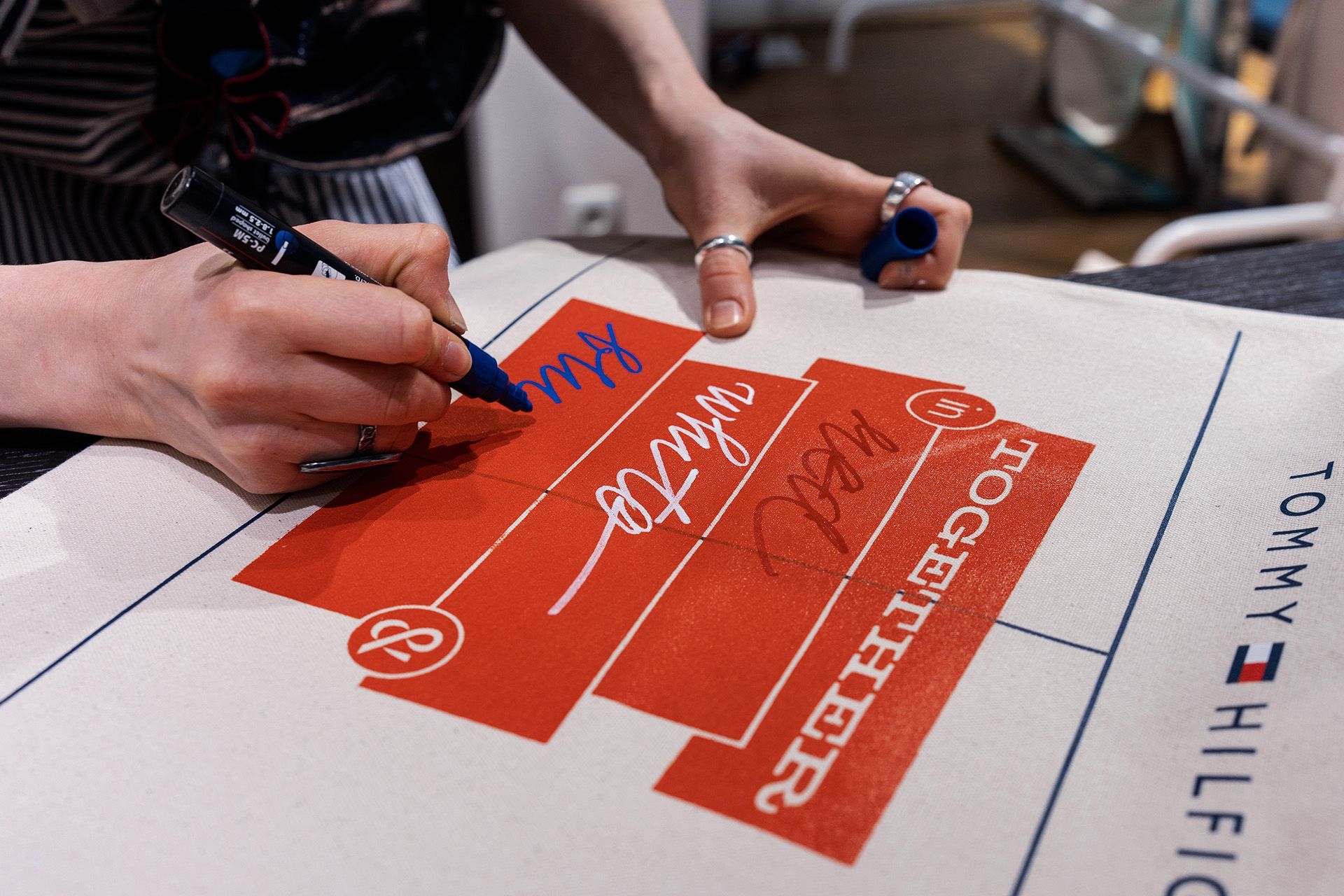
The tote bags had one thing in common across all twelve cities: the Tommy Hilfiger branding on the base. Everything on top of that was the artist's — their city, their hand, their signature. Consistent enough to be recognisably Tommy Hilfiger. Different enough to belong to each city.
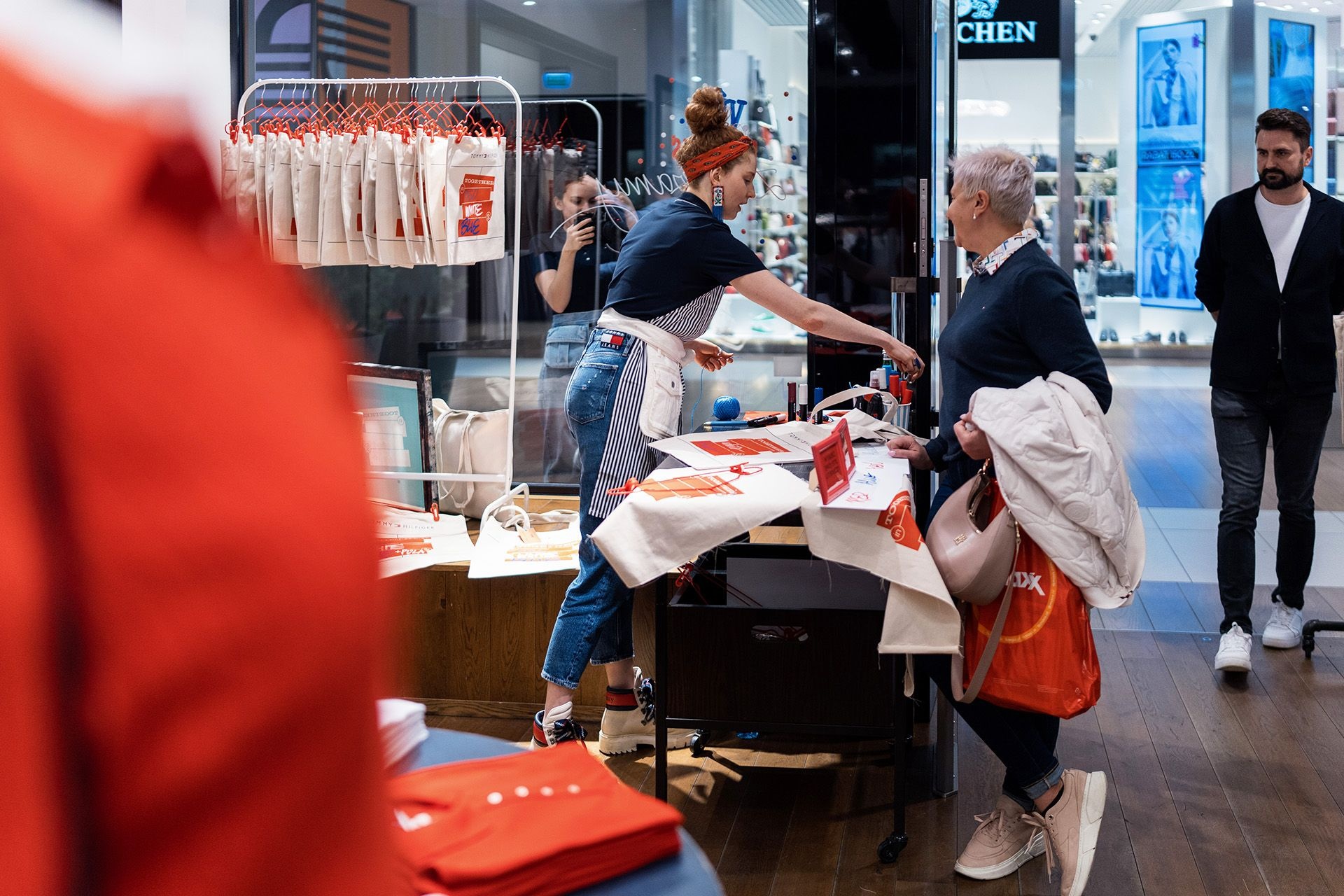
Live tote customisation at the Tommy Hilfiger VIP member events — a local artist placed by Basa Studio in each city across two campaign rounds.
The Pre-Production Work Behind a Live Brand Activation
Live personalisation at a VIP event looks spontaneous. It isn't. The work that makes it feel that way starts weeks earlier — and it's more technical than most clients expect.
Before any artist picked up a marker in front of a guest, Basa Studio ran a material testing process. Each artist received test tote bags to trial their markers against the exact fabric — because ink absorbs radically differently depending on material composition. Too porous and lines bleed. Too coated and the ink sits on the surface and smears. Getting that wrong in front of a VIP guest, in a Tommy Hilfiger store, is not a recoverable situation.
Artists produced digital mockups first — a visual of the tote in their style — so the client could review and approve the aesthetic direction before any physical bag was touched. A small number of bags were pre-prepared before each event. The majority were customised live, in real time, with guests present.
Same branded base, different artistic signatures — each city's tote bags were unrepeatable by design.
Why This Works as a Retail Brand Activation
The most effective retail brand activations don't just create a moment in the store. They create something that travels.
Every guest left with a durable, portable, publicly visible object — hand-made, artist-signed, one of a kind. The ongoing impression of that tote bag on a commute, at a market, in a café is brand exposure that most experiential formats can't replicate. In terms of cost-per-impression across the object's lifespan, personalised artist merchandise sits in a category of its own.
Several artists also promoted the events to their own audiences — inviting followers to attend and register as VIP members. That's audience acquisition built into the activation itself, with the artist's cultural credibility doing work that a paid media placement couldn't replicate. A poster ad announces an event. An artist telling their community come, I'll be there, I'm making something for you is a different kind of invitation entirely.
The Investment
The campaign ran in two rounds — spring and fall — with each round in the mid-five-digit range. That figure covered artist fees, pre-production, live event execution across five to seven cities per round, and in some cases artist-led social promotion to their own audiences.
For a personalisation brand activation running simultaneously across multiple cities, with bespoke artistic output at each location, that's an efficient use of budget — particularly when the output is a physical, lasting object in the hands of every guest rather than a temporary installation that disappears when the event ends.
Operational Professionalism Is Part of the Brief
Liganova managed the overall programme and the client relationship with PVH Corp. Basa Studio's responsibility was the cultural layer: identify the right artists, align them to the brief, and ensure each one could work directly with Liganova's project managers without requiring supervision at the individual event level.
In a multi-city campaign on a tight timeline, every dependency is a risk. An artist who needs hand-holding at each stop becomes a coordination problem. Basa Studio's ability to place artists who were creatively right and operationally independent — and then step back — is what kept twelve events running cleanly across four countries.
Charlotte Specht, Co-founder of Basa Studio:
"It was fantastic to see that we have such a strong network of artists. In no time, both times we were able to book the artists fast. And each one of them is so professional that we were happy to put them in direct contact with a project manager from Liganova without having to supervise the organisational details of each event."
That's what a mature cultural collaborator network looks like in practice: not a roster of names, but a reliable layer of the production infrastructure.
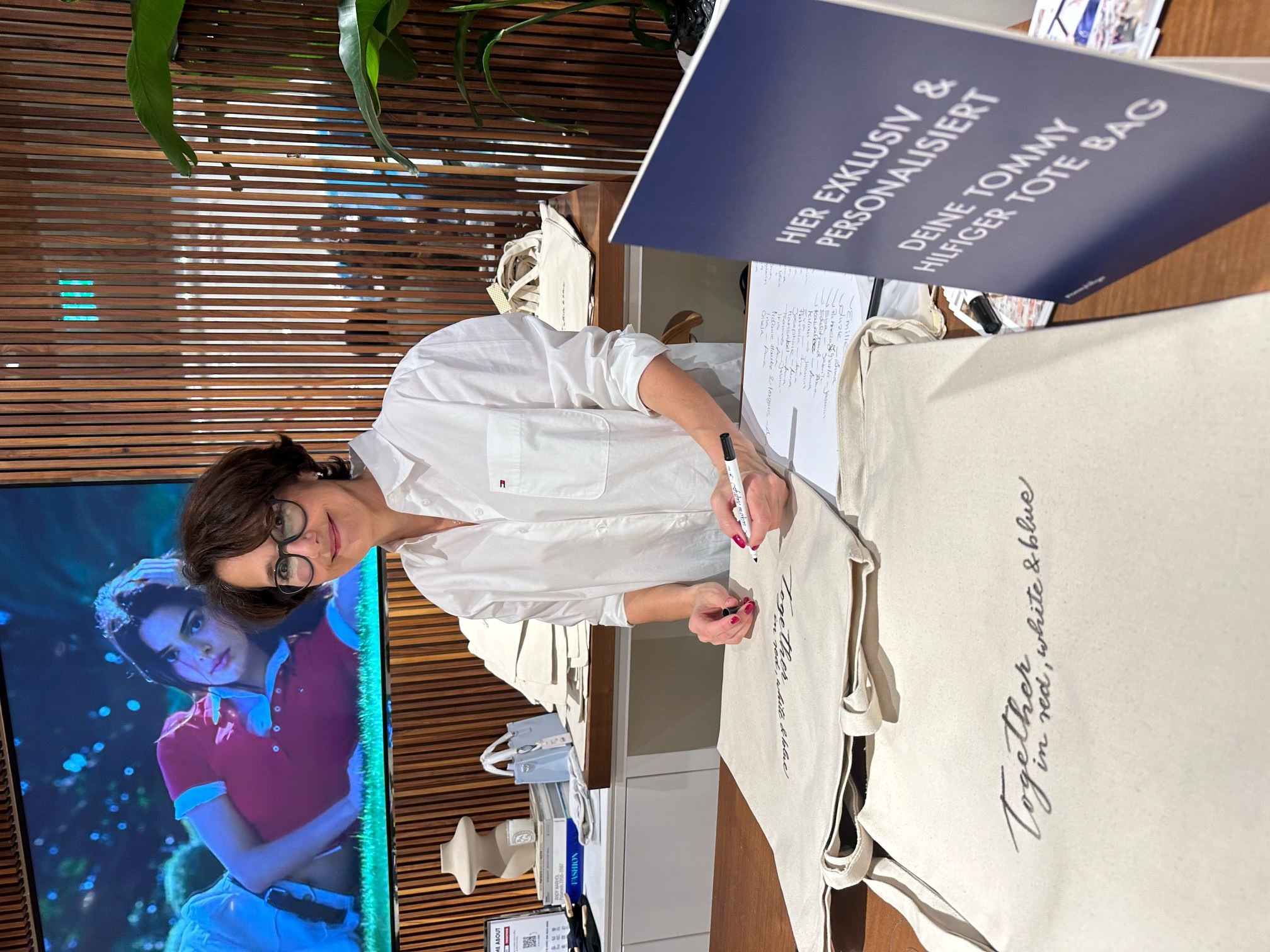
Operationally independent, creatively precise — each artist worked without requiring on-the-ground supervision. Artist in action: Ana T Iron.
Schriftschatz customizing totebags for Tommy Hilfiger
Not a Gift. A Collaboration.
A personalisation brand activation succeeds when the guest leaves with something that couldn't exist without them. Hand-made. Artist-signed. Made in their city, while they watched.
The Tommy Hilfiger campaign proved that this is achievable at scale — across twelve cities, two languages, four countries — without the creative quality flattening out. The tote bags looked different in Cologne and Vienna and Warsaw because the artists were different in Cologne and Vienna and Warsaw. That's not a production variable. It's the whole point.
For brands building or deepening loyalty programmes across European markets, the question isn't whether this level of personalisation is possible. It's whether the network and cultural intelligence are in place to execute it at speed, consistently, and in a way that each city actually recognises as its own.
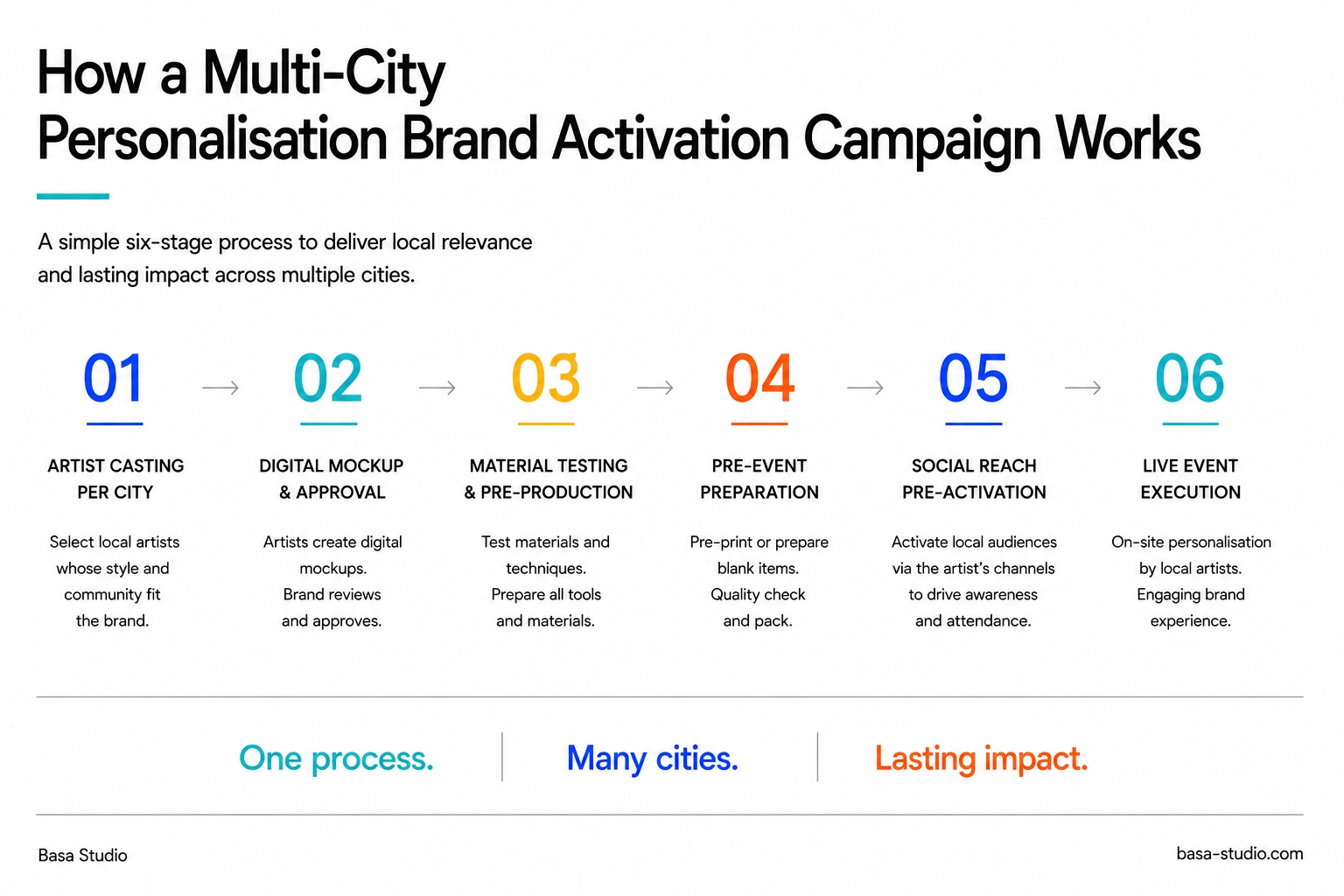
Running a personalisation activation across multiple cities requires a repeatable process that still leaves room for local creative variation.
Basa Studio's six-stage framework makes that possible:
Artist casting per city — selecting local artists whose style and community fit the brand
Digital mockup and approval — artists create concepts for brand review before production
Material testing and pre-production — techniques and tools tested and prepared in advance
Pre-event preparation — items pre-printed or prepared, quality-checked, and packed
Social reach pre-activation — local audiences reached via the artist's own channels
Live event execution — on-site personalisation by local artists, in real time
Basa Studio's six-stage framework for running a personalisation brand activation campaign across multiple cities — from local artist casting to live event execution.
Basa Studio partnered with Liganova on the Tommy Hilfiger tote personalisation campaign. To explore what a cultural activation could look like for your brand, get in touch.
Related creative stories
Browse through other features, interviews and guides to discover creative brand collaborations, meet innovative artists and creators, find out how new artforms are energizing advertising, & more.
We're excited to hear from you! If you're looking for artistic solutions for your next creative marketing campaign, send us your briefing. We can also help create a killer concept if you're in an early ideation phase. Check out our services for more.
Send your briefing
About you
THANK YOU
Your inquiry has been sent
We have received your inquiry. We'll get back to you within 24-48 hours to discuss your project. If you need urgent assistance, reach us on WhatsApp: +49 176 432 64506. In the meantime, we invite you to explore our insights, case studies, and lessons from building culturally grounded brand experiences.
Please contact us by phone if you're not able to reach us via this form.
THANK YOU
We have received your inquiry. We'll get back to you within 24-48 hours to discuss your project. If you need urgent assistance, reach us on WhatsApp: +49 176 432 64506. In the meantime, we invite you to explore our insights, case studies, and lessons from building culturally grounded brand experiences.
We use cookies to help empower our artists and make them accessible to clients. Check out our Privacy Policy and Terms of Service to see how your data can make a difference.