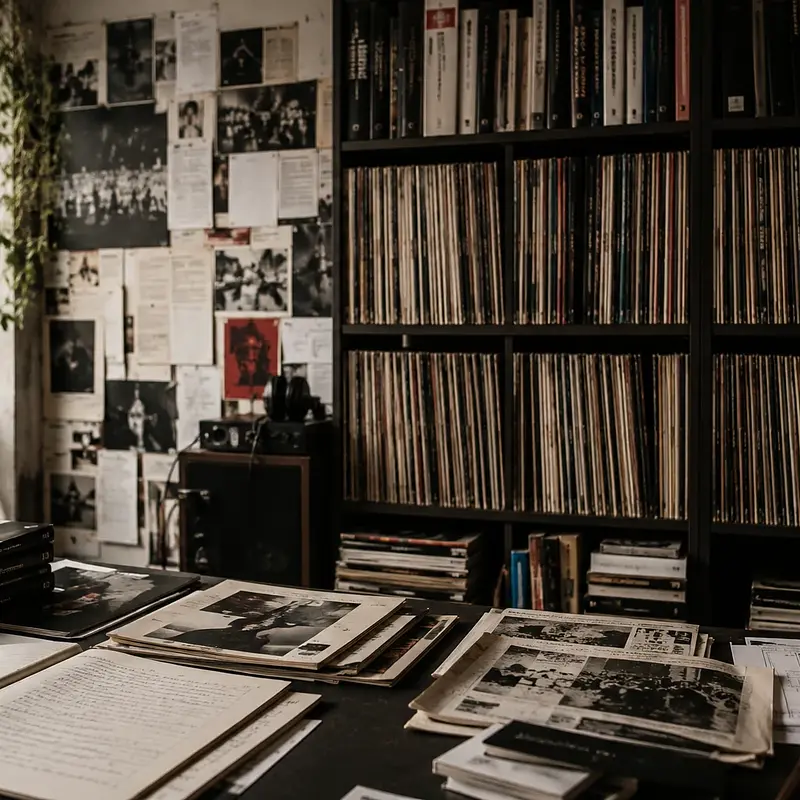
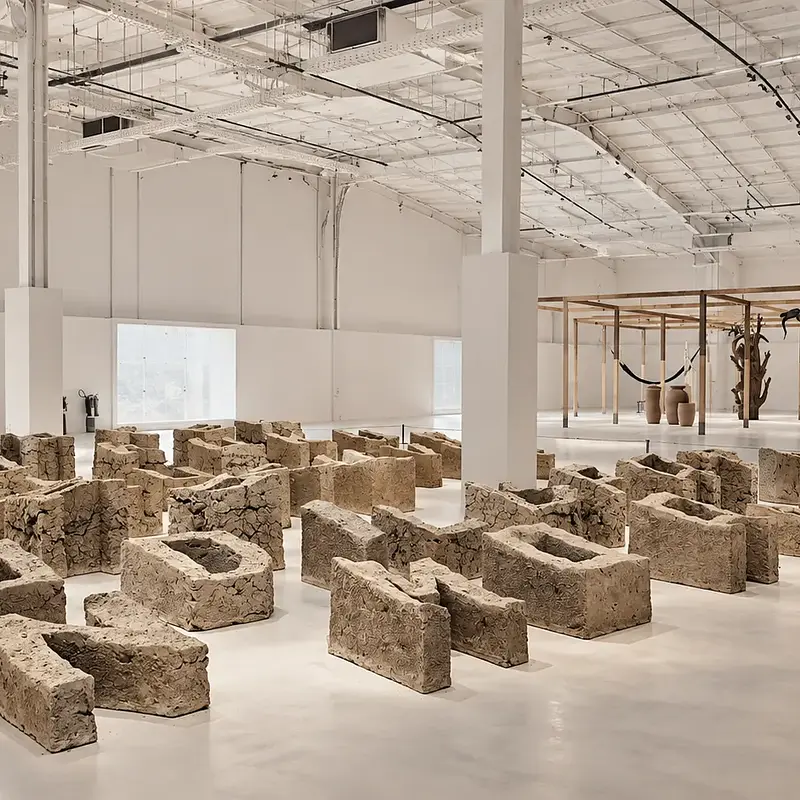
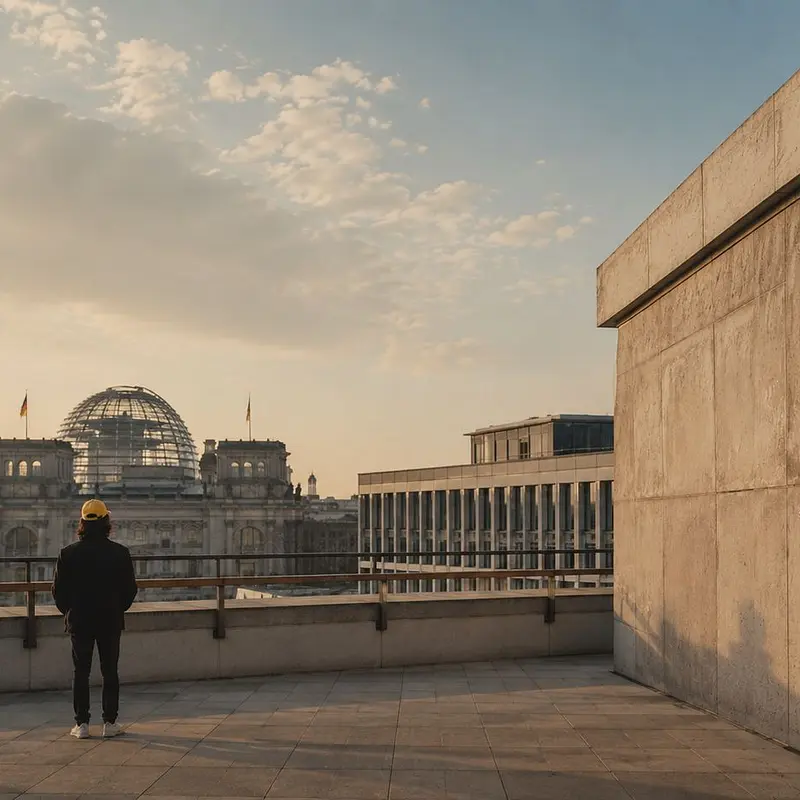
Cultural brand building trends are converging on one conclusion: depth wins. Here is where the industry is heading, and why it matters.
The brands gaining cultural authority now are not doing so by accident. They are making deliberate, sustained investments in depth — across multiple touchpoints, over long horizons, with partners who bring genuine creative intelligence rather than execution capacity. This article is Basa Studio's forecast of where cultural marketing trends and brand strategy are heading. Not a neutral survey. A point of view, grounded in a decade of working at the intersection of art and commerce, on which forces are reshaping brand building — and what they mean for the brands that intend to lead.
Key Trends at a Glance
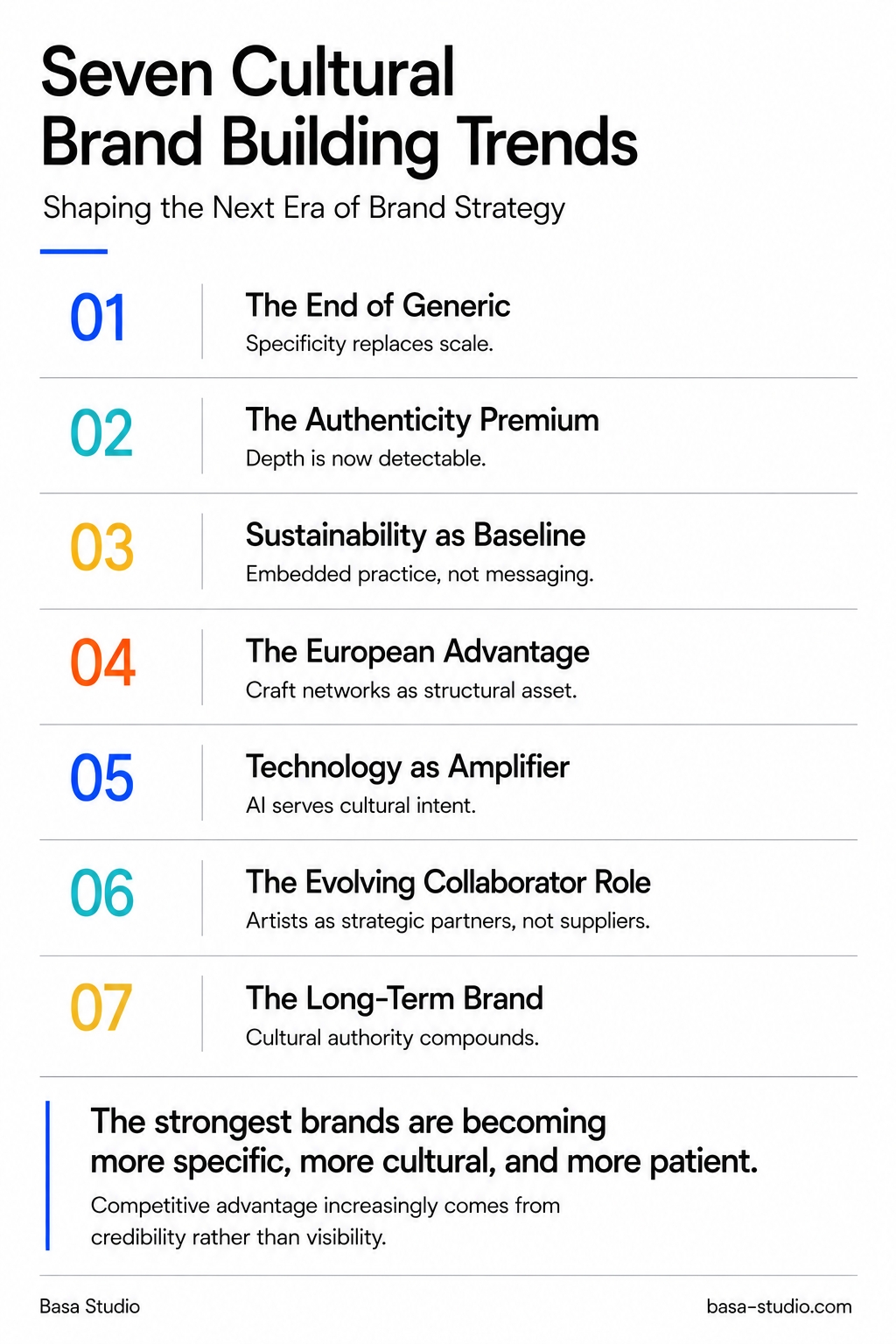
The end of generic — mass-produced activations are losing cultural currency
The authenticity premium — audiences can detect surface-level engagement with growing precision
Sustainability as cultural expectation — no longer a differentiator; now a baseline
The European advantage — craft tradition and artisan density are structural, not sentimental, assets
Technology as amplifier — AI and spatial computing serve cultural intent; they do not generate it
The evolving role of cultural collaborators — artists, artisans, and cultural innovators are moving from suppliers to strategic partners
The long-term brand — cultural authority compounds; brands that build now will be exponentially harder to displace later
Infographic showing seven cultural brand building trends shaping the next era of brand strategy, including the end of generic, the authenticity premium, and the European creative advantage.
Table of Contents
The Bigger Picture: What Is Driving Cultural Marketing Trends Now
What Is Dying in Brand Building — and What Is Replacing It
The End of Generic
The Authenticity Premium
Sustainability as Cultural Expectation
The European Advantage
Technology and Cultural Depth
The Evolving Role of Artists, Artisans, and Cultural Innovators
The Long-Term Brand
What the Art World Already Knows
Voices on the Future
Brand Strategy Future: What Separates the Leaders from the Followers
Frequently Asked Questions
The Bigger Picture: What Is Driving Cultural Marketing Trends Now
Something structural is shifting in how premium audiences relate to brands. The cultural marketing trends now emerging are not the product of changing consumer preferences alone — they are the result of an accumulated failure by the brand industry to build anything that lasts.
For two decades, the dominant model was reach and frequency: be everywhere, be loud, and let repetition do the work of meaning-making. It worked — until it didn't. As media fragmented, attention became scarcer, and audiences became more sophisticated, the model started to break down. What replaced it was a wave of brand work that borrowed the aesthetics of culture without the substance: activations that looked like art installations, collaborations with artists that were transparently transactional, sustainability messaging structurally detached from actual practice.
The result is cultural fatigue — a broad erosion of audience trust in brand-produced cultural gestures. This is not a fringe phenomenon or a generational preference. It is visible in how premium consumers engage with brand experiences, how creative communities choose their collaborators, and how the cultural press covers — or declines to cover — brand work that does not earn its place. The gap between a brand that has cultural depth and one that is performing it has never been easier to detect. And detection, once it happens at scale, is very difficult to reverse.
Cultural fatigue has concrete consequences. Activations that would have generated press coverage and social engagement five years ago now pass without notice — not because they are poorly executed, but because the format itself has lost credibility. Artist collaborations that would have carried cultural weight when they were rare are now so common that audiences have developed a default scepticism toward them. Sustainability claims that were once differentiating are now assumed to be incomplete at best, misleading at worst. The infrastructure of surface-level cultural brand building has been so thoroughly deployed that it has exhausted itself. What remains is an audience that is genuinely hungry for brand work with something real behind it — and a significant gap between the brands that can deliver that and those that cannot.
The forces driving this shift are not going away. Consumer literacy around brand intent is rising. Regulatory pressure around greenwashing and cultural appropriation is increasing. The most talented artists, artisans, and cultural innovators are becoming more selective about the brands they work with. And the brands that built genuine cultural authority early are compounding that advantage with every subsequent investment, making the ground increasingly difficult for late movers to recover.
What follows is not a neutral survey of emerging trends. It is Basa Studio's point of view — shaped by a decade of working at the intersection of art and commerce, across luxury, automotive, lifestyle, retail, and technology brands throughout Europe. The trends we identify are ones we have watched develop from the inside: in the briefs brands bring us, in the conversations we have with artists and artisans about which partners they trust, and in the cultural moments that endure long after the campaign cycle has moved on. Where the industry is heading is not a mystery. The question is whether brands are positioned to lead it or follow it.
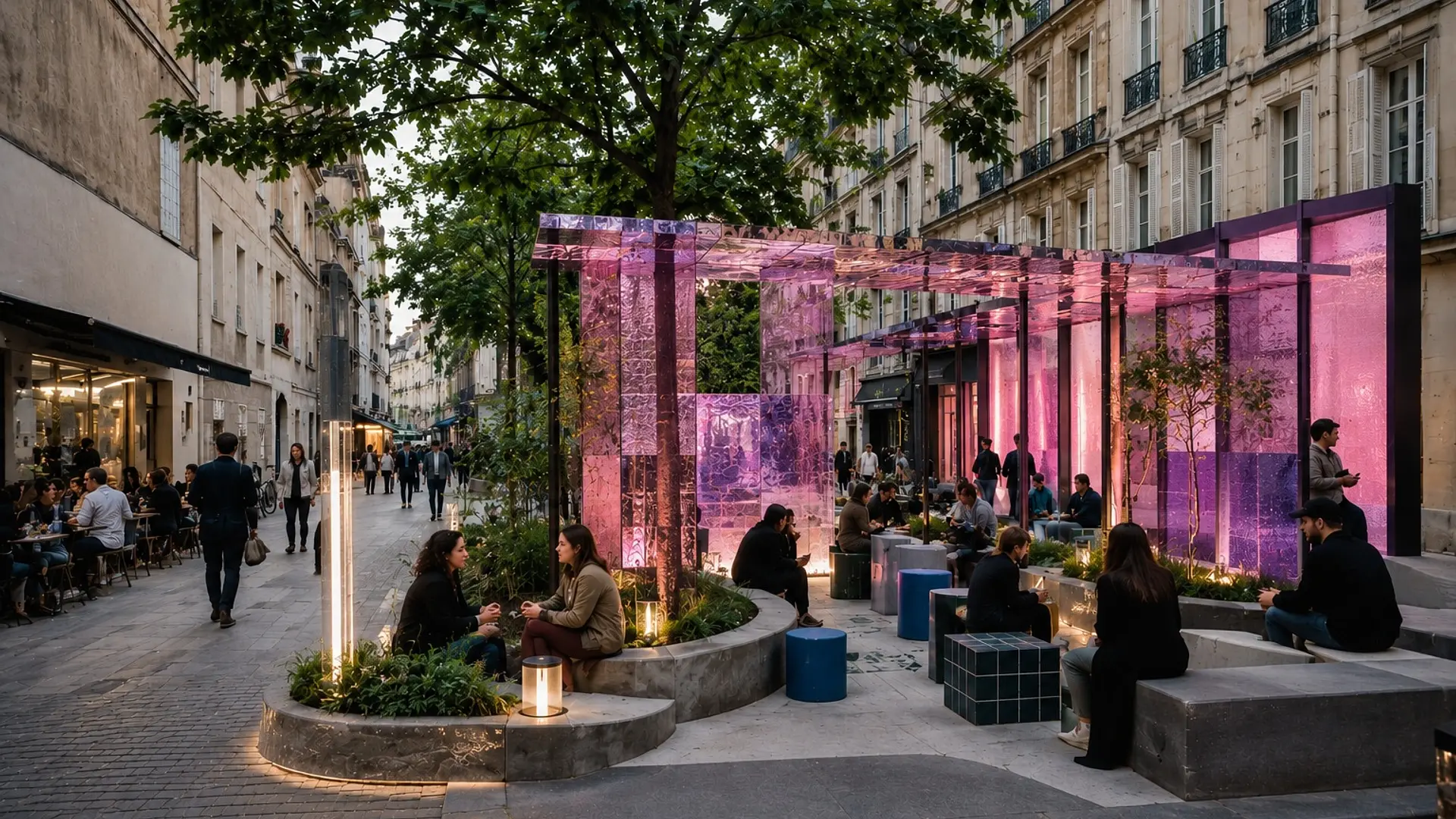
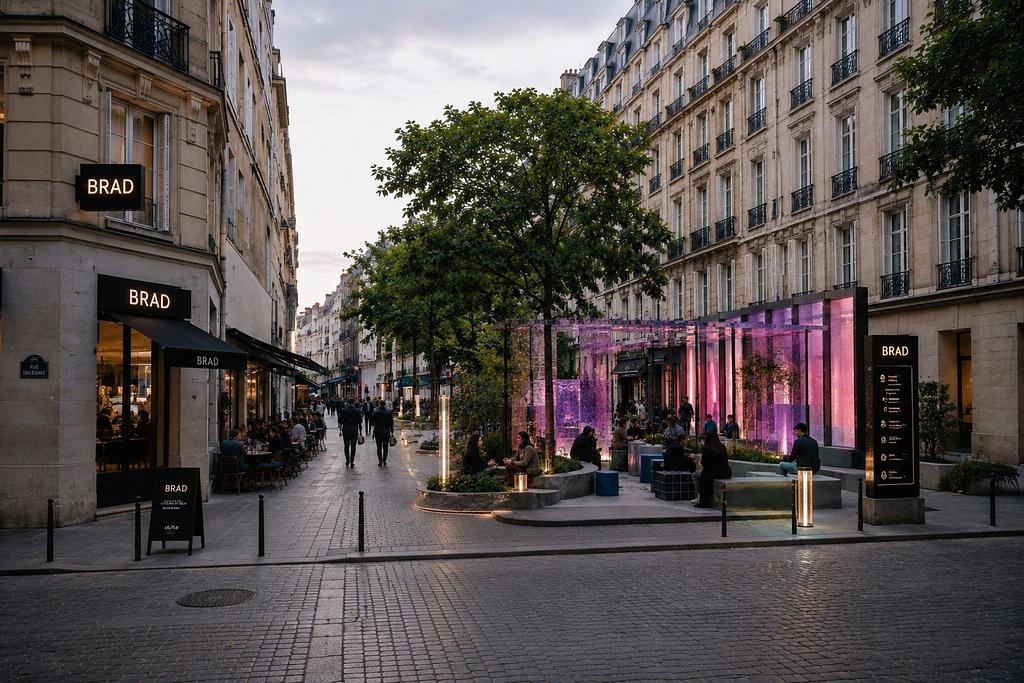
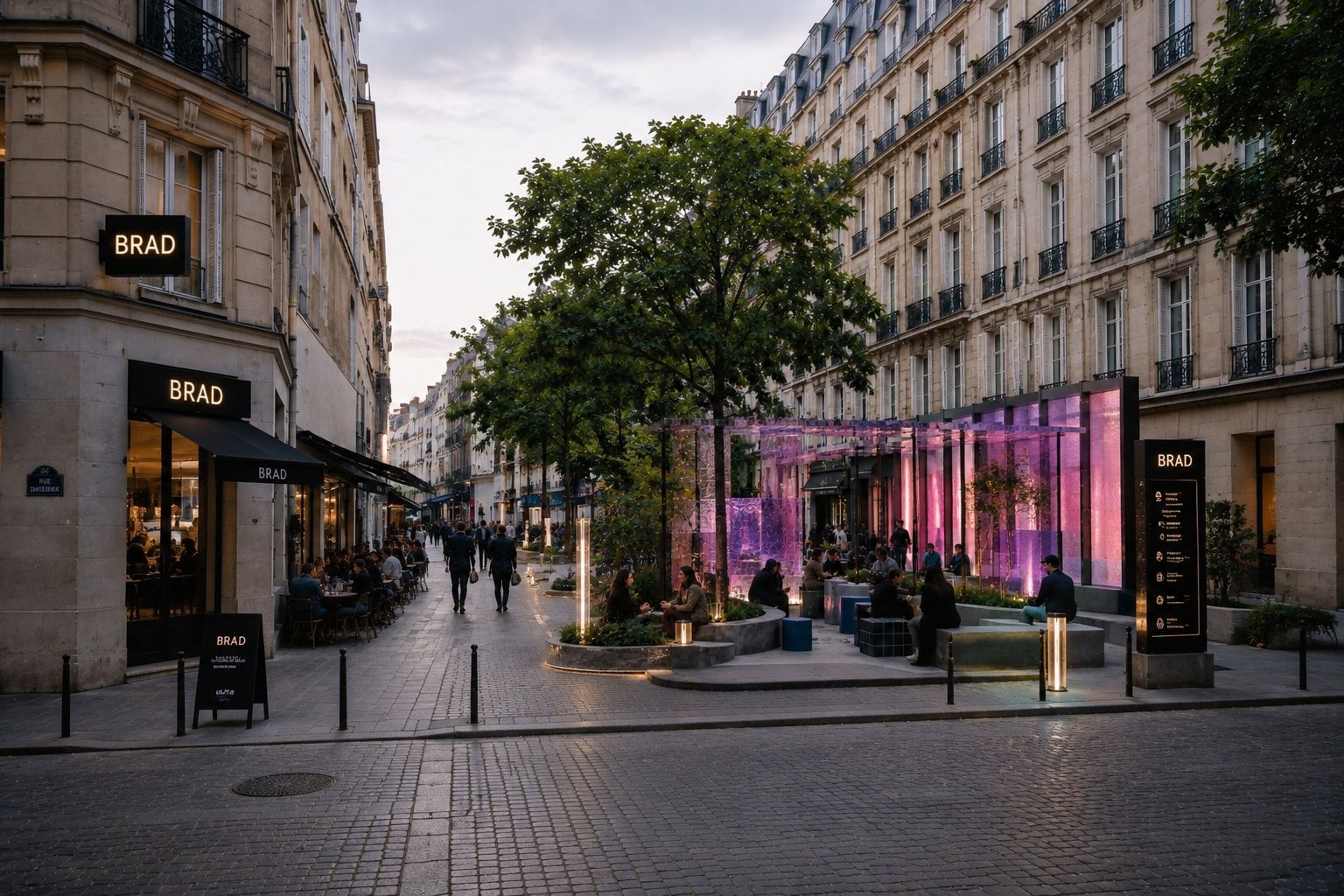
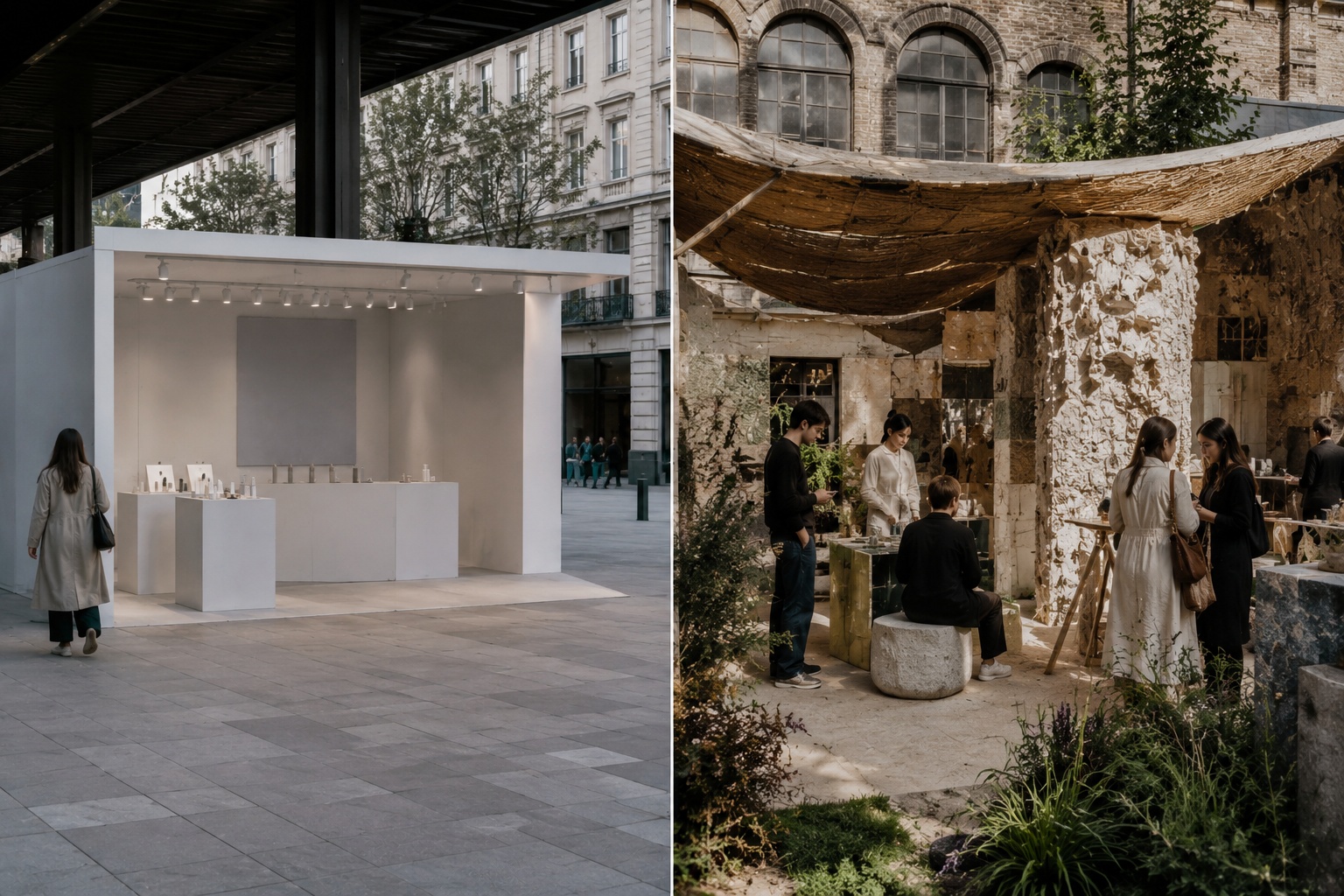
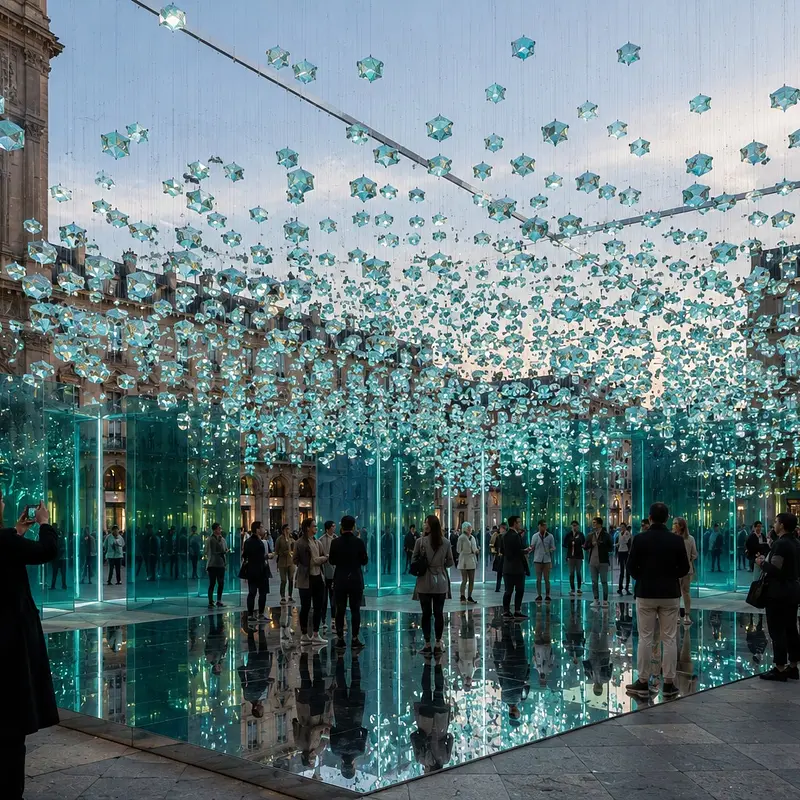
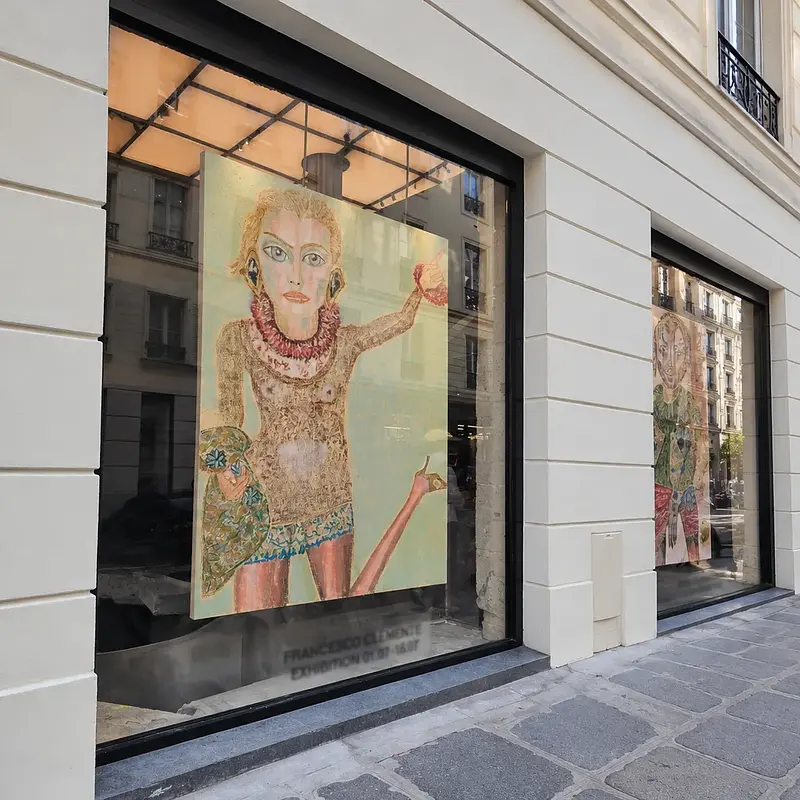
European city streets showcase cultural brand building trends through immersive public spaces and contemporary urban design.
What Is Dying in Brand Building — and What Is Replacing It
The model that is dying is the one built on volume, speed, and surface legibility. Brief an agency. Produce an asset. Distribute it. Measure reach. Repeat. It is a model optimised for efficiency, and it has produced a category of brand work that is increasingly indistinguishable — across categories, across markets, across media formats. When everything looks the same, nothing is remembered. And when nothing is remembered, brands find themselves competing on price.
What is dying alongside the model is the assumption that culture can be accessed without being engaged. That a brand can borrow the credibility of an artist without genuinely involving them. That a brand can claim sustainability without embedding it in how it actually works. That a branded experience is culturally significant simply because it is well-produced. These assumptions have not just become commercially ineffective — they have become visible. Audiences have developed the vocabulary to name what they see, and what they increasingly see is performance.
What is replacing it is not a single alternative but a set of converging principles. Cultural specificity over category sameness. Depth of creative investment over production velocity. Long-term cultural relationships over campaign-by-campaign transactions. A willingness to be shaped by creative partners rather than simply directing them. The brands winning cultural authority are those that have stopped trying to reach culture and started trying to contribute to it — and the distinction, once understood, changes how every brief is written, every partner is chosen, and every touchpoint is designed.
This transition is not always comfortable from the inside. Brand teams that have operated on campaign logic for years find that cultural brand building — in the way Basa Studio practises it — asks different questions, moves on different timelines, and requires a different kind of internal advocacy — particularly when the outcomes are not immediately legible in the metrics that quarterly reporting tends to privilege. The discipline is in holding the position: continuing to invest in cultural depth when the pressure to produce something quick, visible, and measurable is constant. The brands that manage this tension — that build the internal case for long-term cultural investment and hold it consistently — are the ones that emerge with positions their competitors cannot easily replicate.
The brands earning cultural authority today are those whose creative engagement is substantive rather than decorative — and the distance between them and brands still operating on the old model is measurable in pricing power, audience loyalty, and the quality of creative partnerships they can attract. That distance is not static. It grows with every quarter that passes without a genuine cultural investment. And the shift is irreversible in one important sense: once audiences develop the literacy to distinguish cultural depth from cultural surface, that literacy does not recede. The bar does not come back down.
The seven cultural brand building trends below map where that shift is taking the industry — and what each one means for brands making strategic decisions now.
The End of Generic
Generic activation — the templated pop-up, the influencer-seeded product launch, the commissioned mural that says nothing — worked when the standard for brand experience was low. That standard has moved. The activations earning cultural currency now are grounded in something real: a craft tradition, a community, a place, an artistic practice. As culturally grounded work becomes the standard among category leaders, generic becomes not just ineffective — it becomes a positioning liability.
Generic is no longer neutral — it is a positioning liability.
The Authenticity Premium
Audiences are no longer passive in how they evaluate brand engagement. AStackla survey of over 2,000 consumers found that 83% of people say brands need to offer more authentic experiences — a demand that extends well beyond content formats into the cultural substance of brand work itself. A brand that hires an artist for a single activation is doing something qualitatively different from one that builds a long-term relationship with a network of cultural collaborators, and audiences are increasingly able to tell the difference.The brands that close that gap — whose cultural engagement is consistent, substantive, and structurally integrated — are rewarded with stronger preference, greater pricing power, and the kind of word-of-mouth that no media budget can buy.
Audiences do not need to articulate what makes work feel genuine. They feel it — and they remember it.
Sustainability as Cultural Expectation
Sustainability is no longer a differentiator — it is a baseline expectation, especially among younger consumer cohorts, according to Euromonitor International's analysis of the global luxury market. European consumers are among the most scrutinising audiences globally on this point: Brand Finance's Global Brand Equity Monitor, surveying over 150,000 respondents across 40 markets, found they are 25% less likely to agree a brand is committed to environmental sustainability than consumers elsewhere. For brands building cultural depth, the implication is clear. Ashley Reichheld, John Peto, and Cory Ritthaler writing in Harvard Business Review put it plainly: companies that create truly sustainable brands and make good on their promises will seize advantage from those that make flimsy claims or have not invested sufficiently. Sustainability must be embedded in creative practice — demonstrated through what is made and how, not communicated through messaging.
Conscious brand building is demonstrated through what is made and how — not communicated through messaging.
The European Advantage
Cultural depth requires raw materials that cannot be manufactured on demand: craft traditions, artisan networks, accumulated creative knowledge. Europe has them in greater density than anywhere else in the world — from the haute couture ateliers of Paris to the ceramic traditions of Italy, with the World Economic Forum noting that brands including Gucci, Berluti, Hermès, and Chanel now treat these traditions as core to their brand strategy. Major groups including LVMH, Bottega Veneta, and Brunello Cucinelli have invested in their own craft schools to preserve what a peer-reviewed study on luxury craftsmanship management calls "the savoir faire of an artisan elite" — a depth of creative intelligence that is genuinely scarce globally, and a structural competitive advantage for brands that know how to access it.
The artisan networks European studios can access are not available at the same depth anywhere else in the world.
Technology and Cultural Depth
AI and spatial computing are changing the landscape of brand experience faster than most brand teams are equipped to navigate — but the critical question is not whether to engage with these technologies, it is whether to use them as substitutes for creative intelligence or as amplifiers of it. The World Economic Forum has argued that AI must serve human creativity rather than replace it, and Superside's analysis of spatial computing for brands notes that innovation in this space will be judged by outcomes, not novelty. Technology sets no cultural intention — the creative vision, the cultural references, the relationships with artists and makers who bring genuine practice remain the irreplaceable inputs.
Technology extends the reach of cultural work. It does not generate the creative intent that makes it matter.
The Evolving Role of Artists, Artisans, and Cultural Innovators
The old model of cultural collaboration was transactional: a brand identifies a creative with an audience, commissions a deliverable, and publishes it. That model is losing cultural currency — audiences and collaborators alike are becoming attuned to the difference between a brand that uses an artist's cultural capital and one that genuinely engages with their creative practice. As The Industry Leaders documents, brands that build long-term creative relationships consistently attract deeper loyalty from both audiences and the creative community — because they are perceived as stewards of value, not producers of content.
The most culturally significant brand work begins with a conversation, not a brief.
The Long-Term Brand
Cultural authority compounds over time — a brand that makes a single high-quality cultural investment accrues cultural capital from that point forward, with each subsequent work sitting within a developing body of creative evidence that becomes progressively harder to replicate. Jonatan Södergren'sBrand Authenticity: 25 Years of Research, published in the International Journal of Consumer Studies, finds that brands perceived as genuine — whose values, creative practice, and cultural engagement are coherent and consistent over time — accrue cultural iconicity that becomes a self-reinforcing asset competitors cannot easily displace. The brands building cultural authority in 2025 will be exponentially harder to displace by 2030 than those that are still deciding whether to start.
What the Art World Already Knows
The institutions with the deepest cultural authority globally — museums, galleries, biennials, artist estates — build it through sustained creative commitment, curatorial rigour, and long-term relationships with artists whose work gains meaning over time. These are not soft institutional values; they are a proven strategic model that the brand industry is only beginning to study seriously. The most culturally authoritative brands of the next decade will look less like advertisers and more like patrons.
The institutions with the deepest cultural authority did not build it through campaigns. Brands are beginning to understand why.
Voices on the Future
The trends outlined in this article are not abstractions. They are visible in the decisions being made right now — by CMOs navigating cultural strategy inside large organisations, and by the founders and creative leaders building the studios that serve them.
Basa Studio has gathered 3 perspectives on where cultural brand building is heading: Jonatan Södergren, Stockholm Business School researcher and one of the leading academic voices on brand authenticity; Mario Rueda, Basa co-founder, futurist, and host of the Mizter Rad Show, on the forces shaping the next era of culture and commerce; and Charlotte Specht, Basa CEO and co-founder, on what it means to build a studio at the intersection of art and brand strategy — and where the industry needs to go next.
Brand Strategy Future: What Separates the Leaders from the Followers
The cultural marketing trends outlined in this article share a common axis: depth versus surface. That axis is not aesthetic — it is strategic. It shows up in which creative partners a brand chooses and how it works with them. In whether cultural investment is treated as a discipline or an occasional tactic. In whether a brand's relationship with culture is designed to compound over time or to produce a single moment of visibility.
The brands that will lead cultural brand building over the next decade are those that have made a clear choice on that axis — and made it early enough for the compounding to begin. What distinguishes them is not budget. Some of the most culturally authoritative brands in Europe have built their positions with resources far smaller than their category competitors. What distinguishes them is intent, consistency, and the quality of the creative relationships they have invested in building.
In practice, that choice looks like a brief that starts with a cultural question rather than a marketing objective. It looks like partnerships that outlast a campaign — where artists, artisans, and cultural innovators are brought in early, given genuine creative latitude, and engaged over time rather than commissioned to execute a pre-formed idea. It looks like a portfolio of touchpoints that accumulates into something coherent: a body of work that an audience can trace, recognise, and trust. And it looks like patience — an understanding that cultural brand building does not move on quarterly cycles, and that the brands defining category culture in 2030 are the ones making investments now that will not fully mature for years.
The brands that will struggle are those that continue to treat cultural work as a risk to be managed rather than a position to be built. They will produce work that is careful, inoffensive, and forgettable. They will hire creative partners for their audiences rather than their practice. They will measure cultural investment by reach rather than resonance. And they will find, over time, that the brands which chose depth have made their category position increasingly difficult to challenge.
The strategic window for building cultural authority is not permanently open. The longer a brand waits, the more established the culturally authoritative brands in its category become, the more selective the best creative partners become about who they work with, and the harder it is to build a body of cultural work that feels coherent rather than reactive. This is not an argument for urgency in the sense of moving fast — cultural brand building cannot be rushed. It is an argument for starting: committing to a cultural direction, building the first genuine relationship, investing in the first touchpoint with the depth it deserves, and trusting that the compounding will follow.
Basa Studio works with brands that have made the choice for depth — as a long-term cultural partner, from strategy through execution, across the touchpoints where cultural authority is built or lost. The common thread across every project is a commitment to making work that will be remembered, not just seen.
Frequently Asked Questions
What are the key cultural brand building trends shaping the next decade?
The most significant cultural brand building trends are: the end of generic activation, the rise of the authenticity premium, sustainability becoming a baseline expectation rather than a differentiator, the structural advantage of European craft networks, technology as an amplifier of cultural intent rather than a replacement for it, the evolution of artists and artisans from suppliers to strategic partners, and the compounding nature of long-term cultural authority. Each of these is covered in depth in the supporting articles linked throughout this guide.
What is the future of brand building?
The future of brand building is cultural depth — sustained investment in creative partnerships, touchpoints, and cultural relationships that compound over time. The brands that will define their categories in the next decade are those building cultural authority now, not those waiting for a clearer signal. The shift from reach-and-frequency models to depth-and-resonance models is already underway among category leaders.
What is cultural marketing and how is it different from traditional brand marketing?
Cultural marketing is the practice of building brand meaning through genuine engagement with cultural communities, artists, artisans, and creative traditions — rather than through paid media and campaign distribution alone. Where traditional brand marketing asks "how do we reach this audience?", cultural marketing asks "what do we have to say to the culture our audience already belongs to?" The distinction changes how briefs are written, how partners are chosen, and how success is measured.
Why do cultural brand building trends matter for CMOs?
Because cultural authority is a compounding asset. Brands that invest in genuine cultural depth build positions that become progressively harder for competitors to replicate — in pricing power, audience loyalty, and the quality of creative partnerships they can attract. CMOs who treat cultural investment as a discipline rather than a tactic are building long-term brand equity that outlasts any individual campaign.
How is Basa Studio positioned in the cultural brand building space?
Basa Studio is a European creative agency that integrates acclaimed artists, artisans, and cultural innovators into strategic brand work — from brand activations and spatial experiences to retail design, product launches, and landmark installations. Basa Studio operates as a long-term cultural partner for premium brands, working end-to-end from strategy through execution across the touchpoints where cultural authority is built or lost.
Related creative stories
Browse through other features, interviews and guides to discover creative brand collaborations, meet innovative artists and creators, find out how new artforms are energizing advertising, & more.
We're excited to hear from you! If you're looking for artistic solutions for your next creative marketing campaign, send us your briefing. We can also help create a killer concept if you're in an early ideation phase. Check out our services for more.
Send your briefing
About you
THANK YOU
Your inquiry has been sent
We have received your inquiry. We'll get back to you within 24-48 hours to discuss your project. If you need urgent assistance, reach us on WhatsApp: +49 176 432 64506. In the meantime, we invite you to explore our insights, case studies, and lessons from building culturally grounded brand experiences.
Please contact us by phone if you're not able to reach us via this form.
THANK YOU
We have received your inquiry. We'll get back to you within 24-48 hours to discuss your project. If you need urgent assistance, reach us on WhatsApp: +49 176 432 64506. In the meantime, we invite you to explore our insights, case studies, and lessons from building culturally grounded brand experiences.
We use cookies to help empower our artists and make them accessible to clients. Check out our Privacy Policy and Terms of Service to see how your data can make a difference.