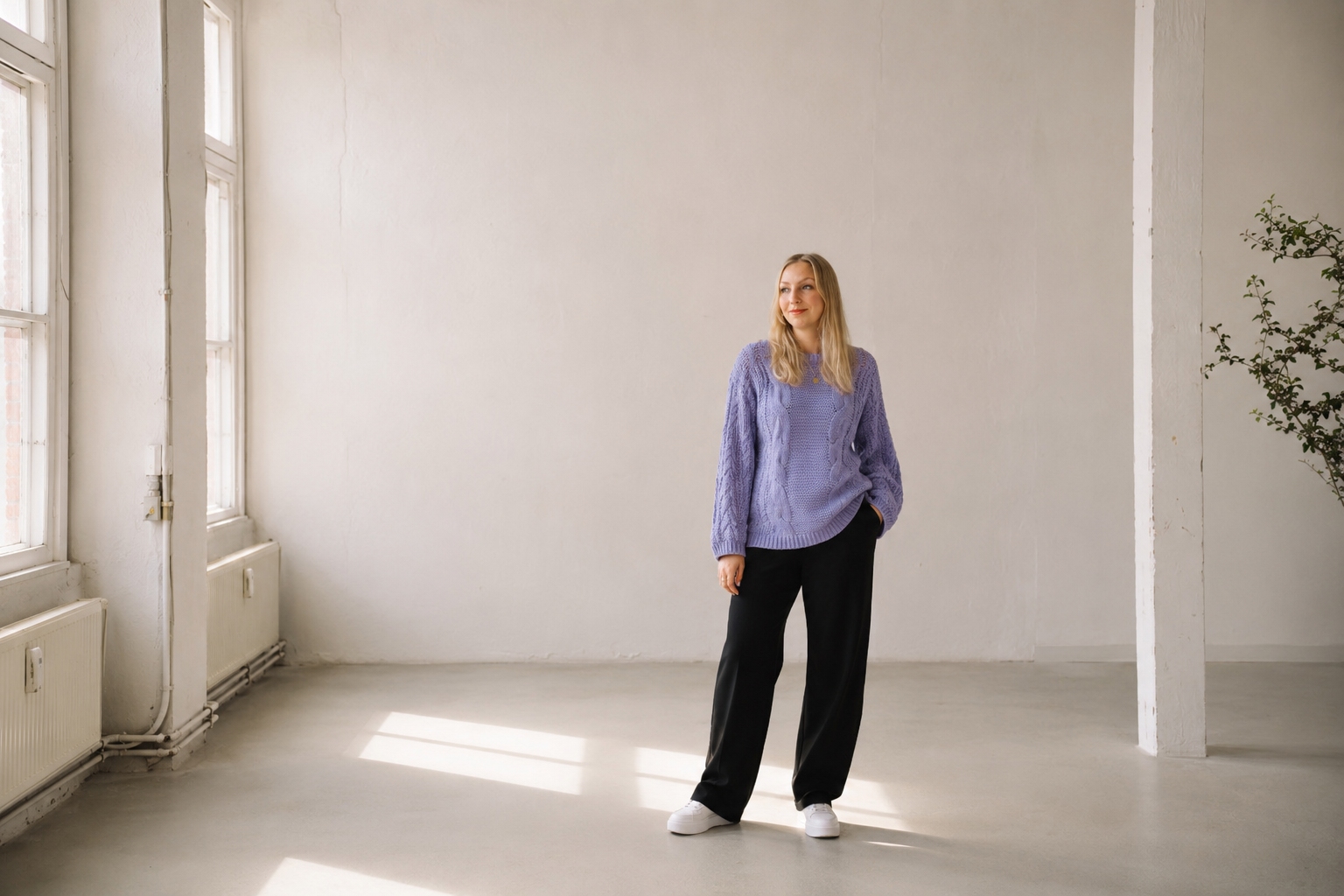
Charlotte Specht — Basa Studio co-founder and founding partner of Nola Club — has shaped artist-brand collaboration for over a decade.
Charlotte Specht — CEO of Basa Studio, co-founder of Book a Street Artist, and founding partner of Nola Club.
Few people have seen the artist-brand relationship from as many angles as Charlotte Specht. She co-founded Book a Street Artist, building it from the ground up as an operational business that brokered thousands of real partnerships between creative professionals and commercial brands — from small boutiques to global names, from emerging artists to household ones. As co-founder of Basa Studio, she navigates the brand side of the equation every day. And through Nola Club, she mentors experienced creative professionals on positioning, strategy, and the transition from solo practice to studio.
When the New York Times examined how street art and real estate value intersect — and whether artists are fairly compensated for what they generate — Charlotte was among the named experts journalist Isabella Kwai sought out. She noted that a large outdoor facade could cost six figures, and that brands commissioning cultural work have a precise demographic in mind — the commercial scale of that investment reflects it. Basa Studio's position on fair compensation is clear: artists should be paid fairly for the immense value they bring.
The questions at the heart of this conversation are ones that anyone serious about artist-brand collaboration strategy has been circling for years: who owns the creative vision, who gets paid fairly, and how to tell a collaboration built on genuine alignment from one that merely looks that way.
The single factor that determines whether a collaboration works
You've been at the centre of artist-brand collaborations for over a decade.
What is the single thing that determines whether a collaboration works or fails?
"I would say the single most important factor is the achievement of a win-win situation on both sides of the deal. In order to get there, both the brand and the artist need clarity about what success looks like for them.
For brands, that means defining what they actually want — whether it's driving traffic to a store launch, social media reach, a new aesthetic for a product expansion, or positioning themselves as a leader in cultural marketing. Sometimes it comes down to raw numbers: OOH campaign performance, sales, reach.
Artists also need to be clear about what makes them feel great about a collaboration. I have seen time and again that a motivated artist who is wholly invested in a brand collaboration delivers with heart and soul — and that can be felt by the audience. Financial goals matter, of course. But visibility in a new market or on a more professional level can be just as rewarding. Press, recognition, the chance to experiment with new materials or show a new side of their work — these things are genuinely motivating.
If both sides are clear about this — and especially if the brand communicates its goals honestly — the conditions are set for success. It has to be clear who benefits more from whom, and compensation adjusted accordingly. I have seen projects where the client was purely focused on product and profit, and an artist could absolutely align with that — as long as the fact that the brand is profiting from the artist's involvement is reflected in what the artist receives."
What both sides keep getting wrong
What do brands consistently misunderstand about artists — and what do artists consistently misunderstand about brands?
"A lot of this comes down to money — but not in the way people assume.
Many brands think they can simply pay enough to buy an artist's creativity and their brand. But very few artists are purely motivated by money. Appreciation of their work, respect for their practice as a business, and getting a genuine seat at the table on equal terms — these things can matter as much as the fee.
Equally, too many artists assume that brands only want to make money and decide everything on profit margins. But many brands have understood that positioning themselves within a cultural environment — becoming genuinely relevant and authentic within a community they want to reach — is a long game worth playing. The ones who get it right grant an artist real creative freedom and let their personality come through. The sweet spot is not where the artist's style and the brand's aesthetics overlap. It is where the brand expands into new spheres it couldn't reach without the collaboration.
One thing that gets confused by both sides regularly is the term 'creative freedom.' Artists often interpret it as 'I can do whatever I want.' But brands have constraints — their own corporate identity, the opinions of multiple stakeholders, the veto of key decision-makers, and a general pressure to avoid anything that could generate a negative reaction. That gap in expectations, if it isn't addressed honestly at the start, is where most collaborations begin to break down."
The sweet spot is not where the artist's style and the brand's aesthetics overlap — it is where the brand expands into territory it couldn't reach alone.
What Nola Club reveals about sustainable creative practices
Through Nola Club you work with experienced creative professionals on positioning and growth.
What separates the creatives who build sustainable commercial practices from those who don't?
"There is an important factor in the world of artist-brand collaborations that few artists fully realise. Brands decide who to work with not only on talent, style, or aesthetics — not even on follower count or reach. Brands are looking for security and reduced risk. They need clear answers to questions like: is this artist reliable? Can they deliver at this scope? What does the process of working with them look like? Will they understand our needs? How will they handle problems or conflict?
When I mentor artists who want to build a sustainable commercial practice, I always shift the focus to the structural, operational, and psychological aspects of their business. The design of the client experience is the key. The goal is to answer all of those questions with a confident yes — ideally before the brand even thinks to ask them."
It is a framework that reframes creative professional brand work entirely — not as a creative challenge, but as a client experience design problem.
What a brief that respects creative integrity actually looks like
The brief is where artist-brand collaboration strategy is either grounded or lost — long before a single creative decision is made. Charlotte has a specific view on what separates the ones that work from the ones that don't.
What does a brief that genuinely respects creative integrity look like — and how is it different from the standard agency brief?
"It is quite common for clients to think they respect creative integrity when in reality they have a very firm idea of how everything should look and be done. This gets even more complicated when a creative agency is already on retainer and wants their name prominent on the final output — and more complicated still when several agencies are involved at once.
This is why at Basa Studio, we bring the artist into the process as early as possible. When they are invited to create — or at least to review and challenge the initial concept — their creativity can genuinely come through and add real value to the project. There is a fundamental difference between buying an artist's time to realise someone else's vision and bringing them in because their expertise and creativity is needed and valued.
If the brief is essentially 'implement what we came up with,' there is very little room for genuine creative input. That is a different kind of engagement — and there is nothing wrong with it if both sides are honest about what it is. But it should not be called a creative collaboration."
On fair compensation — and why Charlotte shifted her focus
The New York Times quoted Basa Studio on fair artist compensation in brand and real estate collaborations.
What was the position you took — and has the industry moved since?
"The New York Times came to me to talk about urban art as an asset. They were looking at phenomena like the transformation of Wynwood — from a neglected manufacturing neighbourhood into one of the world's most recognisable creative and cultural districts — and at the growing number of similar transformations happening globally.
My observation was this: while most people agree that urban art can transform neighbourhoods and drive real estate value, far less attention is given to how little of that value actually reaches the artists themselves. Too many layers sit in between, each taking their share. And that dynamic extends across much of the creative industry.
Our stance at Basa Studio is clear: give artists a seat at the table, be transparent about your goals and gains, and commit to fairly compensating them for the immense value they bring.
For a long time, I tried to address this from the client side — pushing for higher budgets, more awareness, fairer distribution. Those efforts were often successful. But I realised I could have a greater impact by supporting creatives beyond our own projects. That is why my focus shifted. Through Nola Club, I work with creatives on positioning and pricing — but more importantly, on building the level of confidence where asking for fair numbers becomes a natural standard. Where they don't just know their value, but fully own it."
From transaction to partnership
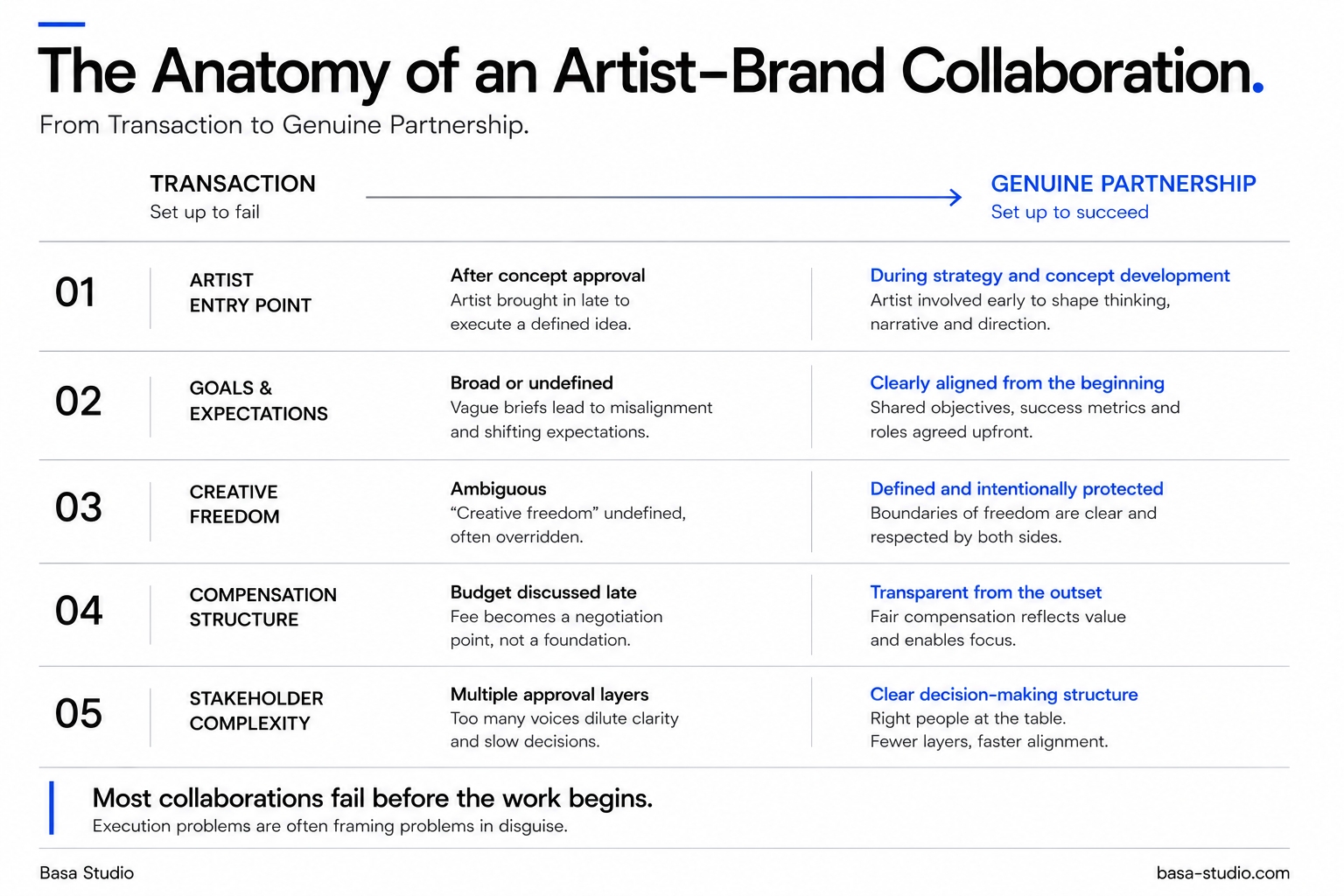
The framework below summarises a principle that has shaped Basa Studio's approach for years: most unsuccessful artist–brand collaborations don't fail because of the creative work itself—they fail because of how they're structured from the outset. It contrasts a transactional model, where artists are brought in late and treated as vendors, with a partnership model built on early involvement, clear expectations, protected creative freedom, transparent compensation, and streamlined decision-making.
Most artist-brand collaborations break down at the same point — not execution, but the original framing. Clarity on both sides changes everything.
Where do you see the artist-brand relationship heading over the next five years — and what gives you optimism, and what concerns you?
"We will see more and more artist-brand relationships over the next five years — and the definition of what a cultural collaborator looks like is expanding. We already see brand experiences built around small, curated gatherings with a desired audience: a curated dinner, an intimate showcase. The collaborator is increasingly a cultural innovator in a specialised field — a chef, a food artist, a botanical artist, a scent creator.
At the same time, I come across a new artist-brand collaboration from a luxury beauty or fashion brand almost every day — a limited edition, a new retail space, a hyper-branded pop-up, a statement showcase at Milan Design Week, Art Basel, or Cannes. The format keeps expanding.
I think we came out of the pandemic with a strong collective desire to connect in physical spaces again — small, curated, intimate ones. Brands are picking up on this and creating those spaces with the help of cultural collaborators.
The digital world is also still transforming at speed. New types of artists and art forms keep emerging, pushing the boundaries of what a creative collaboration can look like. I see many creatives adapting intelligently to what AI and other technologies bring — either by embracing and mastering them, or by doubling down on what cannot be replicated by technology: a flavour, a feeling, a genuinely human touch.
But there is one essential thing brands need to get right as artist-brand collaborations multiply: authenticity. It is a word whose usage has become extremely inflated. Everyone wants it, few truly achieve it.
It comes back to the first question — what makes a collaboration work. As long as brands dig deep into their own identity and then show the courage to match it with an artist's identity — not to find overlap, but to let something entirely new come into existence — I believe audiences will embrace it."
What runs through everything Charlotte describes — the clarity of intent, the honesty of the brief, the courage to let something genuinely new emerge — is not a methodology. It is a disposition. And the collaborations that endure — the ones audiences remember — are always built on exactly that.
Charlotte Specht co-founded Basa Studio together with Mario Rueda. She is also the founding partner of Nola Club, where she offers 1:1 mentoring for experienced creative professionals on positioning, strategy, and business growth.
Related creative stories
Browse through other features, interviews and guides to discover creative brand collaborations, meet innovative artists and creators, find out how new artforms are energizing advertising, & more.
We're excited to hear from you! If you're looking for artistic solutions for your next creative marketing campaign, send us your briefing. We can also help create a killer concept if you're in an early ideation phase. Check out our services for more.
Send your briefing
About you
THANK YOU
Your inquiry has been sent
We have received your inquiry. We'll get back to you within 24-48 hours to discuss your project. If you need urgent assistance, reach us on WhatsApp: +49 176 432 64506. In the meantime, we invite you to explore our insights, case studies, and lessons from building culturally grounded brand experiences.
Please contact us by phone if you're not able to reach us via this form.
THANK YOU
We have received your inquiry. We'll get back to you within 24-48 hours to discuss your project. If you need urgent assistance, reach us on WhatsApp: +49 176 432 64506. In the meantime, we invite you to explore our insights, case studies, and lessons from building culturally grounded brand experiences.
We use cookies to help empower our artists and make them accessible to clients. Check out our Privacy Policy and Terms of Service to see how your data can make a difference.