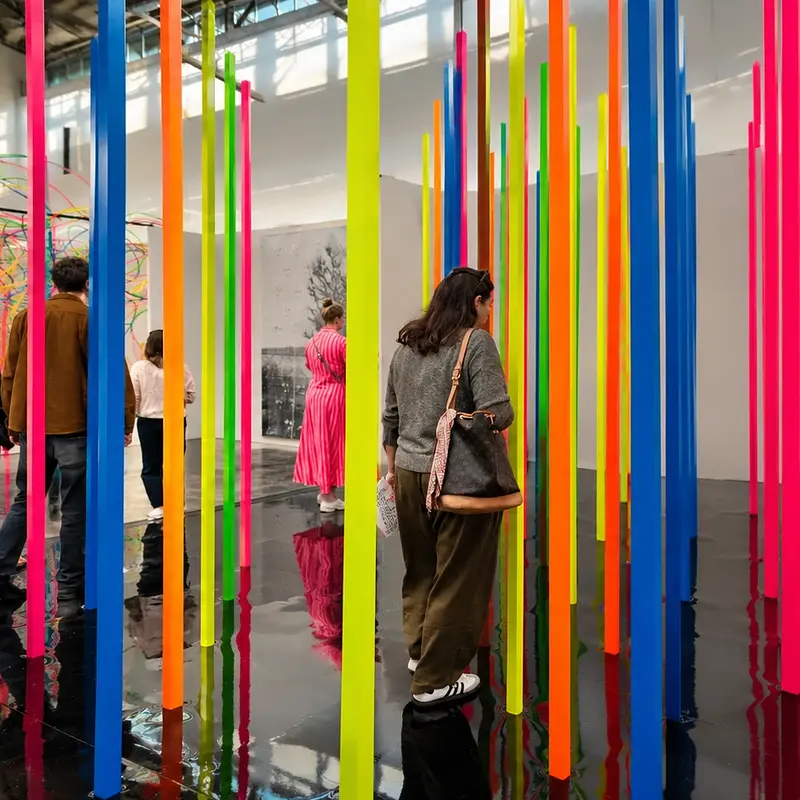
The ROI of cultural brand building is measurable, compounding, and — when framed correctly — highly defensible to a CFO.
Most senior marketers encounter cultural brand building the same way: a competitor does something genuinely striking — a bespoke installation, a product launch built around a commissioned artwork, a retail space that earns design press — and the reaction is: I want that. But can I justify it?
That question deserves a rigorous answer. Not a mood board. A business case — grounded in a rigorous cultural brand building process, with metrics, timelines, and language a CFO can evaluate.
This article builds that case.
Why Standard Campaign ROI Models Don't Apply
Performance marketing ROI is calculable because the system is closed. You spend a defined amount, target a defined audience, track a conversion event, and divide output by input. Clean. Auditable. Defensible.
Cultural brand building operates in an open system. A single high-quality activation generates effects across multiple channels, audiences, and time horizons simultaneously — and most of those effects are invisible to standard attribution models.
Consider what actually happens when a premium brand deploys a curated cultural experience: it generates press coverage the brand did not buy, social content it did not create, and shifts brand perception among audiences who were not even present. It strengthens the effectiveness of every paid touchpoint that follows — because it changes the context in which those touchpoints land. None of that shows up in a last-click attribution report.
A Google and WARC analysis across major European markets found that when sustained brand effects are measured alongside short-term returns, average profit ROI from marketing investment more than doubles. The returns were not absent. They were outside the measurement window most brands were using.
The first step is measuring cultural impact across all the dimensions it actually produces — not just what arrives in the first quarter.
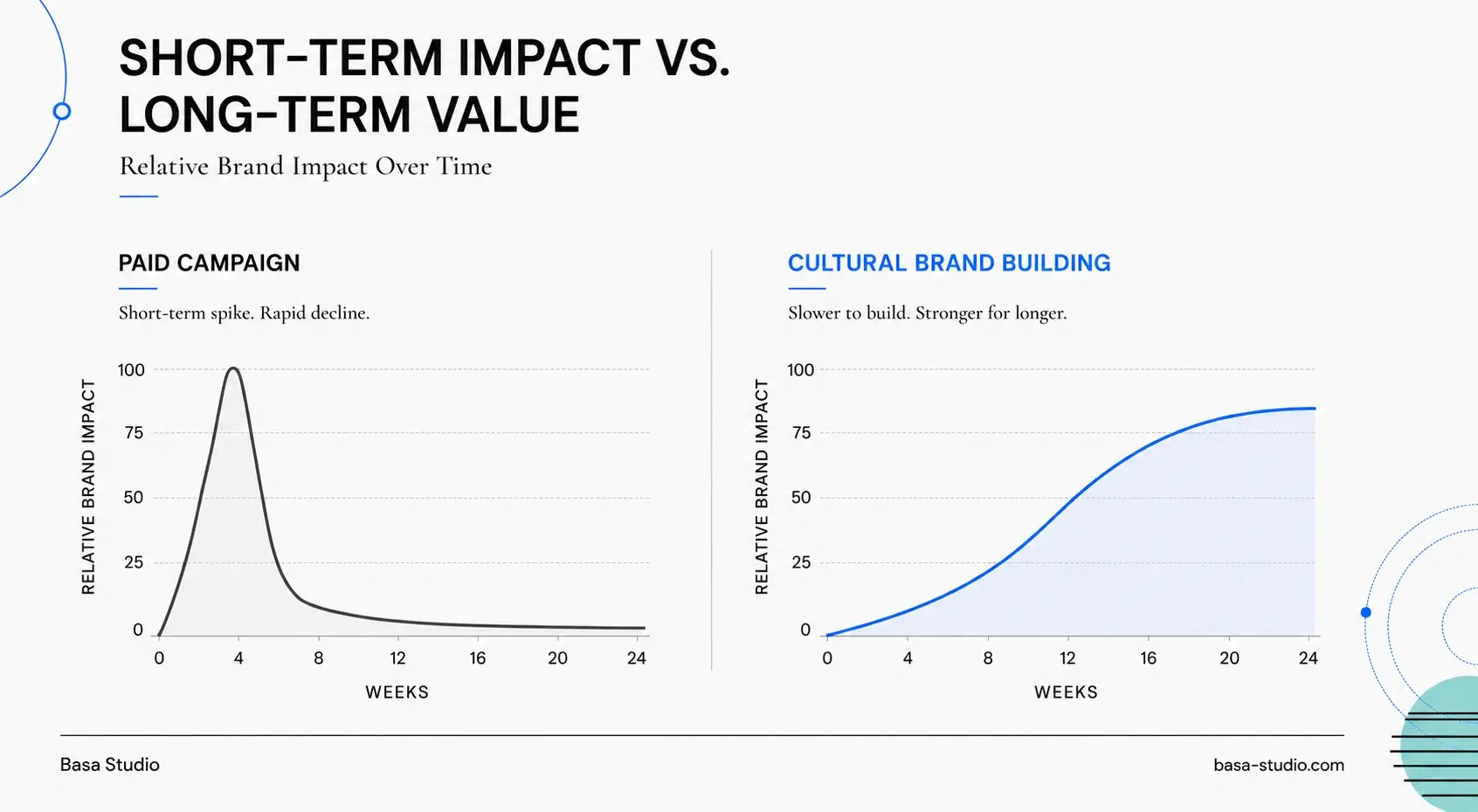
Cultural brand investment generates returns over a fundamentally different timeline — standard attribution models only capture the left curve.
The Brand Building Metrics That Actually Matter
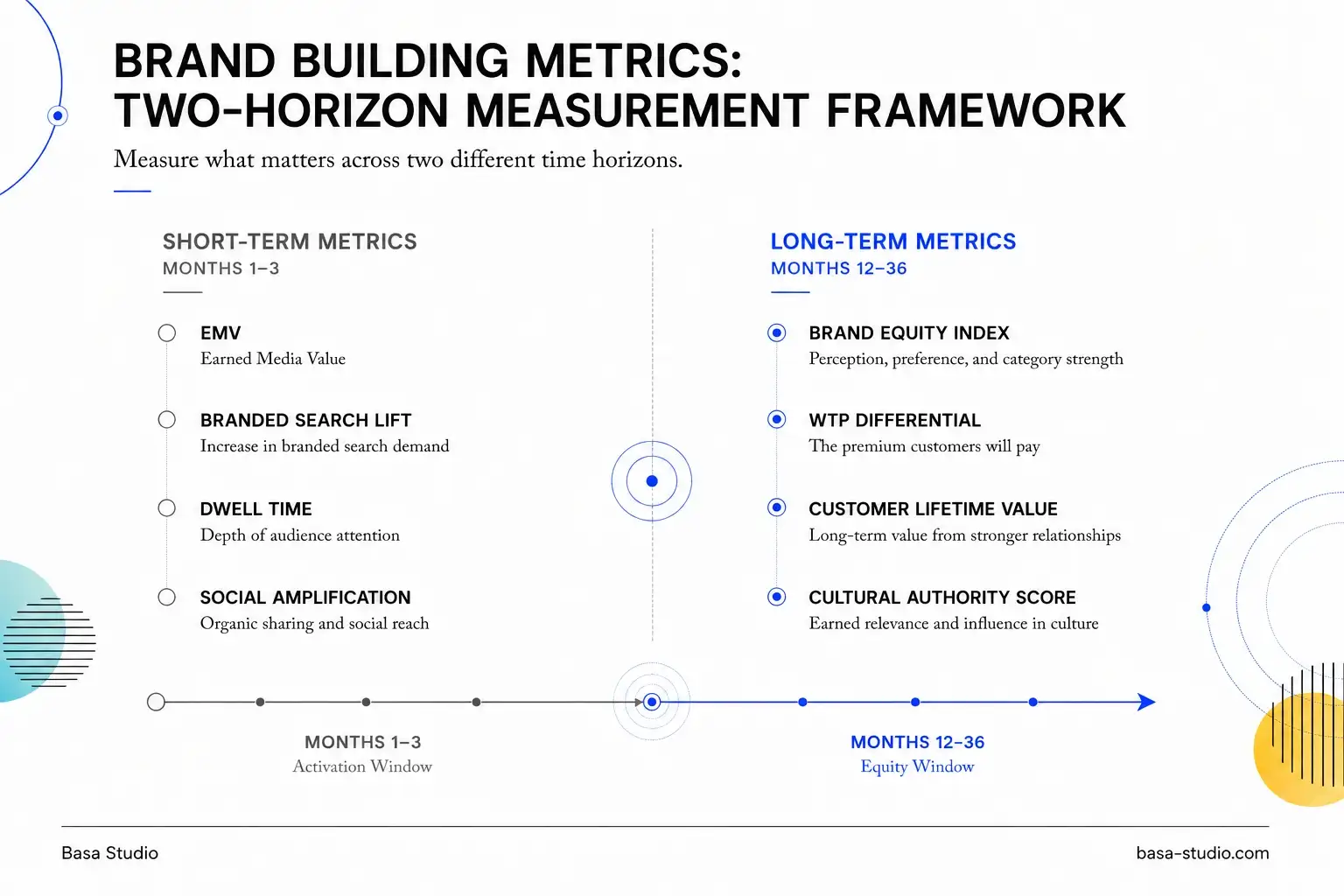
A brand building metrics framework for cultural investment covers two time horizons: short-term activation metrics (Months 1–3) and long-term equity metrics (Months 12–36). In the first three months, the signals to track are earned media value, branded search lift, dwell time, and social amplification rate — the immediate evidence that the activation earned attention rather than bought it. From month twelve onwards, the metrics shift to brand equity index, willingness-to-pay differential, customer lifetime value by acquisition channel, and cultural authority score. These move more slowly, but they are the ones that show up on the P&L. Collapsing both windows into a single measurement period guarantees you will undercount the value.
These are signals generated directly by the activation. Meaningful, trackable within a normal campaign cycle — but only the first layer of return.
Earned media value (EMV): The most immediately calculable metric. Catalogue every piece of press, editorial, and social content the activation generated that the brand did not pay for. Apply the rate card equivalent for equivalent paid placement. The methodology for doing this rigorously is covered in the dedicated EMV section below.
For a sense of what this looks like at scale: Jacquemus built its entire growth model on earned media over paid. According to a Femfounded case study, its activations — site-specific runway shows in Provence lavender fields, giant handbag trolley installations across Paris streets — were designed for social shareability first and traditional press second, generating earned coverage that would have cost tens of millions in traditional advertising equivalents. Revenues grew more than 30% year-on-year to approach €300 million. Cultural investment, not advertising spend.
Branded search lift: A well-executed cultural moment produces a measurable spike in branded search. Google Search Console's branded queries filter lets you track this directly — measuring branded clicks and impressions before and after an activation to isolate the search impact. The Jacquemus Le Bambino Paris installation generated a 900% spike in branded searches within 24 hours of release, driven almost entirely by organic sharing. That is social amplification working as a measurable signal — and it is what separates a cultural moment from a campaign.
Dwell time: The contrast with paid media is not subtle. Ford's Go Faster immersive driving experience held participants for four hours of continuous brand engagement — learning stunt techniques, starring in a personalised film trailer, leaving as organic social advocates. No paid media format produces four hours of undivided attention. Dwell time is not a vanity metric. It is a proxy for how deeply a brand has been encoded in memory.
Cultural brand investment requires two distinct metric sets — one for the activation window, one for the equity window.
Long-Term Metrics: Equity Window (Months 12–36)
These metrics capture what cultural brand building is structurally designed to produce. They move slowly — but consistently, when investment is sustained — and they connect directly to financial outcomes.
Brand recall and long-term sales lift: Brand equity index tracks perception, but the commercial effect shows up in sales baseline over time. A Nielsen study commissioned by Google found that a 1% increase in upper-funnel brand awareness generates a 0.6% lift in long-term sales — independent of any short-term activation. For premium brands, this relationship between brand investment and sales baseline is one of the most financially material metrics available. Track it through annual brand studies cross-referenced against sales baseline movement over rolling 24-month periods.
Brand equity index: Tracks aided and unaided recall, brand preference within category, and perceived quality differential versus competitors. Brand equity is the financial expression of everything cultural investment builds — and it is directly linked to pricing power. Marketing Week's 2025 Language of Effectiveness research, conducted with Kantar and Google across more than 1,000 brand marketers, found that 87.9% agree stronger brands command higher prices — yet fewer than 40% can draw that line in a way they can present internally.
Willingness-to-pay (WTP) differential: The most direct financial translation of brand equity. A brand that can charge more than its competitors for the same product — and hold that premium — is generating real revenue from brand investment.Track it through annual consumer research: ask a representative sample of your target audience the maximum they would pay for your product versus a named competitor equivalent. Run the same study each year with a consistent methodology. A consistent upward trend is a metric that speaks the CFO's language without translation.
Customer lifetime value by acquisition channel: Customers who encounter a brand through a culturally resonant experience enter the relationship differently than those acquired through a discount or a targeted ad. Forrester research finds that better brand experiences can increase customer LTV by up to 2.3×. Harvard Business Review found that customers with a genuine emotional connection to a brand are worth 52% more than the benchmark over their lifetime. That difference accumulates in LTV, repeat purchase rate, and referral behavior — and it is measurable at the CRM level when acquisition channel is tracked.
Cultural authority score: A composite built from share of earned media within your category, frequency of unsolicited brand mentions in relevant cultural contexts, and the quality tier of inbound partnership requests. Less standardised than the metrics above — but it captures the compounding reputational asset that cultural brand building produces, and it can be tracked consistently with a defined methodology.
How to Calculate Earned Media Value from a Cultural Activation
EMV is the most immediately defensible ROI metric for cultural brand building — it produces a number, in currency, that any finance function can evaluate.
Step 1 — Inventory all earned coverage. Catalogue every piece of press, editorial, and social content generated by the activation the brand did not pay for. Note the outlet, format, estimated reach, and whether the brand was the primary subject or a secondary mention.
Step 2 — Apply rate card equivalents. Use the advertising rate card for equivalent paid placement in each outlet. For social content, use the platform's standard CPM or creator rate equivalent for the account size and engagement rate. Be conservative — the goal is defensibility, not optimism.
Step 3 — Present the rate card equivalent without a multiplier. The temptation is to apply a credibility multiplier to reflect that editorial coverage is more trusted than advertising. Resist it. Multipliers are arbitrary, contested, and will invite scrutiny from any finance function worth its salt. The rate card equivalent alone — what you would have paid for equivalent space — is a clean, auditable number. Let the quality of the coverage make the credibility argument; you make the financial one.
Step 4 — Compare to activation cost. Total EMV ÷ activation investment = EMV ROI ratio. Present this alongside the methodology, not in place of it. A CFO who understands how the number was built is more likely to trust it than one handed a ratio without context.
The deeper point: unlike a paid campaign that stops delivering when spend stops, a cultural installation or spatial experience continues generating earned value for as long as it exists — in editorial when the space opens, again when a publication covers the neighborhood or the artist, again in influencer content years later. Its return profile is structurally different from any media buy.
The Compounding Effect: Why Cultural Work Doesn't Switch Off
Every paid media campaign has an off switch. The moment budget stops, impressions stop, reach collapses, and whatever brand effect was building dissipates. The investment concludes.
Cultural brand building doesn't work that way. Les Binet and Peter Field's foundational work, based on analysis of thousands of IPA effectiveness cases, established that 60% of total marketing payback comes from long-term brand building — not short-term activation. The same Google and WARC research cited above found that brands focusing only on short-term ROI may be overlooking up to 50% of the total returns their investment generates. Most brands are making reinvestment decisions at the twelve-week mark. They are abandoning the puzzle before the picture is complete.
The compounding mechanism is straightforward: each cultural activation builds a layer of brand association. The next activation lands in a context already shaped by the previous one — reaching a more receptive audience, generating more credible press, attracting higher-quality partnership interest. Brands that invest consistently in cultural depth over three to five years develop a self-reinforcing reputation that makes every subsequent investment more efficient. The marginal cost of earned attention decreases. The marginal return on brand equity increases.
That is the argument that belongs in the board presentation — not the activation recap.
How to Present This to a CFO: Translating Cultural Outcomes into Financial Language
The CFO conversation fails when CMOs arrive with creative rationale. It succeeds when the framing shifts from what we made to what we built — expressed in financial terms.
Lead with assets, not activations. A cultural brand activation produces assets: earned media value (quantified), brand equity movement (indexed), audience quality improvement (LTV data), and a reputational position that lowers the cost of future marketing. Present each as a line item.
Use the dual-horizon framework explicitly. Show two measurement windows — short-term (activation ROI, EMV) and long-term (equity trajectory, WTP differential, LTV by channel). Collapsing both into a single quarter's P&L produces an incomplete — and misleadingly negative — picture of the return.
Benchmark against the alternative. What would equivalent reach, equivalent quality of attention, and equivalent brand equity movement cost through paid channels? The Ehrenberg-Bass Institute's 95-5 rule, developed by Professor John Dawes, is the sharpest framing here: at any given moment, only 5% of potential buyers are actively in-market. Performance marketing captures that 5%. Brand building builds preference among the 95% who will eventually become buyers. Cultural brand building is the highest-quality form of that investment.
Set a measurement review schedule, not a campaign review. Agree upfront that cultural brand investment will be evaluated at 12 months and 36 months — not at the end of a campaign flight. A CFO who would not evaluate a three-year capital expenditure in its first quarter should apply the same logic here.
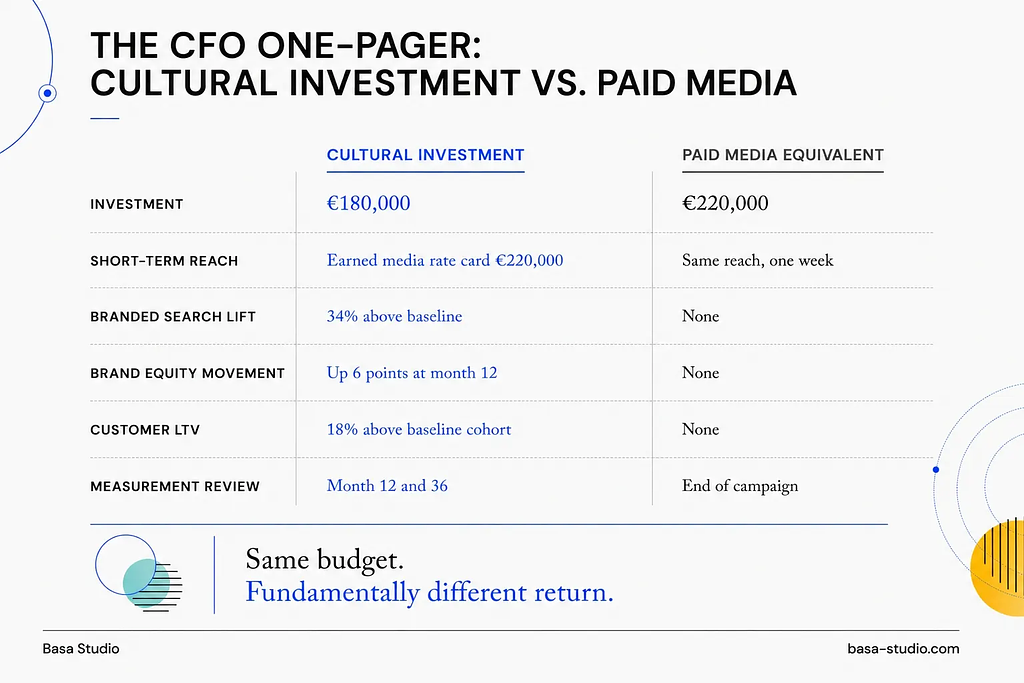
In practice, this is what it looks like — a European premium apparel brand, €180,000 invested across three artist collaborations over 18 months.
The comparison holds up line by line. Both investments were similar in size — €180,000 for the cultural program, €220,000 for the paid media equivalent. But where paid media delivered reach for a single week and nothing after, the cultural investment produced a 34% lift in branded search, a six-point gain in brand equity by month twelve, and a customer cohort with 18% higher lifetime value. One campaign ended. The other kept compounding.
Same budget. Fundamentally different return.
What Timeframe Should CMOs Plan For?
Cultural brand building is a long-term play — but long-term is not the same as unmeasurable.
McKinsey's 2024 Global Consumer Marketing Leader Survey of 104 C-suite executives across Europe and North America found that while 87% of CMOs believe brand building is strategically important, only 41% rate their organisations as mature in marketing performance measurement. The problem is not conviction — it is measurement architecture. The timeline below addresses that directly.
Months 1–3: Activation returns. Earned media, branded search lift, dwell time, social amplification. Quantifiable and real. Present them as proof of concept — not proof of program.
Months 3–12: Association building. Brand perception scores begin moving on the attributes the activation was designed to reinforce. Branded search volume settles at a new, higher baseline.
Months 12–24: Equity accumulation. Brand equity index movement becomes visible in annual tracking. WTP differential begins widening against category benchmark. Customer LTV by acquisition channel starts separating.
Months 24–48: Compounding returns. Cultural authority becomes self-reinforcing. New activations require less budget to generate equivalent earned media because the brand's reputation precedes them. Partnership and collaboration opportunities become inbound.
CMOs who communicate this timeline proactively — rather than defending short-term numbers under pressure — reframe the conversation from accountability to strategy.
The Business Case Is There. The Framework Has to Match It.
Cultural brand building produces measurable, financially material returns — in earned media value, brand equity, customer quality, and the compounding efficiency of sustained investment. The reason it is undervalued in budget conversations is not because the returns are absent. It is because most measurement frameworks were built for a different kind of investment.
The business case for cultural brand building is rigorous. Make sure the framework you bring to the table is rigorous enough to match it.
Related creative stories
Browse through other features, interviews and guides to discover creative brand collaborations, meet innovative artists and creators, find out how new artforms are energizing advertising, & more.
We're excited to hear from you! If you're looking for artistic solutions for your next creative marketing campaign, send us your briefing. We can also help create a killer concept if you're in an early ideation phase. Check out our services for more.
Send your briefing
About you
THANK YOU
Your inquiry has been sent
We have received your inquiry. We'll get back to you within 24-48 hours to discuss your project. If you need urgent assistance, reach us on WhatsApp: +49 176 432 64506. In the meantime, we invite you to explore our insights, case studies, and lessons from building culturally grounded brand experiences.
Please contact us by phone if you're not able to reach us via this form.
THANK YOU
We have received your inquiry. We'll get back to you within 24-48 hours to discuss your project. If you need urgent assistance, reach us on WhatsApp: +49 176 432 64506. In the meantime, we invite you to explore our insights, case studies, and lessons from building culturally grounded brand experiences.
We use cookies to help empower our artists and make them accessible to clients. Check out our Privacy Policy and Terms of Service to see how your data can make a difference.