Cultural brand building in corporate spaces drives measurable returns. The WeWork Madrid project shows what happens when creative strategy meets spatial design.
When a corporate space earns genuine attention — from employees, visitors, and the wider cultural community — it stops being overhead and starts being an asset. That shift doesn't happen through décor choices. It happens through strategic cultural investment: commissioning work with substance, from artists whose visual language has depth, and integrating that process into the brand's spatial identity from the earliest stage of planning.
WeWork's Madrid location is a precise example of what this looks like in practice.
The Business Case for Cultural Investment in Corporate Spaces
The question most brand and workplace managers ask when cultural investment comes up is some version of: what do we actually get back?
It's the right question. And the answer has two parts.
The first is measurable in the conventional sense: employee experience, retention signaling, visitor impression, press coverage, social amplification. These are documented. The numbers are striking: according to the Art of the Workplace Report, commissioned by Brookfield Properties in partnership with The School of Life and based on a survey of 3,000 office workers across the UK, 69% of adults believe that interesting and visually attractive artworks positively impact their wellbeing at work. Among workers aged 18 to 29, 63% already prefer working in the office to working from home — but that figure rises to 75% among those who work in offices with a significant amount of art. And 87% of workers with no exposure to cultural events at work report feeling uninspired day to day.
The second return is harder to put in a spreadsheet but arguably more valuable: what the space communicates about the brand. A corporate space that contains meaningful, well-curated cultural work signals investment in craft, in community, in permanence. It communicates that the brand thinks beyond the transaction. For a company like WeWork — whose entire value proposition is built around the quality and energy of shared spaces — that signal isn't peripheral to the product. It is the product.
This is what Victor Lipman, writing in Forbes, called Return on Environment: not aesthetic ROI, but motivational ROI. The argument is that art in the workplace is "less about aesthetics and more about pride in one's environment" — and that pride motivates. That's good business.
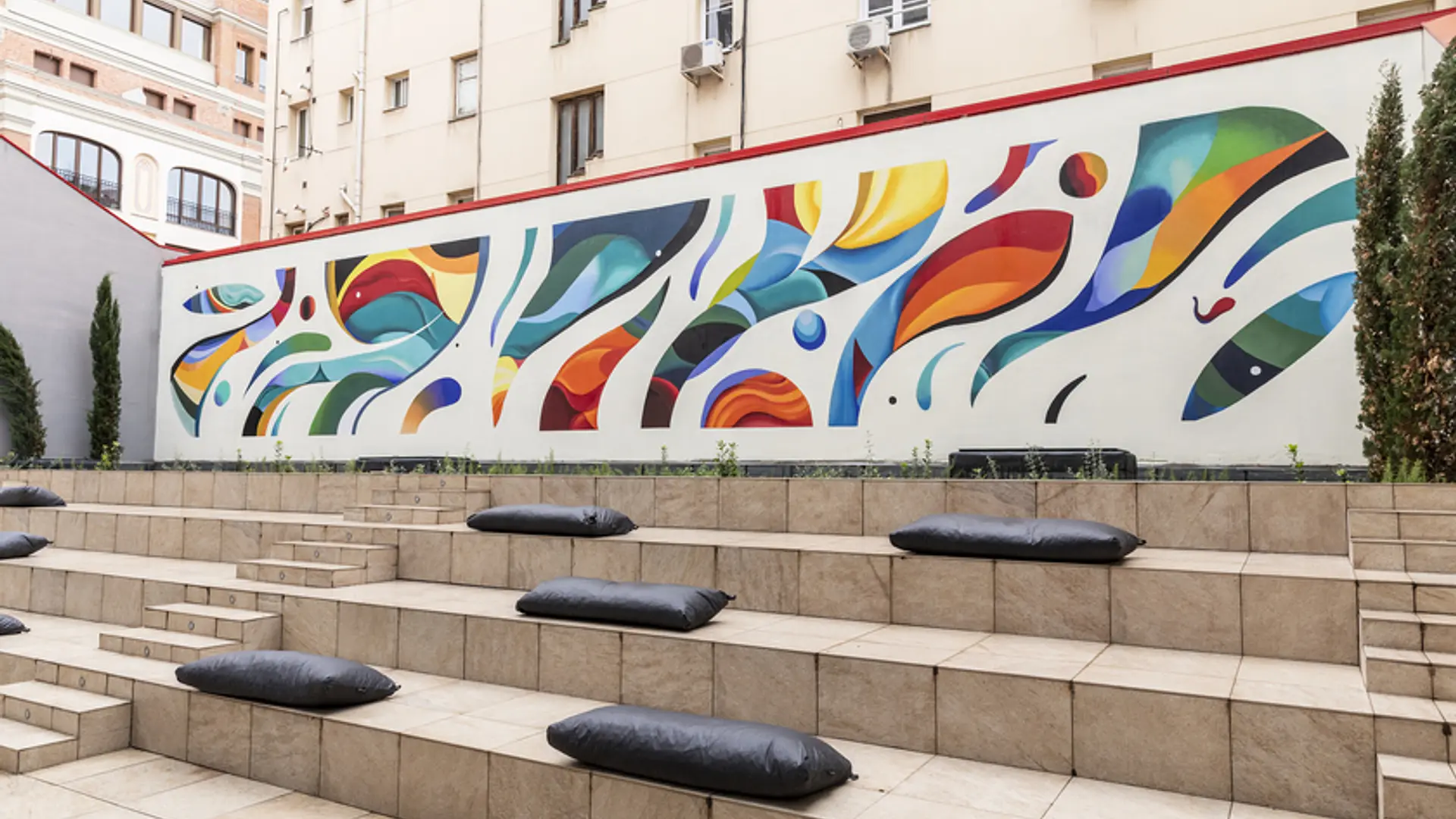
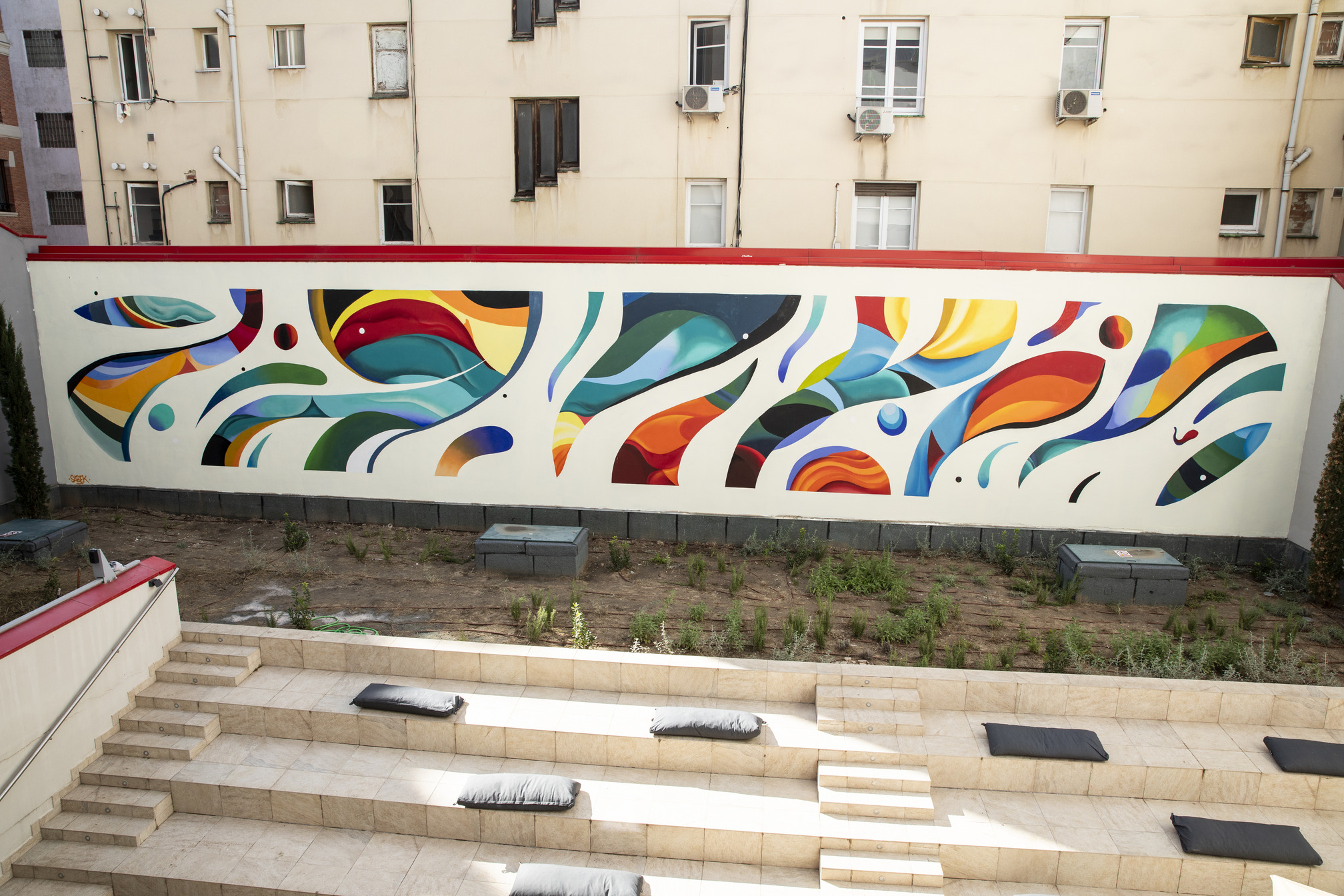
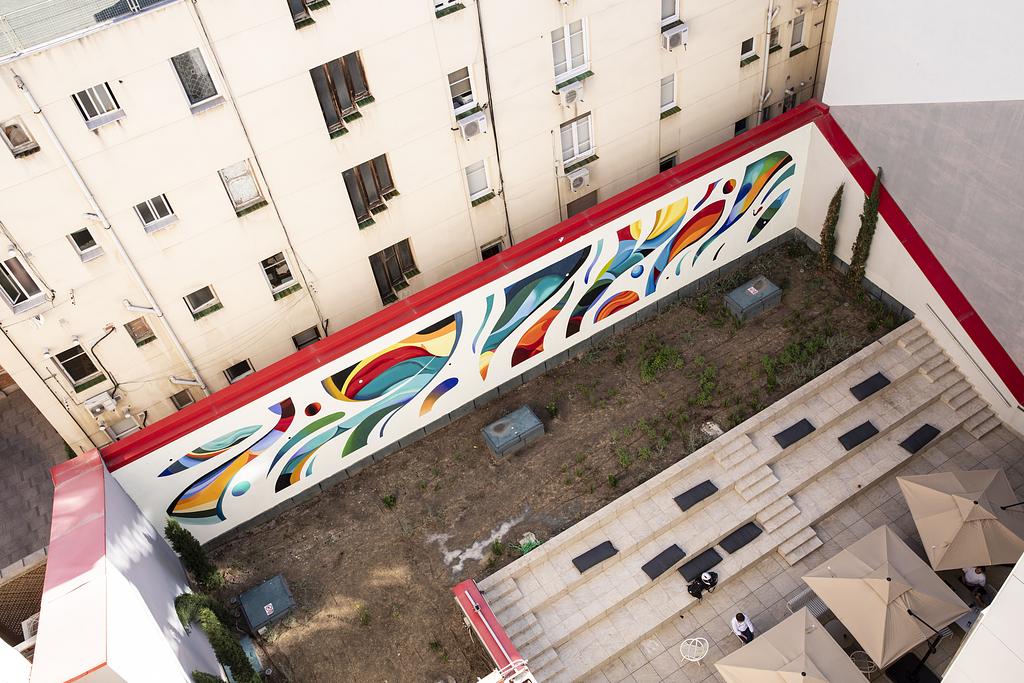
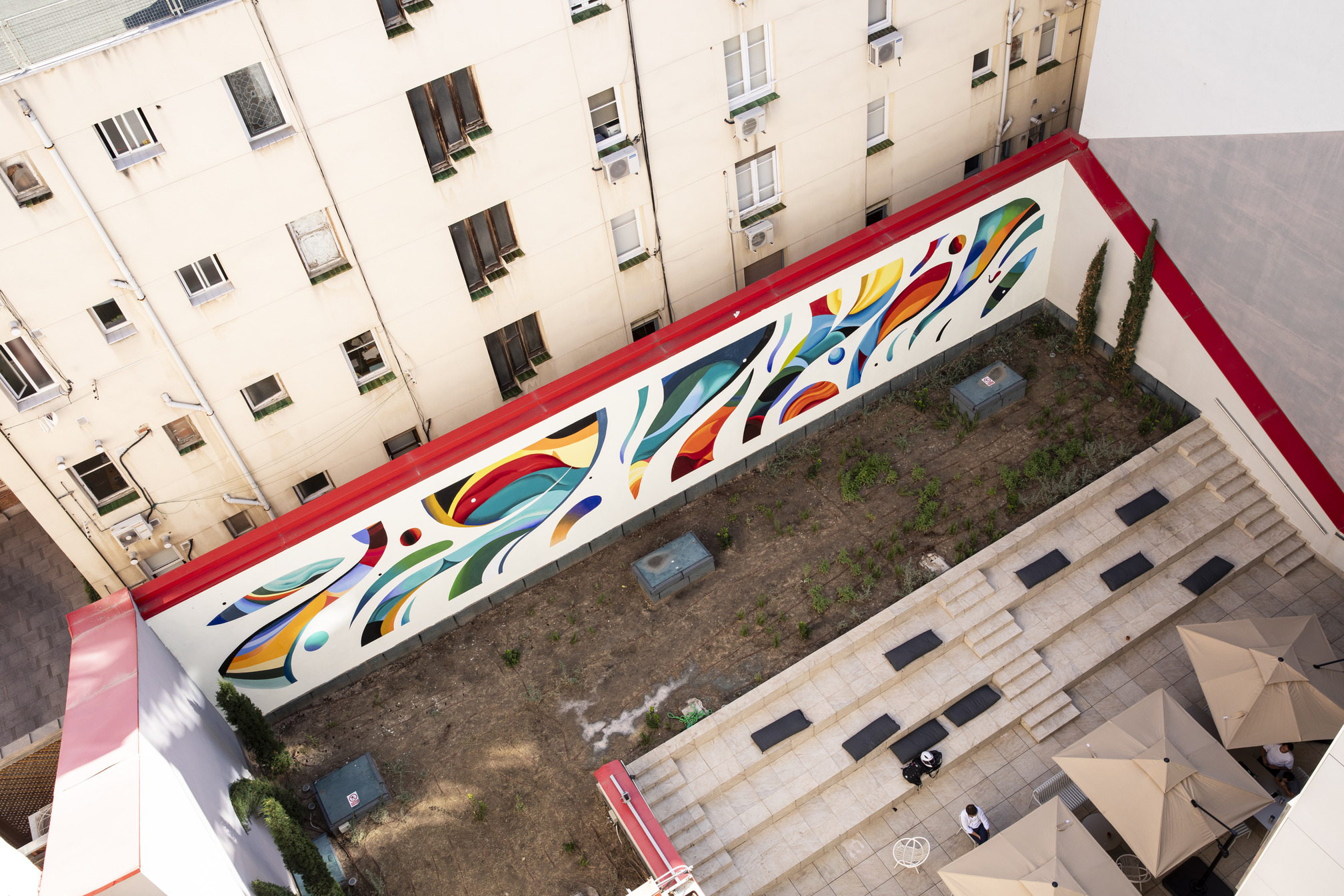
Sabek's completed large-scale work at WeWork Goya, Madrid. 17 metres wide, 5 metres high — designed to transform an outdoor terrace into a destination within the workspace. Photo: Ana Larrazabal.
The Brief: Starting with Creative Direction, Not a Finished Concept
WeWork came to Basa Studio with a spatial problem and a creative instinct. The outdoor terrace at their Madrid Goya location — a significant amenity — wasn't performing as a destination. It needed something that would anchor the space, give it visual identity, and make it worth spending time in.
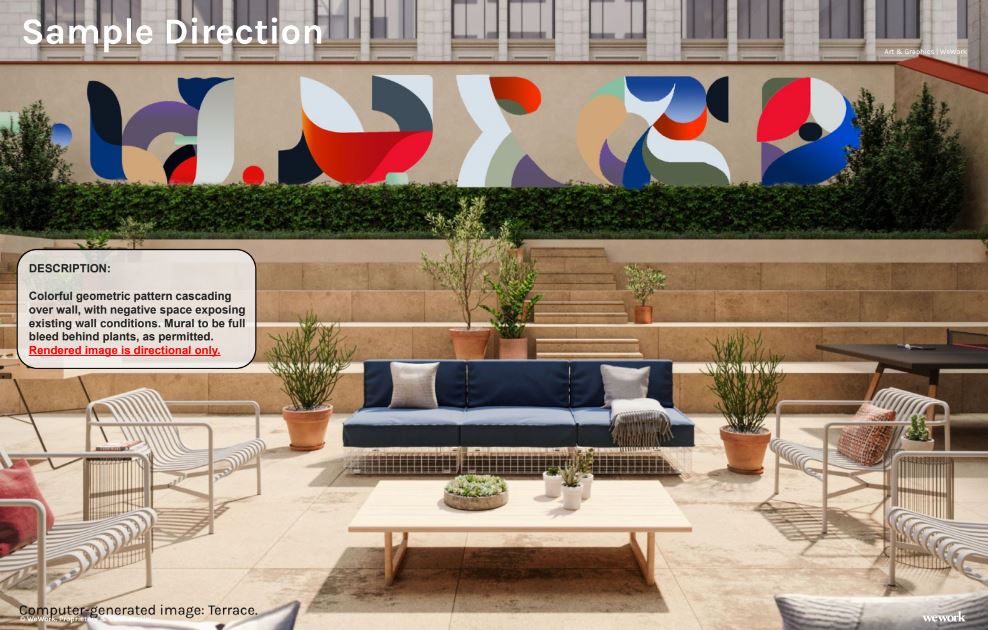
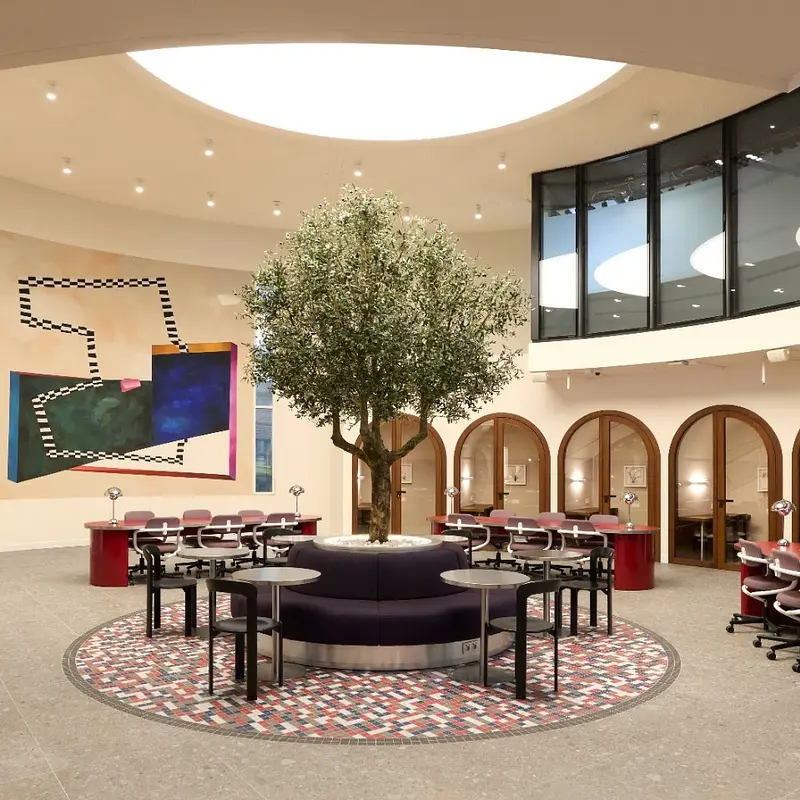
The initial direction WeWork provided was a rendered concept: a geometric, colourful composition that would cascade across the wall and integrate with the terrace's modern aesthetic. This wasn't a finished brief — it was a starting point. A creative signal. The kind of directional input that tells a studio what the brand is reaching for, without prescribing how to get there.
That distinction matters. Brands that arrive with fully resolved concepts often end up with executed briefs rather than genuine cultural moments. The space for interpretation — for the artist's visual intelligence to operate — is precisely where the cultural depth gets built.
WeWork's initial direction: a computer-generated render showing a geometric, colourful composition for the terrace wall. This served as a creative starting point, not a final brief. Credit: WeWork.
Selecting the Right Cultural Collaborator
Basa Studio's role at this stage was not to execute the render. It was to identify which artist's practice — whose visual language, whose sensibility, whose relationship to Madrid as a city — could take that starting point and produce something with genuine cultural weight.
Sabek, a Madrid-based artist with a distinctive abstract practice built around bold form, fluid movement, and a sophisticated use of colour, was the right fit. His work operates at a scale where it commands space rather than decorates it. And critically, his connection to Madrid is not incidental — it's constitutive of how he works. Commissioning him wasn't importing an aesthetic. It was drawing from the city's own creative depth.
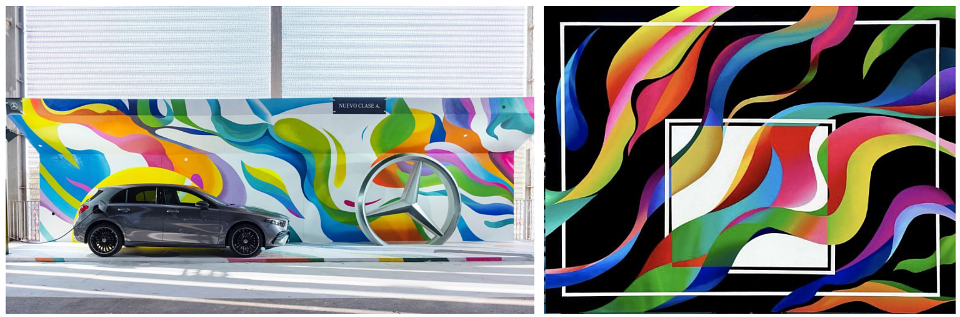
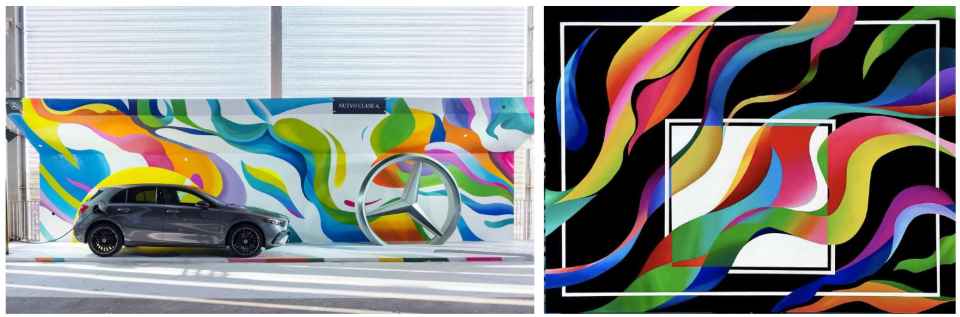
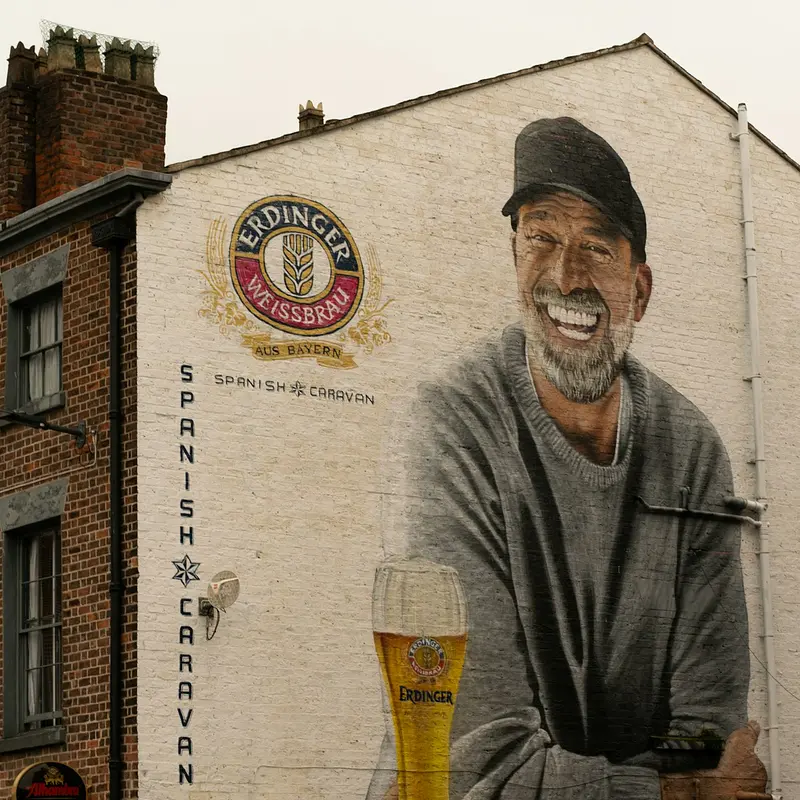
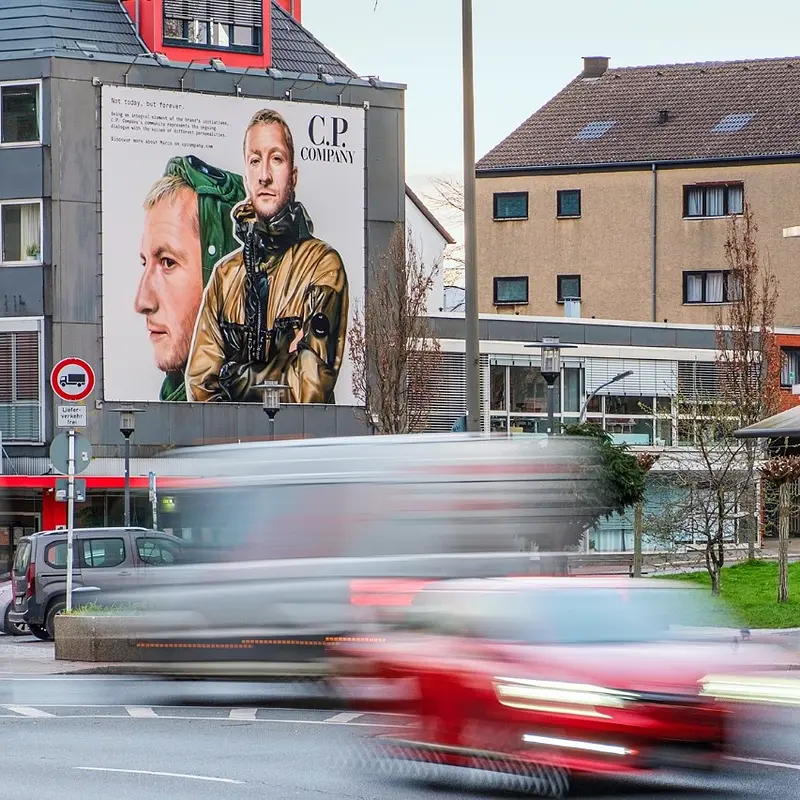
Examples of Sabek's broader practice, including previous brand collaborations. His visual language — bold abstraction, fluid form, large-scale composition — was a strategic fit for WeWork's spatial brief.
This is the distinction between cultural collaboration and generic art procurement. The former is a strategic match: lived experience, visual intelligence, and brand context in alignment. The latter is a transaction.
Creative Autonomy as a Strategic Decision
One tension that surfaces in every cultural collaboration of this kind is the question of creative control. Brands have brand standards. Artists have creative integrity. These don't always point in the same direction.
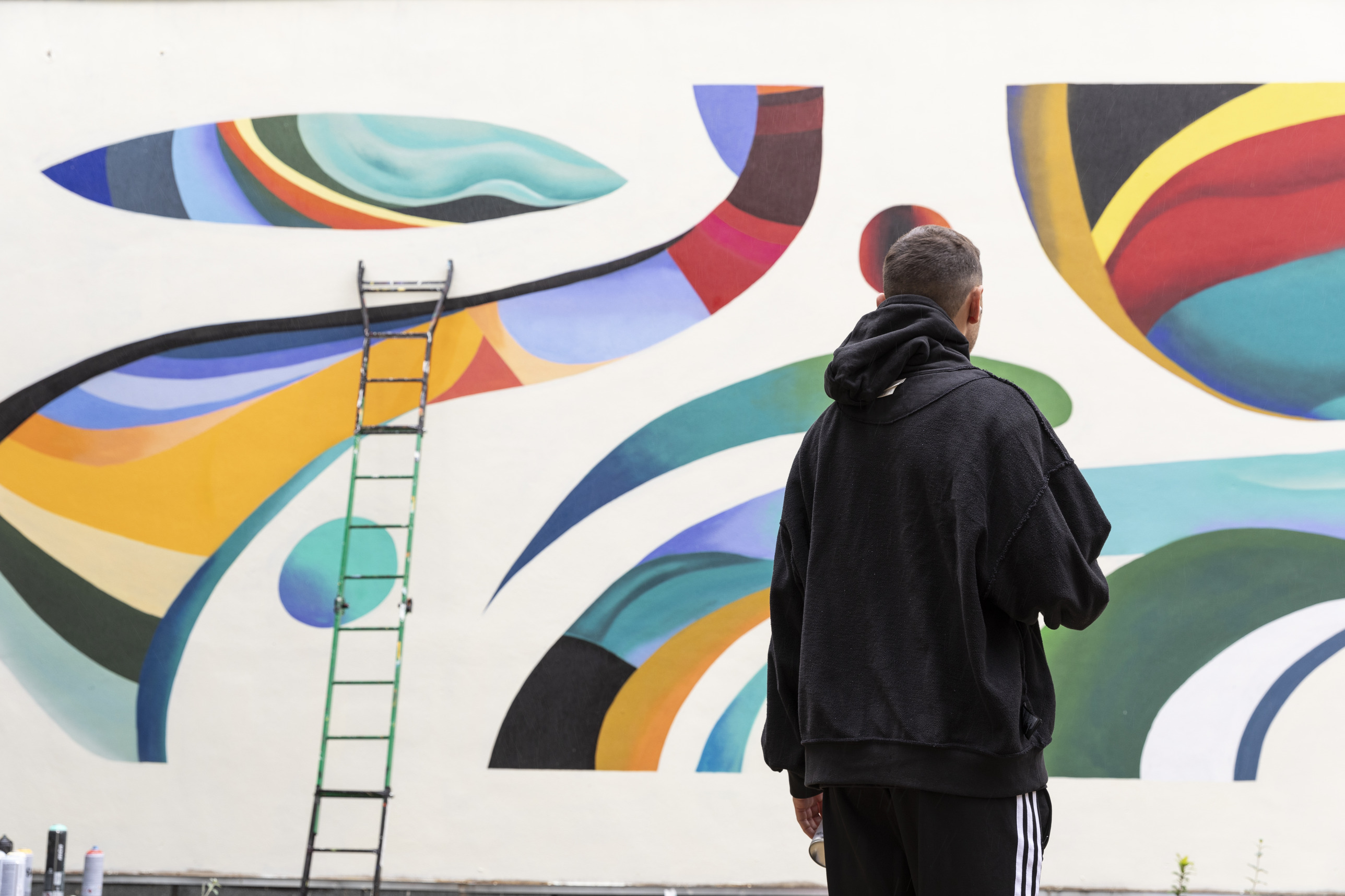
Sabek assessing the composition mid-execution. Creative latitude — agreed from the outset — was the condition that produced both the quality of the work and the artist's full engagement with the project. Photo: Ana Larrazabal.
In the WeWork project, the resolution was deliberate. WeWork provided the directional brief and trusted Basa Studio's recommendation on artist selection — then extended significant creative latitude to Sabek to interpret the space in his own terms. This wasn't a concession. It was a strategic choice, and it had a direct consequence: Sabek's commitment to the project extended beyond the work itself. He participated in the opening event — something professional artists at his level typically only agree to when they feel genuine ownership of what they've made.
That participation matters. It transforms a commissioned piece into a cultural moment with a story attached. The artist shows up. The brand shows up. The work becomes a point of community and conversation rather than a completed installation.
Execution: Scale, Timeline, and Precision
The completed work spans 17 metres in length and 5 metres in height — a scale that requires not just artistic vision but precise project coordination. Wall preparation, material specification, timeline management across the outdoor environment, and quality control at every stage of execution.
The project ran from briefing to completion across four months. For a commission of this scale, that timeline reflects a considered approach — time invested in the right artist selection, in the brief development, in the preparation that allows execution to proceed without compromise. The painting itself, once underway, moved efficiently. A work of this size can be completed in as little as a week on the wall. The months before that are where the real work happens.
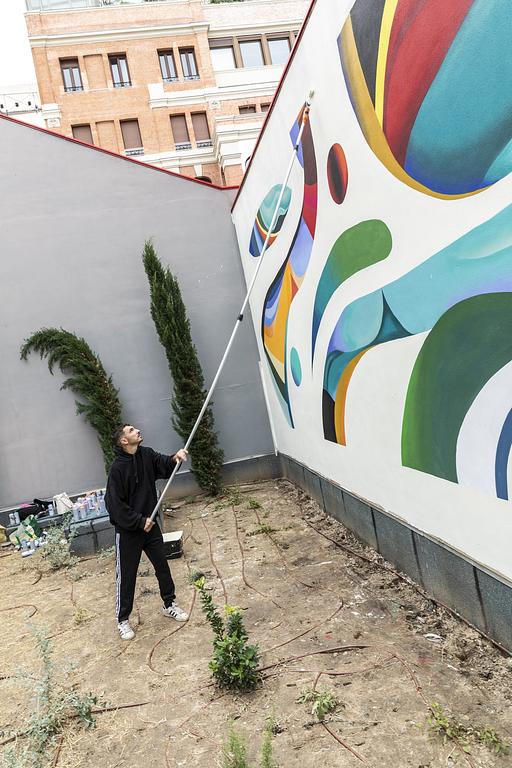
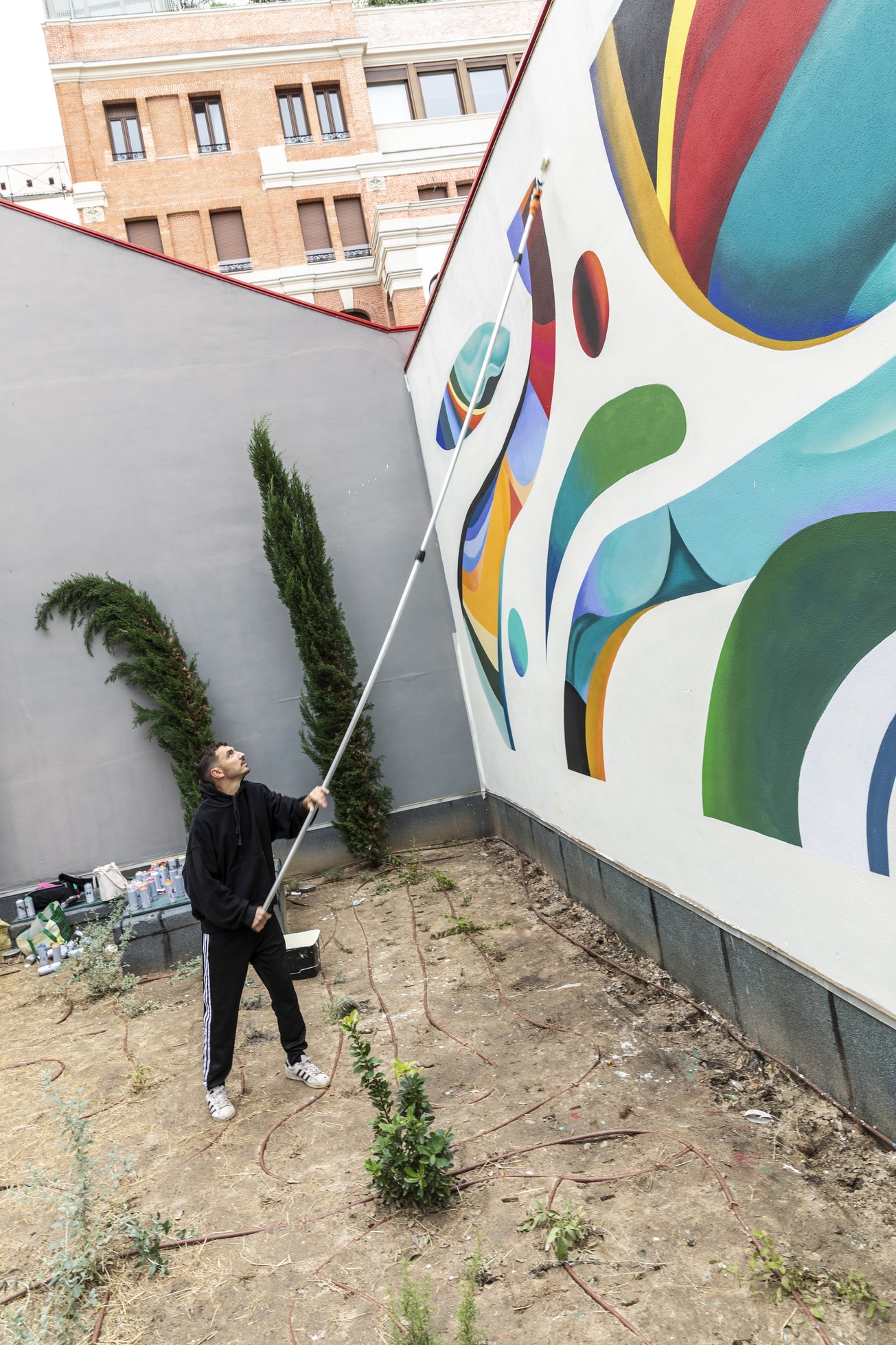
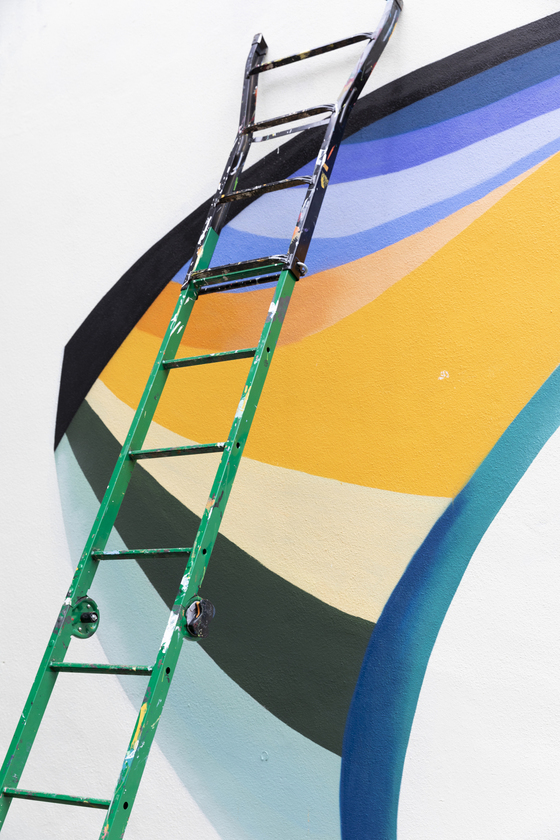
Sabek at work on the WeWork Goya terrace wall. At 5 metres high, the work required scaffolding-level access across a 17-metre span — scale that demands as much production precision as artistic skill. Photo: Ana Larrazabal.
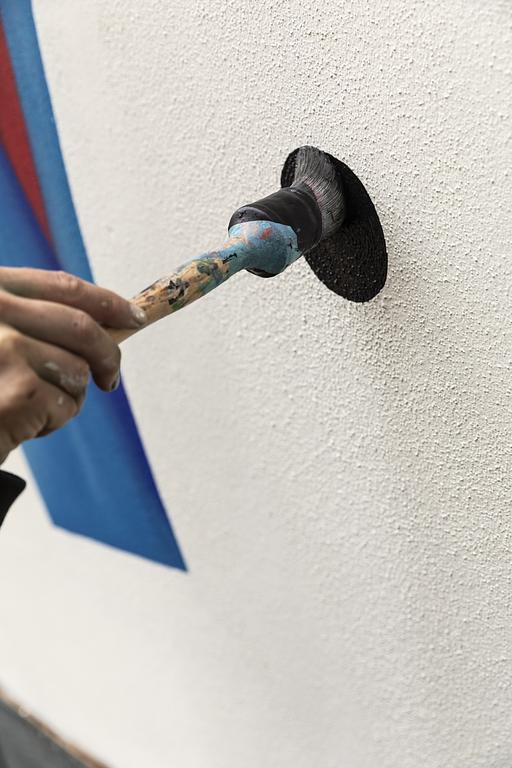
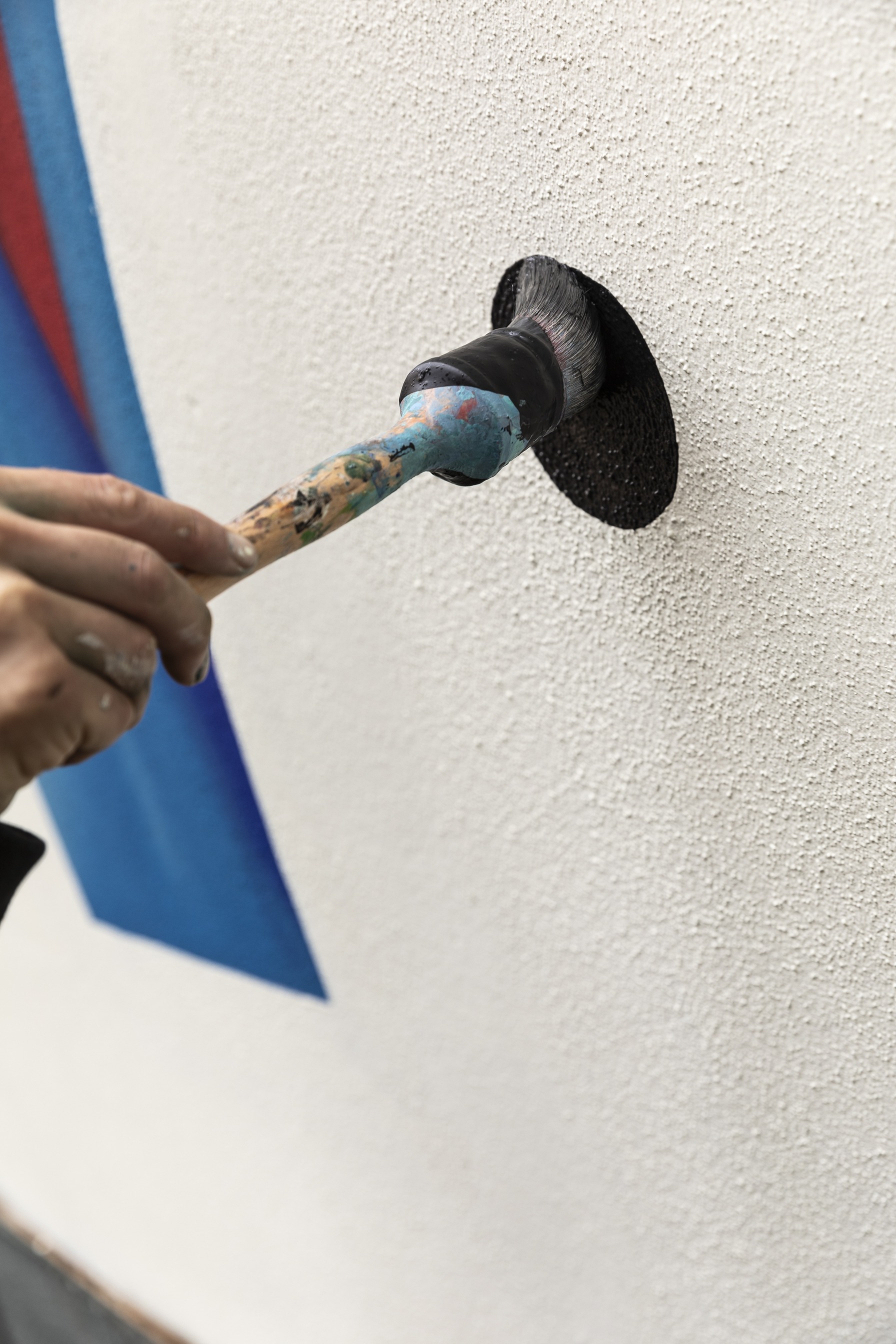
Detail of Sabek's brushwork on the WeWork wall surface. Precision at close range, as much as at distance. Photo: Ana Larrazabal.
Budget transparency from the outset was a condition of the project's smooth execution. When financial parameters are clear from the beginning, the creative conversation stays focused on the work — not on managing expectations mid-process.
The Outcome: A Space That Works Differently
The completed installation changed how the WeWork Madrid terrace functions. It became a destination rather than an amenity — a space members and visitors actively engage with, that generates conversation, that gives the location a specific identity distinct from every other WeWork in the network.
This is the spatial business case for cultural brand building, made concrete. The work doesn't just occupy the wall. It activates the space around it. It changes how long people stay, how they feel while they're there, what they say about the place when they leave.
The completed work at WeWork Goya, Madrid. A large-scale commissioned piece that transformed a terrace into the location's most distinctive spatial asset. Photo: Ana Larrazabal.
For WeWork, whose competitive differentiation depends entirely on the quality of the environments they create, that outcome is not peripheral to the business. It's the business.
What This Project Demonstrates About Cultural Brand Building
The WeWork Madrid project is a useful case study not because the outcome was beautiful — though it is — but because the process was strategic.
Cultural brand building in corporate spaces works when three conditions are met: the right collaborator is selected with precision, not convenience; creative latitude is offered as a strategic decision, not a reluctant compromise; and the project is managed with the same rigour applied to any significant business investment.
When those conditions are in place, the return extends well beyond the wall. The space earns a different kind of attention. The brand earns a different kind of credibility. And the work — made with genuine craft and creative ownership — earns a permanence that no campaign can manufacture.
Work in progress. Photo: Ana Larrazabal.
Related creative stories
Browse through other features, interviews and guides to discover creative brand collaborations, meet innovative artists and creators, find out how new artforms are energizing advertising, & more.
We're excited to hear from you! If you're looking for artistic solutions for your next creative marketing campaign, send us your briefing. We can also help create a killer concept if you're in an early ideation phase. Check out our services for more.
Send your briefing
About you
THANK YOU
Your inquiry has been sent
We have received your inquiry. We'll get back to you within 24-48 hours to discuss your project. If you need urgent assistance, reach us on WhatsApp: +49 176 432 64506. In the meantime, we invite you to explore our insights, case studies, and lessons from building culturally grounded brand experiences.
Please contact us by phone if you're not able to reach us via this form.
THANK YOU
We have received your inquiry. We'll get back to you within 24-48 hours to discuss your project. If you need urgent assistance, reach us on WhatsApp: +49 176 432 64506. In the meantime, we invite you to explore our insights, case studies, and lessons from building culturally grounded brand experiences.
We use cookies to help empower our artists and make them accessible to clients. Check out our Privacy Policy and Terms of Service to see how your data can make a difference.