Live sketching brand activation turns a retail moment into a cultural one. Here's why leading brands use live art to earn attention — and drive results.
When the Purchase Becomes the Experience
Most in-store activations ask customers to notice a brand. Live sketching brand activations ask them to participate in one — and that difference is worth more than any promotional display.
When Biotherm wanted to introduce their Les Eaux Parfums fragrance collection across Germany, they didn't add a sampling station or run a discount mechanic. They turned Douglas stores in Frankfurt, Metzingen, and Berlin into live creative spaces, deploying sketch artists over two consecutive weekends to create personalized, fragrance-specific artwork on tote bags — on the spot, in front of the customer, for the customer.
The result was a retail touchpoint that customers didn't passively receive. They witnessed it being made for them. That shift — from transaction to cultural moment — is what separates a brand activation that earns attention from one that simply demands it.
Live sketching transforms a product purchase into a witnessed creative act — a moment customers are far more likely to remember, share, and return for.
Why Live Art Works as a Brand Touchpoint
Research consistently shows that 91% of customers feel more positive about a brand after actively participating in a brand activation or experience. Live sketching goes one step further: it doesn't just involve the customer — it produces something made specifically for them, in real time, tied directly to the product they've just chosen.
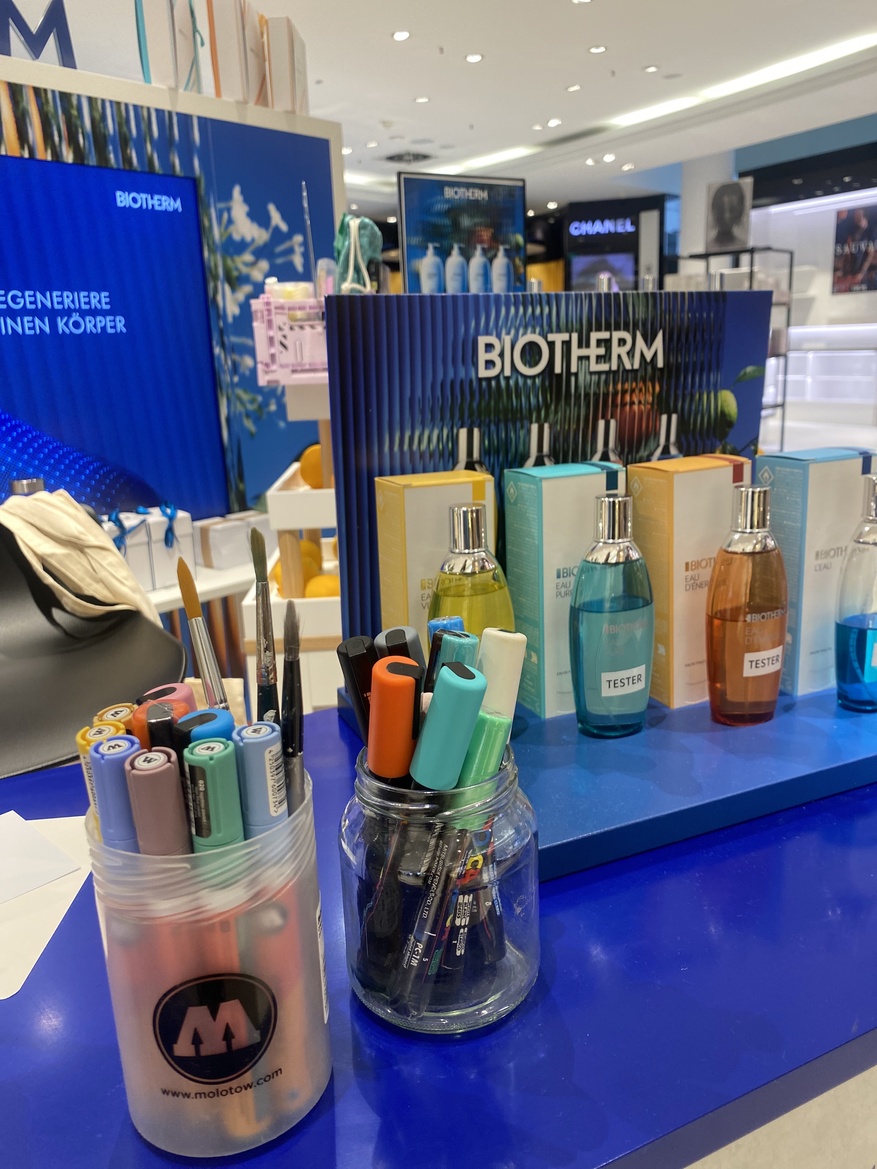
The artist's station at the Biotherm activation inside Douglas — markers, brushes, and the full Les Eaux Parfums collection within reach. The setup signals craft before a single bag is drawn.
That combination — personalization, craft, and immediacy — creates a sensory memory that generic retail mechanics cannot replicate. The customer doesn't leave with a branded pen or a discount voucher. They leave with a one-of-a-kind object that carries both the brand's identity and the record of a specific moment in a specific place.
For premium and luxury brands in particular, this matters. 74% of consumers say that engaging with branded event marketing experiences makes them more likely to buy the promoted products— but the quality of the experience shapes whether that purchase intention compounds into loyalty or fades by the following week. A live sketching activation, executed with genuine artistic craft and clear brand alignment, is designed to compound.
The Strategic Logic Behind the Biotherm Activation
What made Biotherm's activation a case study rather than just an event was the structural thinking behind it. Each decision — from artist selection to campaign duration to the final sensory flourish — served a strategic purpose.
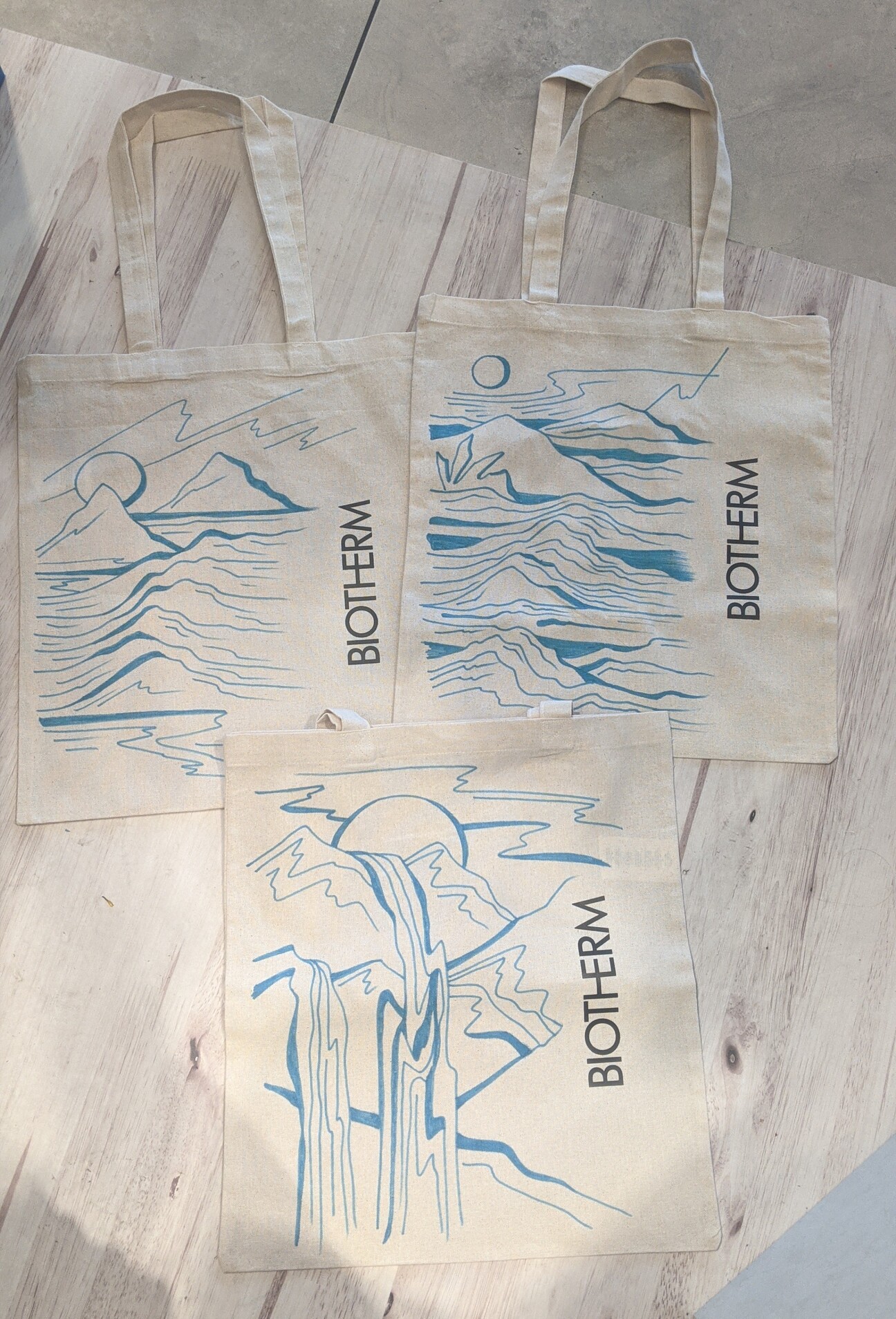
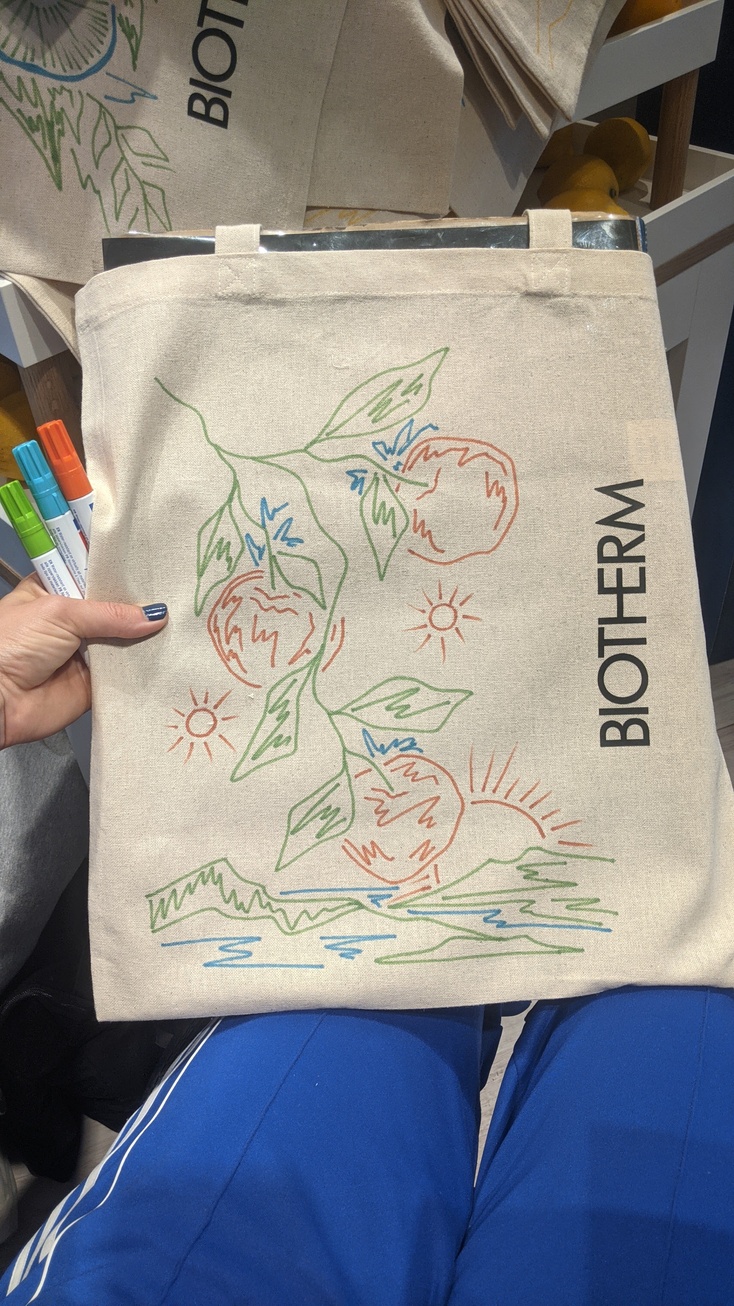
Three tote bags, three distinct compositions — each sketched live at the Douglas activation by Bold Lemon. The variation within a consistent visual language is what separates a briefed artist from a templated execution.
Fragrance-led creative direction. Each of the four fragrances in the Les Eaux Parfums collection had a defined sensory profile. Artists were briefed on each scent's character — citrus and energy for Eau d'Energie, pure freshness for L'Eau — and their sketches reflected those qualities rather than applying a generic visual style across all products. The artwork became a translation of the fragrance, not just a decoration.
Multi-city, multi-weekend structure. Rather than concentrating the activation into a single-day event, Biotherm extended it across two weekends in three cities. This was not a logistics convenience — it was a strategic choice. A sustained presence builds word-of-mouth between weekends, gives customers who missed the first opportunity a second chance, and signals to the market that this is not a stunt but a considered brand moment.
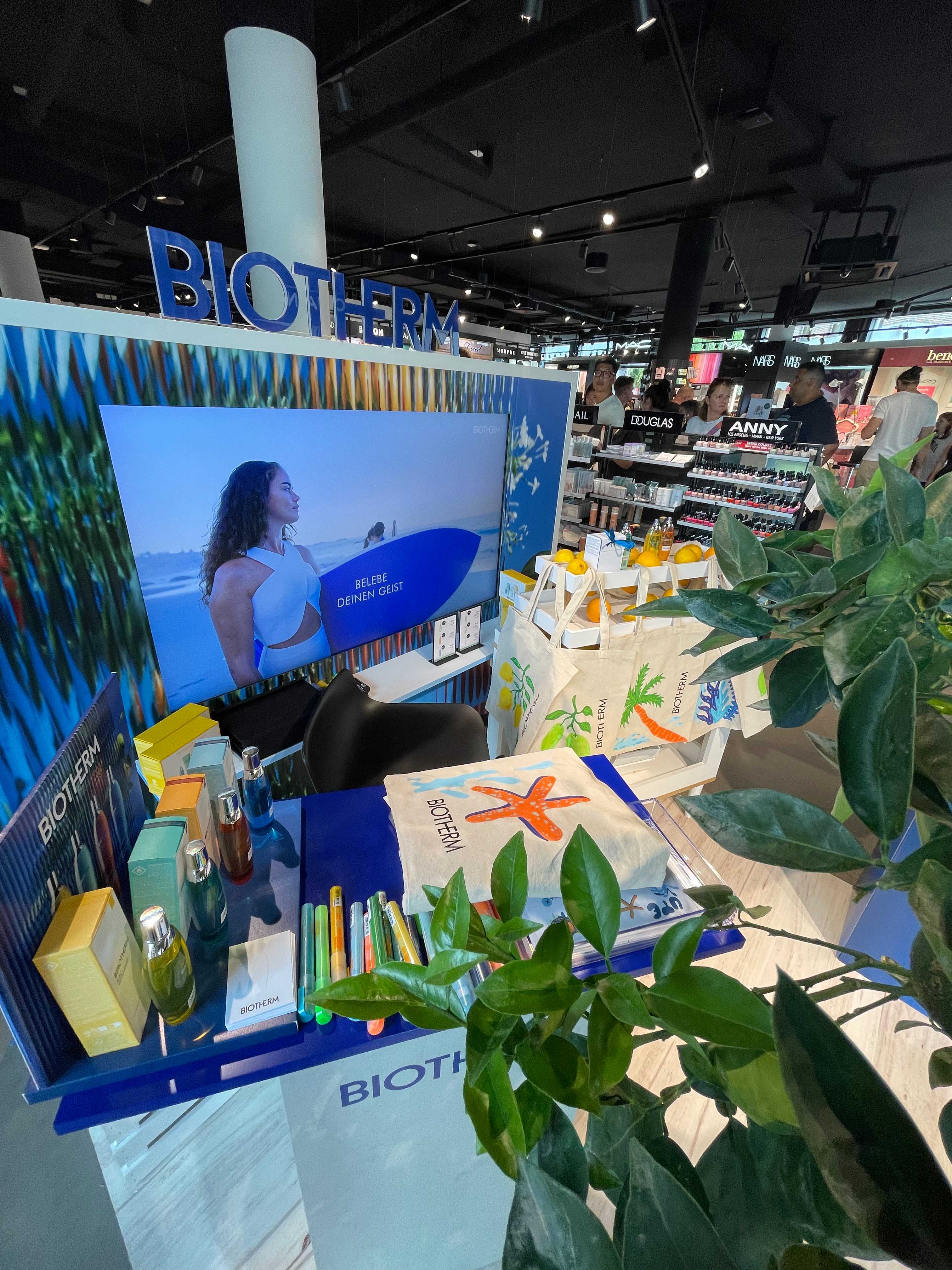
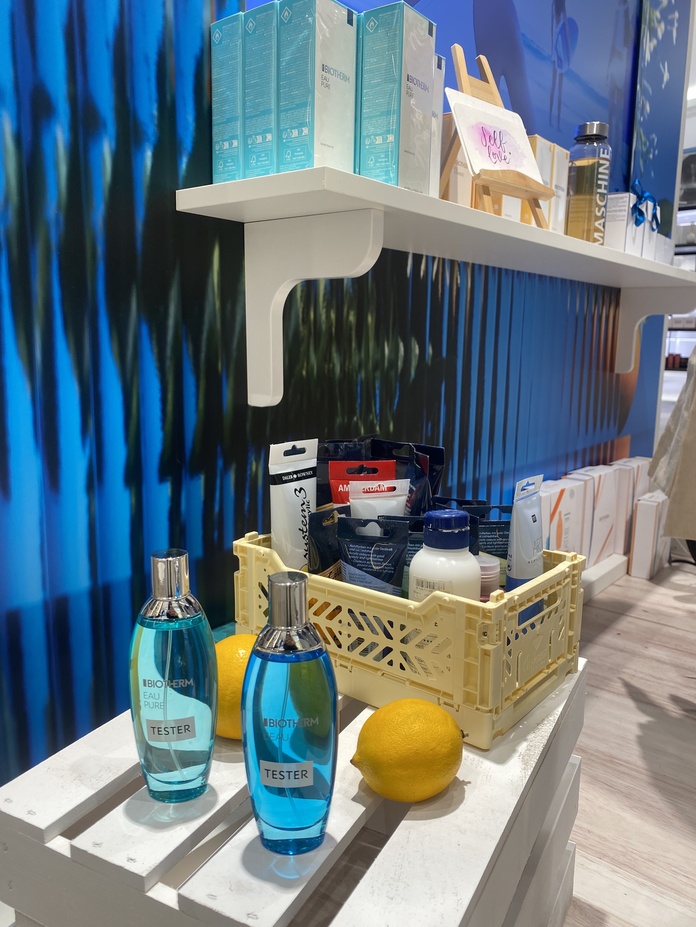
Biotherm's Eau Pure display at the Douglas activation — citrus props alongside the fragrance tester. The visual brief the artist worked from was right there on the counter.
Local artist selection. Working with artists embedded in each city — Gamze Yalcin in Berlin, Bold Lemon in Frankfurt, Julia Michel and Casiegraphics in Metzingen — ensured that each location carried its own creative character while maintaining overall brand coherence. It also eliminated unnecessary travel costs and kept the activation's energy consistent across all event days.
The multi-sensory close. After completing each tote bag, the artist spritzed it with the corresponding fragrance. It's a small gesture, but strategically it closes the experiential loop: the object the customer takes home carries not just the visual memory of the activation but the scent of the product itself. The touchpoint extends beyond the store.
Each tote bag was sketched to reflect a specific fragrance profile — translating a scent into a visual object the customer takes home.
What Brand Managers Get Wrong About Live Art Activations
The most common failure mode for live sketching events for brands is treating the artist as a service provider rather than a creative collaborator. When artists are briefed at the last moment, given no brand context, and expected to simply execute a predefined visual template, the result reads exactly like what it is: a hired hand filling time.
The Biotherm model worked because the artist collaboration was structured differently. Artists received brand materials and fragrance briefings two to three weeks before the activation. Some items were pre-sketched to ensure immediate availability when the first customers arrived. The artists were not executing a template — they were interpreting a sensory brief with their own creative intelligence. That distinction is visible in the finished work, and customers can feel it.
For any brand considering a live sketching brand activation, the investment in proper artist briefing and preparation time is not a logistical nicety — it is what determines whether the experience carries cultural substance or collapses into gimmick.
The In-Store Touchpoint That Keeps Working After It Ends
One of live sketching's most undervalued business outcomes is what happens after the event closes. The tote bag, the illustrated card, the sketched packaging — these objects leave the store with the customer and continue to function as brand touchpoints for weeks or months afterward.
For brands investing in in-store brand activations, the question is not just what happens in the store on the day. It is what artifact the customer carries out, and what story that artifact continues to tell.
The sketched object leaves the store and becomes a brand touchpoint in its own right — continuing to work long after the activation ends.
Planning a Live Sketching Activation: What Actually Matters
For marketing directors evaluating a live sketching brand activation, the strategic checklist is shorter than most agency decks suggest — but each point is non-negotiable.
Creative alignment before aesthetic appeal. The artist's style should serve the brand's identity, not override it. The question is not who makes the most impressive work in isolation, but whose sensory vocabulary most naturally extends the brand's own.
Briefing depth determines output quality. Allow a minimum of two to three weeks for artist preparation — concept review, sample creation, and brand alignment. Activations that skip this produce work that looks assembled rather than considered.
Duration over intensity. A single-day event creates a spike. A multi-weekend activation builds momentum and maximizes the number of genuine brand interactions across the target market.
The full sensory loop. Every touchpoint in a live sketching brand activation — the setting, the artist interaction, the object produced, and what the customer carries away — should be designed as part of a coherent experience, not as separate logistics decisions.
Measure what the artifact does, not just what the event does. Track social sharing, repeat purchase, and customer return rate from activation participants. The event is the beginning of the measurement window, not the end.
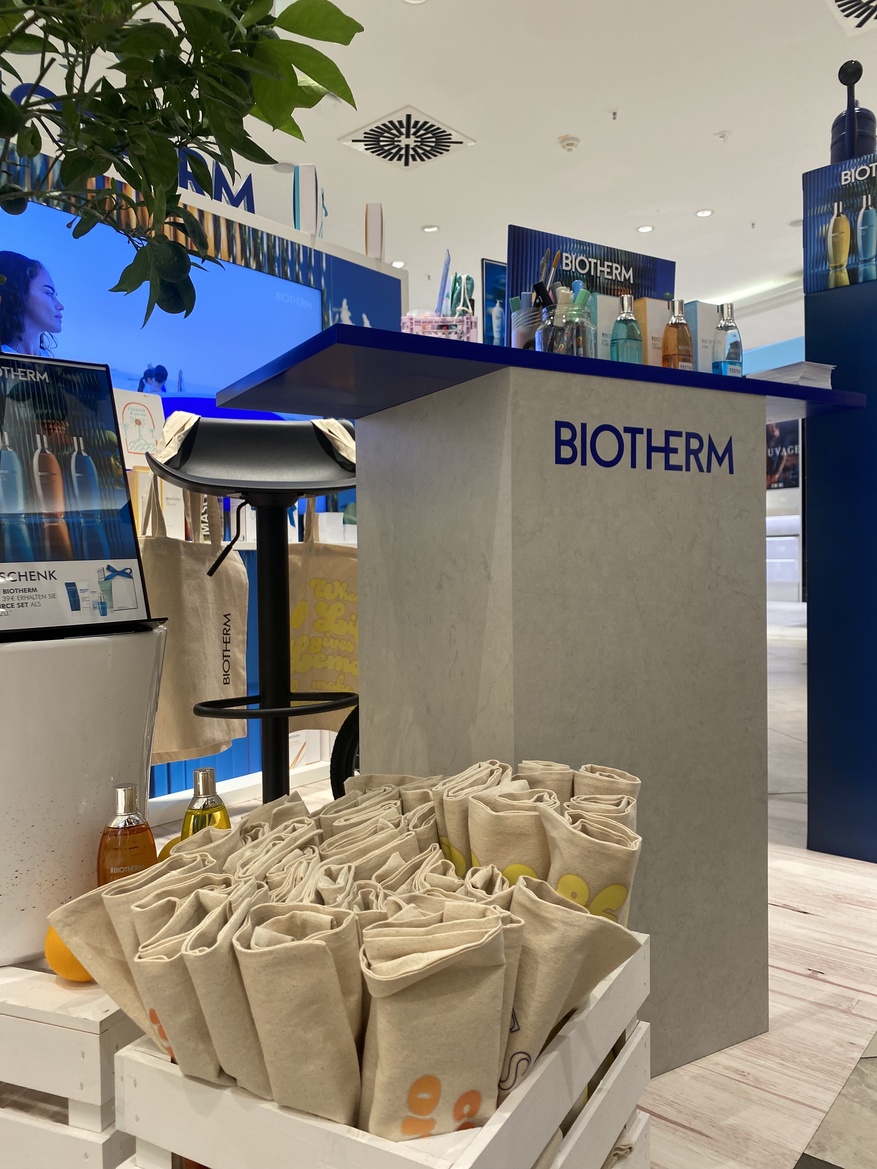
Pre-rolled blank tote bags staged at the Biotherm counter — a detail that reveals the preparation behind the experience. The activation begins before the artist picks up the marker.
Live Sketching as Cultural Strategy, Not Novelty
The risk with any format-driven activation is that the format becomes the idea. Live sketching brand activations fail when the brief is "let's do a live sketching thing" rather than "how do we create a touchpoint that translates our brand's sensory identity into something a customer can hold?"
The Biotherm activation worked because the format served the concept. Live art was the right medium for translating fragrance into something visual and tactile — not because sketching is a trend, but because it solved a specific brand communication problem elegantly.
That is the standard every live sketching brand activation should be held to: not "did the artist draw well?" but "did this touchpoint deepen the customer's relationship with the brand in a way that lasts?"
When the answer is yes, the activation earns its place in the broader brand experience strategy — not as a one-off stunt, but as a repeatable, scalable model for cultural depth at the retail touchpoint.
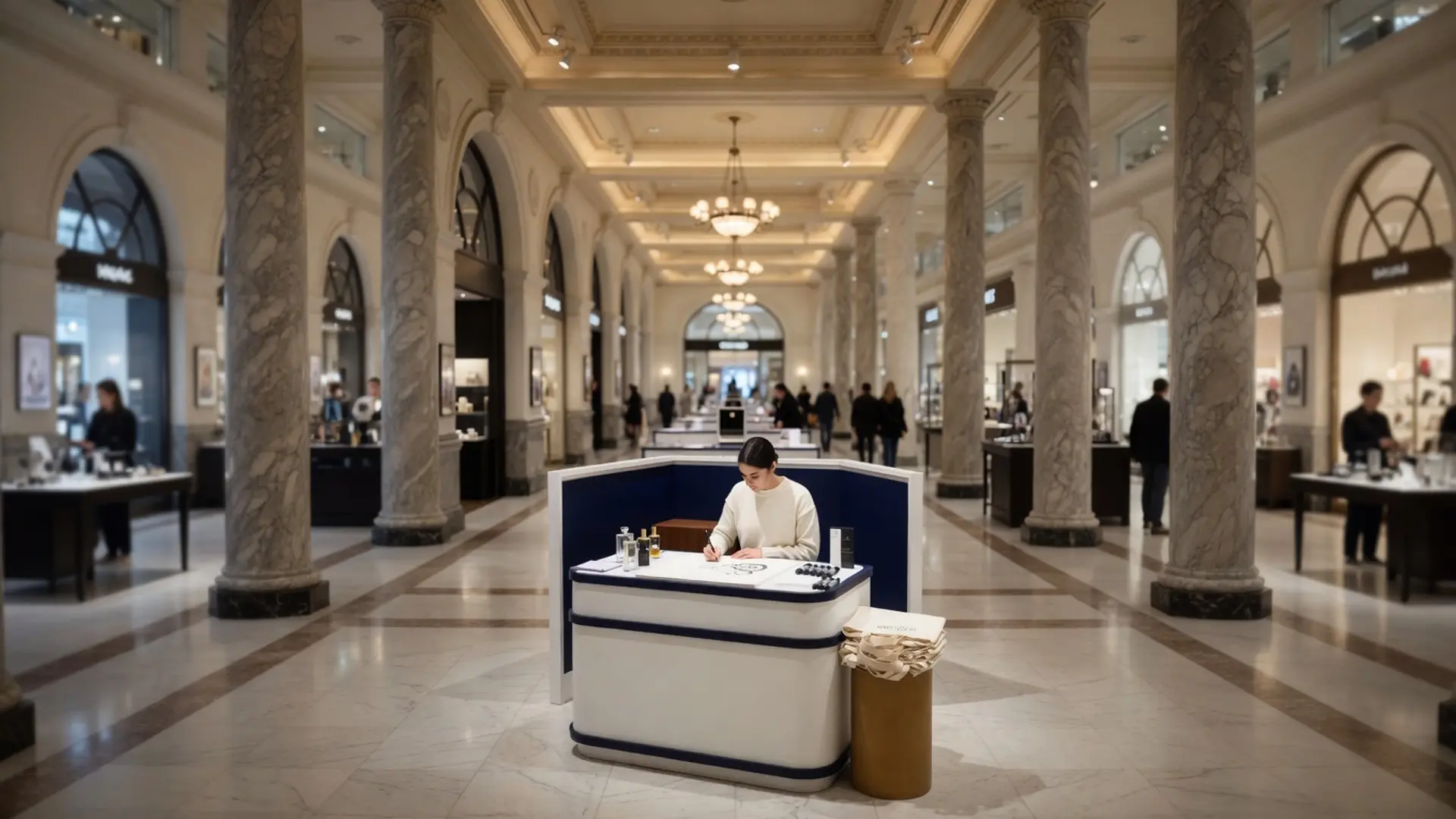
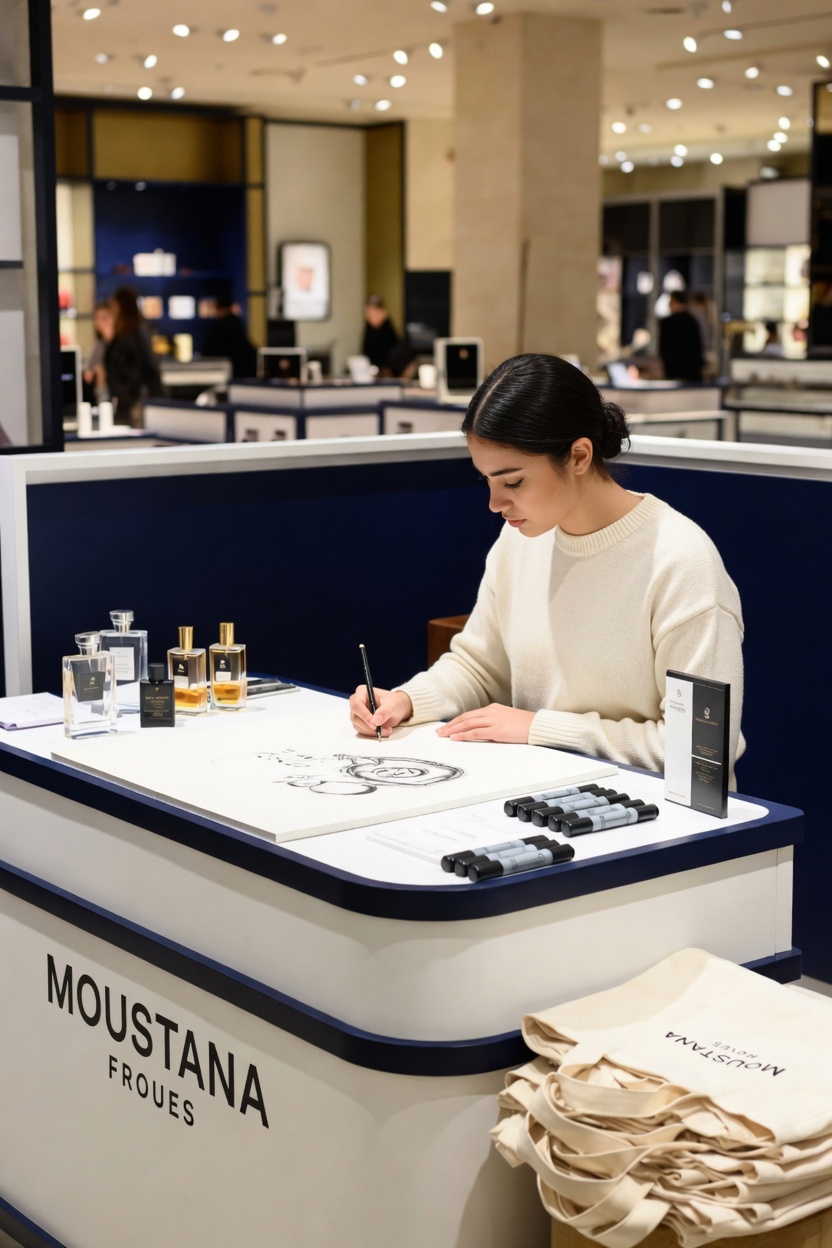
A live sketching activation at a premium fragrance counter — the format works across brands and retail contexts wherever the purchase moment needs cultural depth.
Related creative stories
Browse through other features, interviews and guides to discover creative brand collaborations, meet innovative artists and creators, find out how new artforms are energizing advertising, & more.
We're excited to hear from you! If you're looking for artistic solutions for your next creative marketing campaign, send us your briefing. We can also help create a killer concept if you're in an early ideation phase. Check out our services for more.
Send your briefing
About you
THANK YOU
Your inquiry has been sent
We have received your inquiry. We'll get back to you within 24-48 hours to discuss your project. If you need urgent assistance, reach us on WhatsApp: +49 176 432 64506. In the meantime, we invite you to explore our insights, case studies, and lessons from building culturally grounded brand experiences.
Please contact us by phone if you're not able to reach us via this form.
THANK YOU
We have received your inquiry. We'll get back to you within 24-48 hours to discuss your project. If you need urgent assistance, reach us on WhatsApp: +49 176 432 64506. In the meantime, we invite you to explore our insights, case studies, and lessons from building culturally grounded brand experiences.
We use cookies to help empower our artists and make them accessible to clients. Check out our Privacy Policy and Terms of Service to see how your data can make a difference.