Public art brand activation is one of the highest-ROI moves a brand can make in public space. Here's what Deutsche Bahn got right.
When Infrastructure Becomes a Brand Asset
Deutsche Bahn spends between one and two million euros annually cleaning graffiti from Berlin's S-Bahn stations alone. That figure doesn't include the less quantifiable cost of what urban planners in Germany call Angstraum — the fear of space that grey, deteriorating transit environments generate in commuters. Reduced footfall, negative brand association, and the compounding effect of neglect on public perception: these are real business problems. They just don't usually get solved through brand activations.
The Quality Offensive project changed that. When creative agency beMATES brought Basa Studio on board to develop a public art brand activation across three Berlin S-Bahn stations — Wedding, Frankfurter Allee, and Bornholmer Strasse — the brief wasn't about aesthetics. It was about solving a measurable urban brand problem at scale.
That distinction matters. And it's the reason this project is worth examining closely.
The Quality Offensive project transformed three Berlin S-Bahn stations through large-scale public art commissions — addressing Angstraum, vandalism costs, and community perception in a single strategic move.
The Strategic Logic Behind Public Art Brand Activation
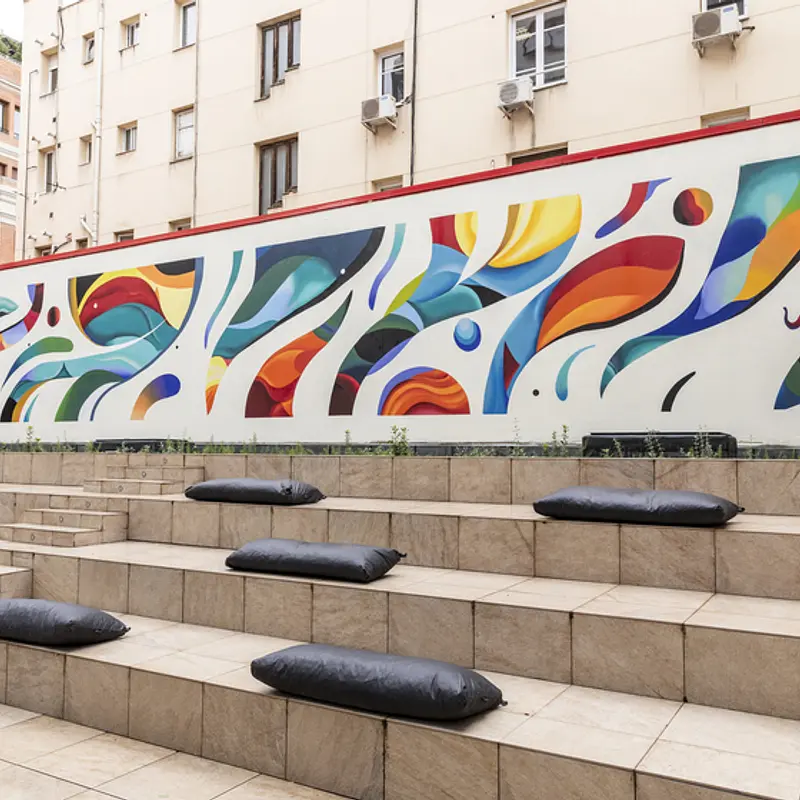
Brands operating in public space face a specific version of a familiar problem: how do you own a touchpoint you don't fully control? Transit infrastructure, urban corridors, and shared civic spaces sit at the intersection of brand territory and public territory. Most brands default to advertising formats — billboards, wraps, digital screens — that the public has become adept at ignoring.
Public art brand activation works on a different logic. It doesn't compete for attention; it earns it. A commissioned mural or spatial art intervention doesn't ask commuters to stop and look — it changes the environment so that looking becomes natural. The brand's presence is embedded in the space rather than layered on top of it.
For Deutsche Bahn, this logic had an additional commercial dimension: if a culturally significant art installation occupies the walls of a station, the calculus around graffiti vandalism changes entirely. The space becomes curated rather than neglected. Community investment shifts accordingly.
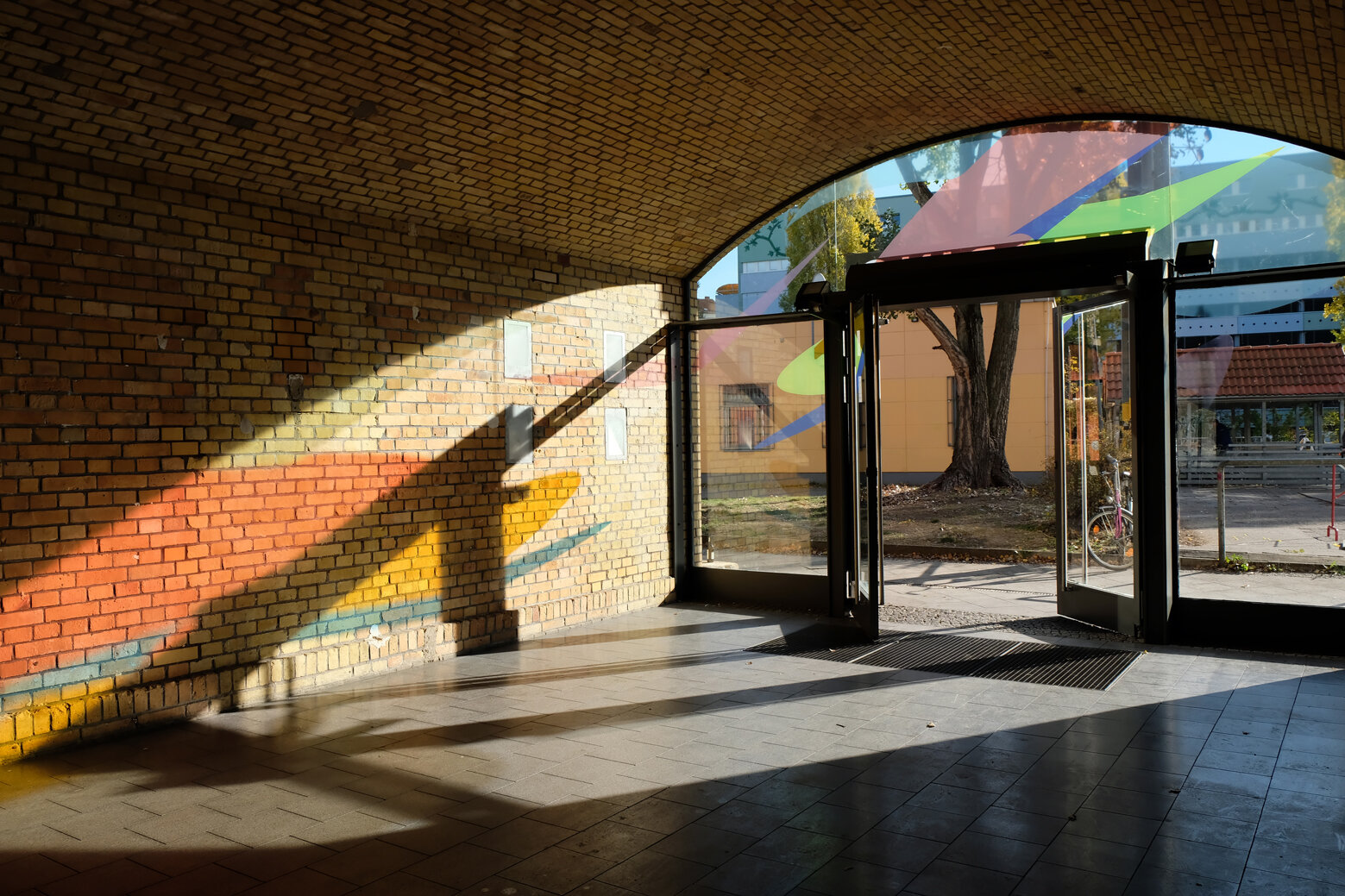
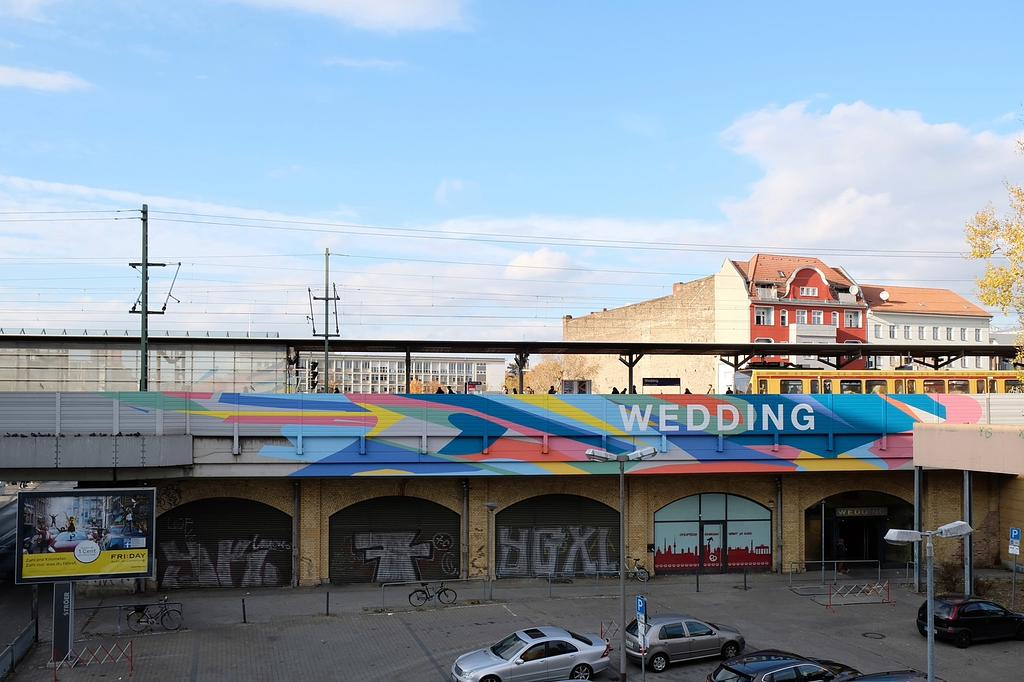
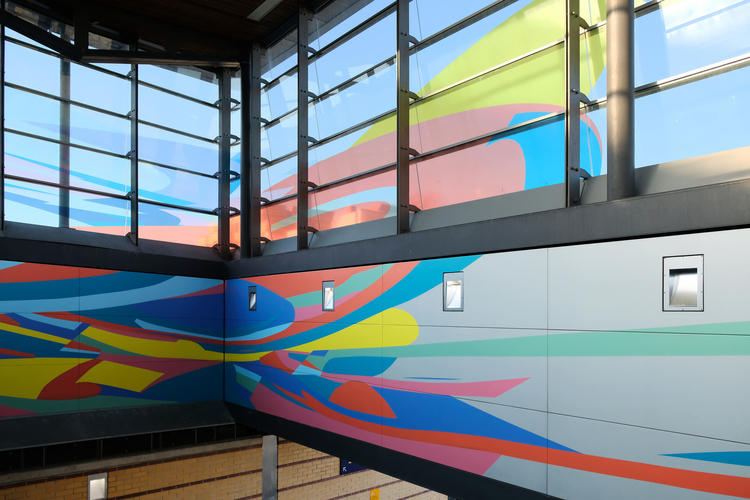
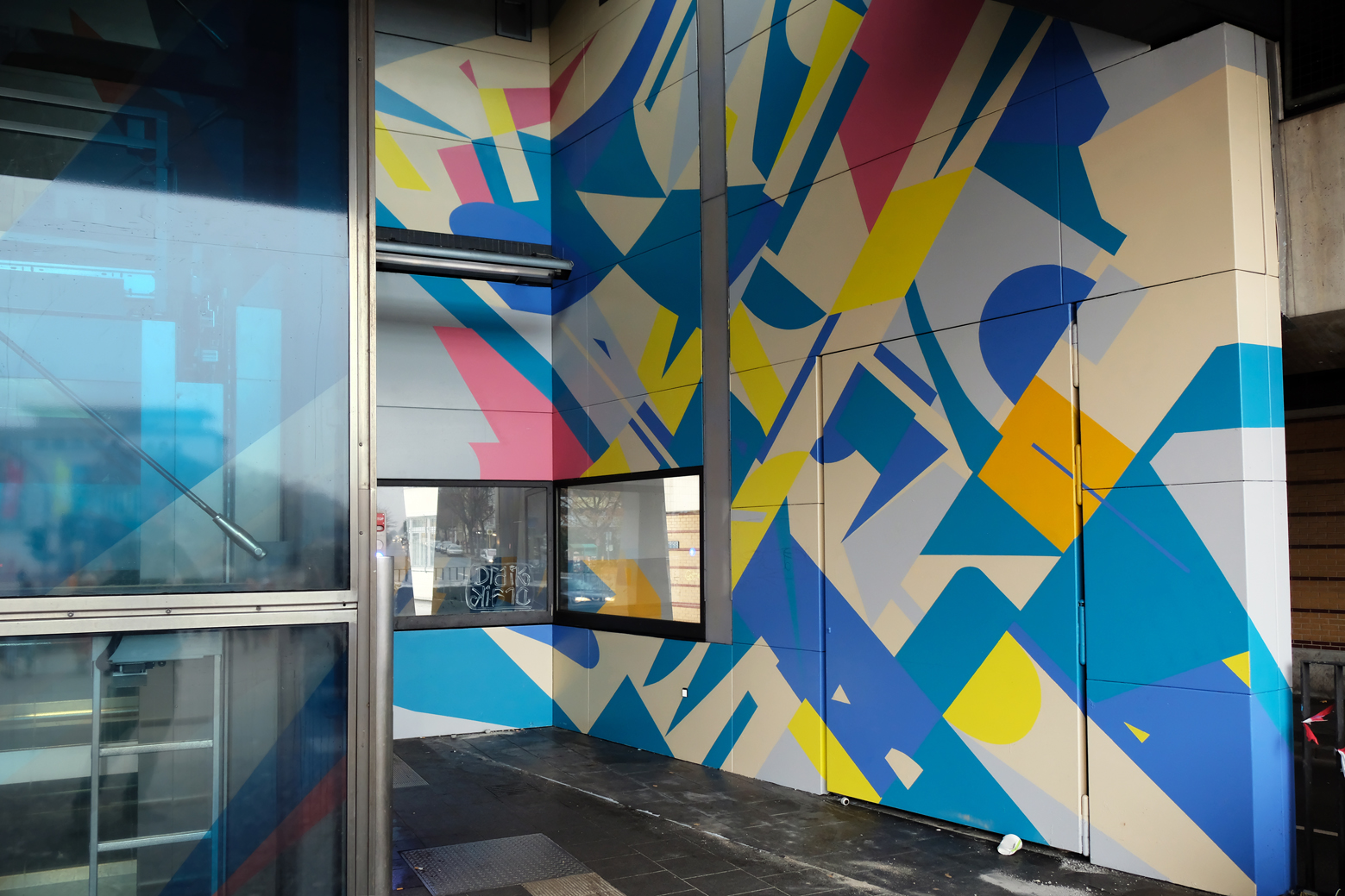
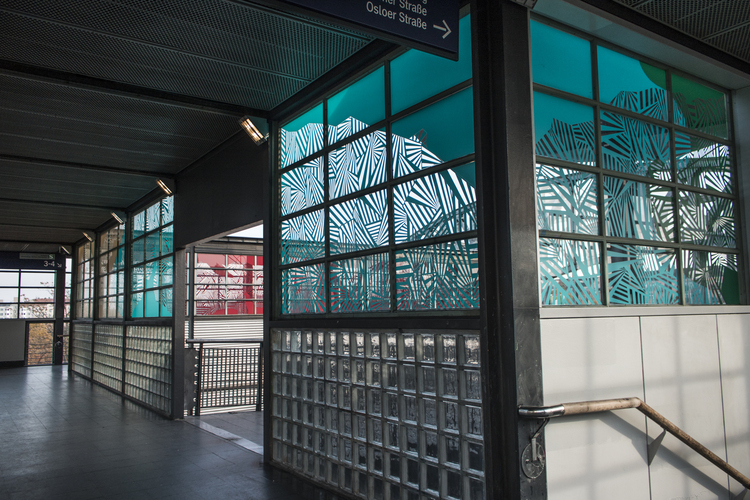
Kera's geometric forms extend across brick walls and station glass at Wedding S-Bahn station — colour and form turning a transit threshold into a curated cultural space.
Three Stations, Three Distinct Cultural Arguments
The most important strategic decision in the Deutsche Bahn project wasn't which artists to work with — it was the recognition that each station required a fundamentally different creative response.
Wedding, Frankfurter Allee, and Bornholmer Strasse are not interchangeable. They differ in architecture, in the demographic character of their surrounding neighbourhoods, and — critically — in historical meaning. Getting that wrong would have produced generic decoration. Getting it right produced what the project actually delivered: site-specific cultural interventions that local communities could recognise as their own.
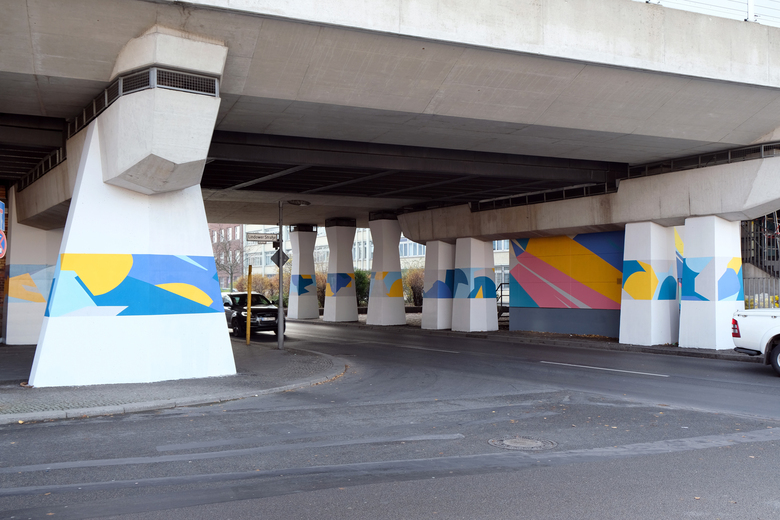
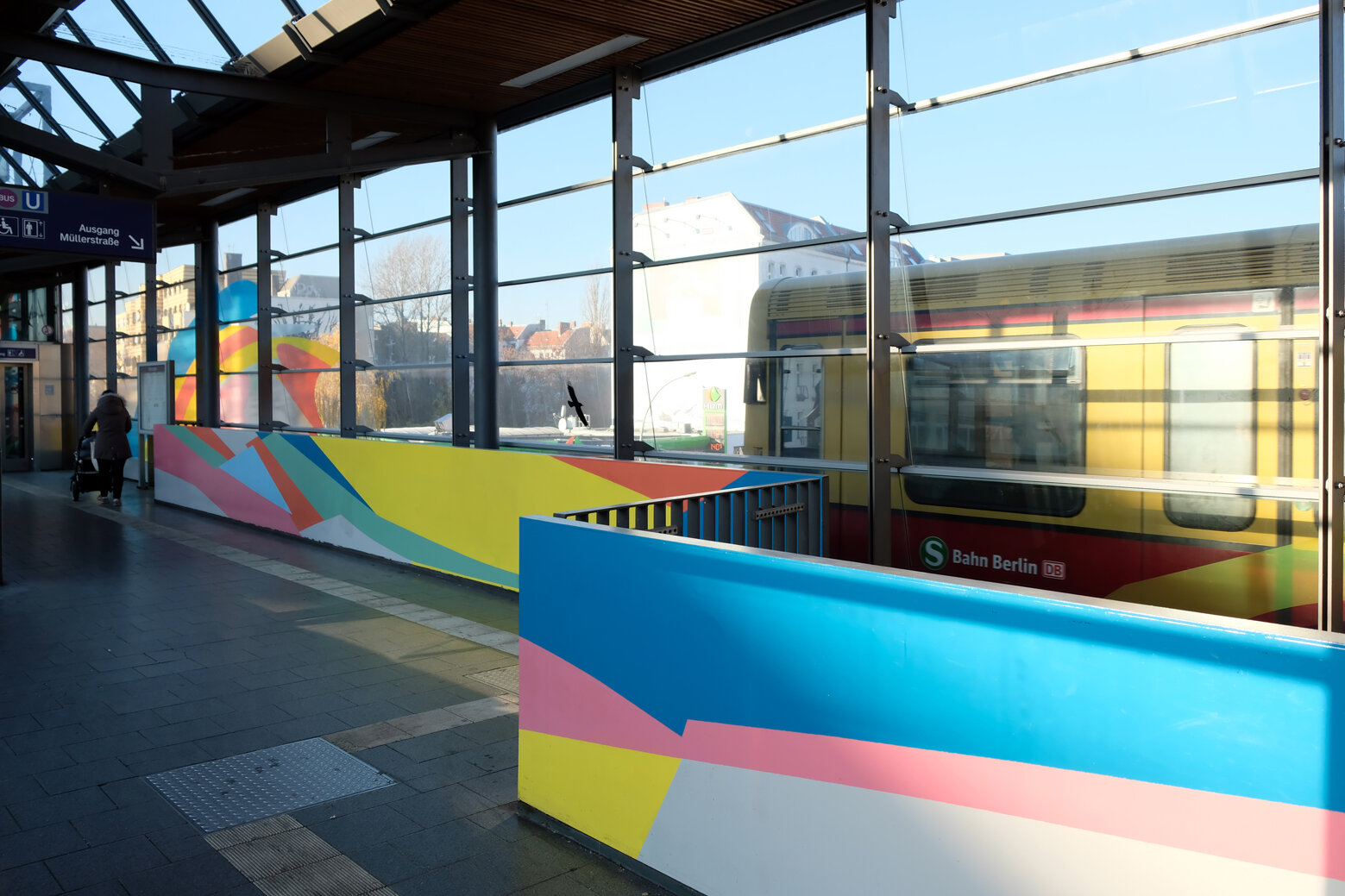
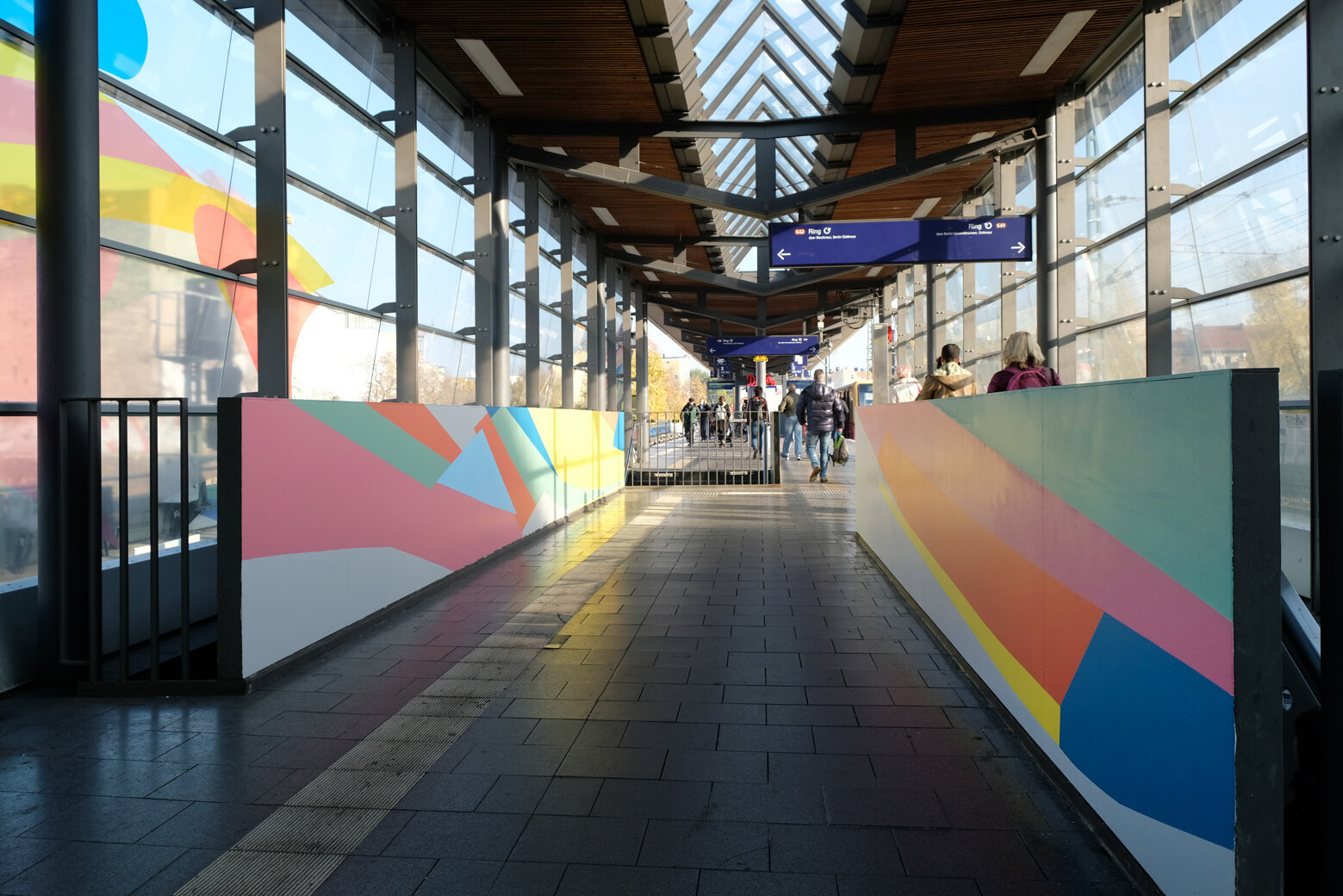
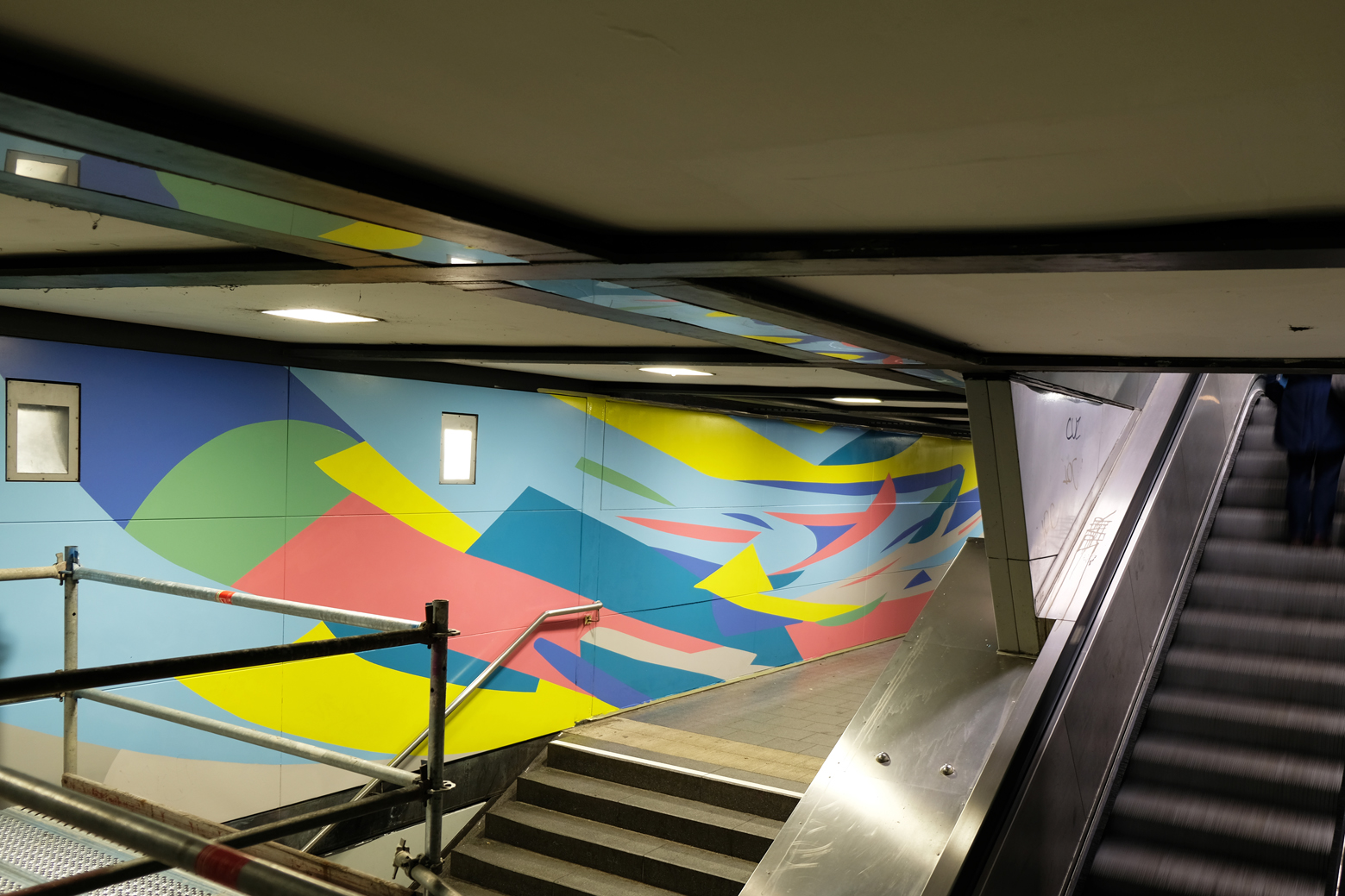
Wedding required a spatial system, not a surface treatment. Working with Berlin-based artist Kera, the approach was to use abstract geometric forms and carefully calibrated colour to create what Kera described as a guide system — abstract forms that orient commuters through the station rather than merely decorating its walls. Kera also chose deliberately not to paint over existing graffiti by local writers, a decision that signals cultural fluency rather than corporate displacement. That kind of restraint is hard to brief; it comes from integrating the right collaborator early enough that they can make those calls with authority.
At Wedding station, artist Kera developed a colour and form system that functions as spatial wayfinding — turning abstract art into an environmental guide for commuters.
Kera's geometric system extends across platform barriers and glass surfaces — colour and form integrated into the station's architecture, not applied over it.
The mural wraps both sides of the main commuter corridor — functioning as a spatial guide rather than a decorative feature.
Below platform level, the mural continues into the stairwell — transforming the station's most transient and least-considered space into a culturally anchored environment.
The mural system wraps corners and climbs into the upper glass structure — treating the station as a continuous spatial canvas rather than a series of isolated surfaces.
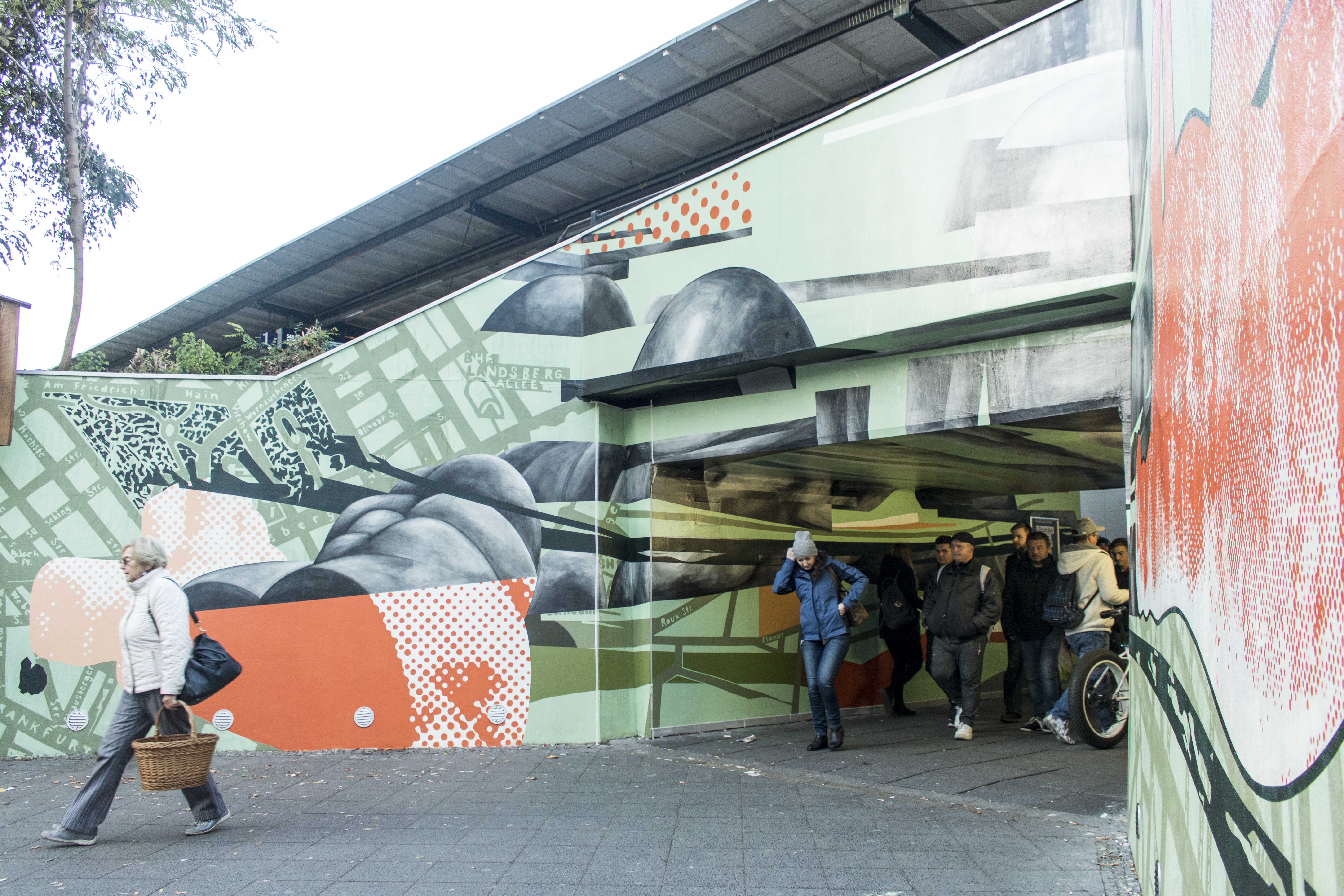
Frankfurter Allee called for a different kind of specificity: local history rendered at architectural scale. Artist Falk Land, who lives in the adjacent Friedrichshain neighbourhood, drew on the area's landmark statues and street grid to create work that reads as a portrait of place rather than a generic urban mural. The geographical connection here wasn't incidental — it was the brief. When a brand commissions public art from someone with lived proximity to the site, the resulting work carries credibility that imported aesthetics never will.
Falk working in Frankfurter Allee. Photo by Caeiro.
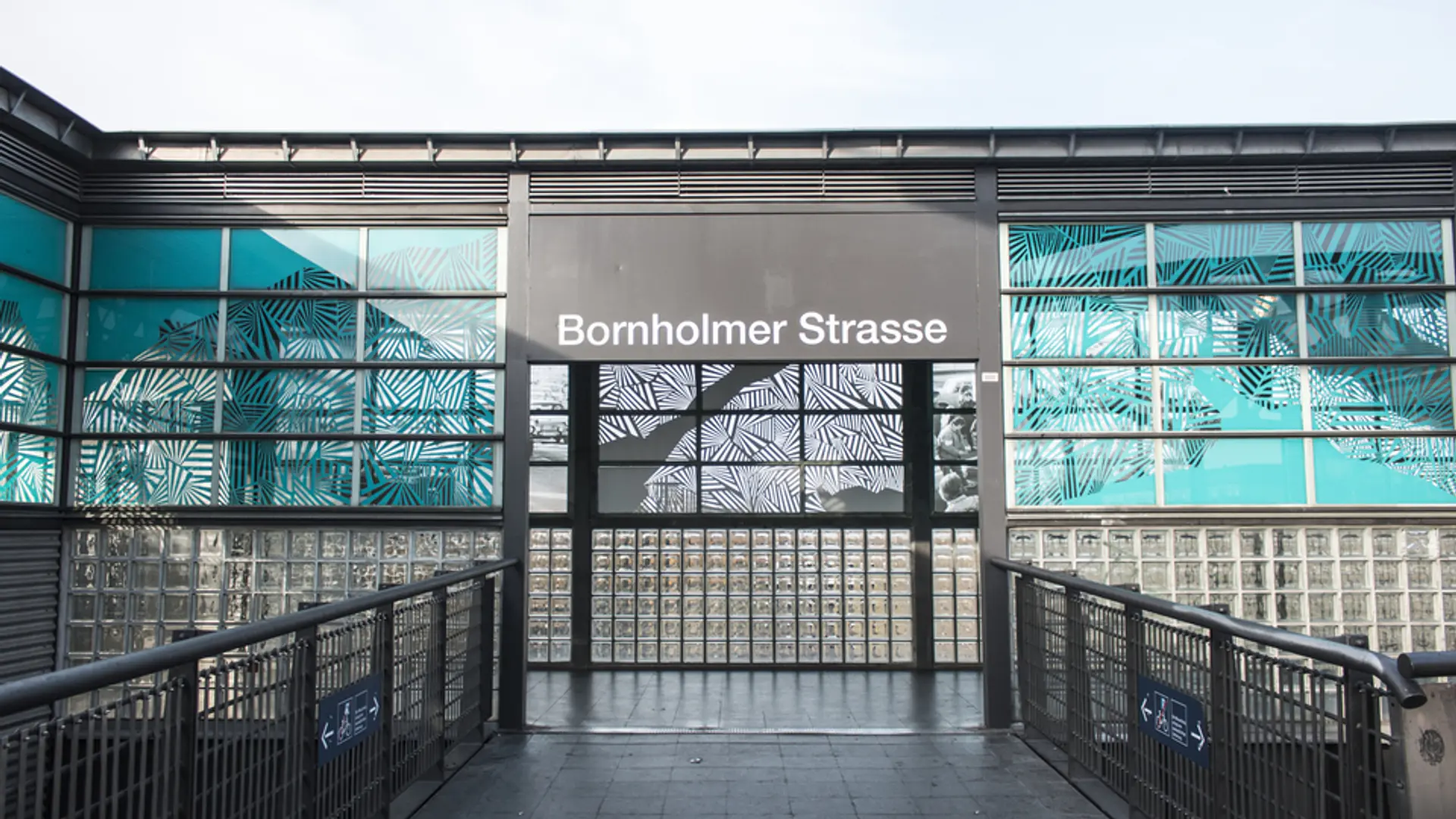
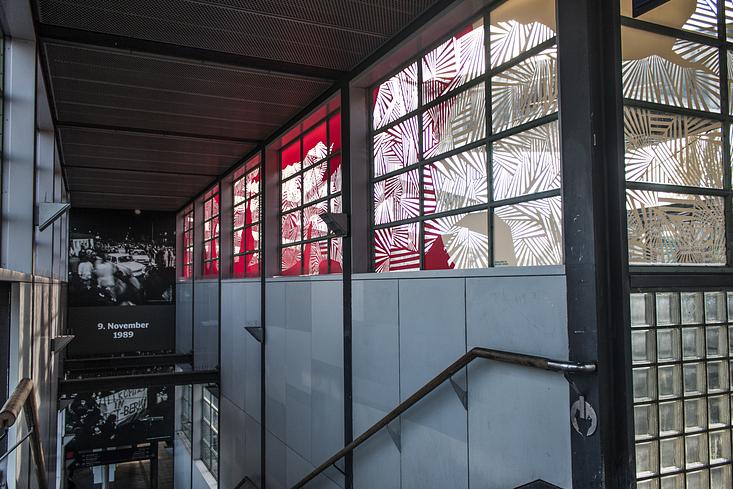
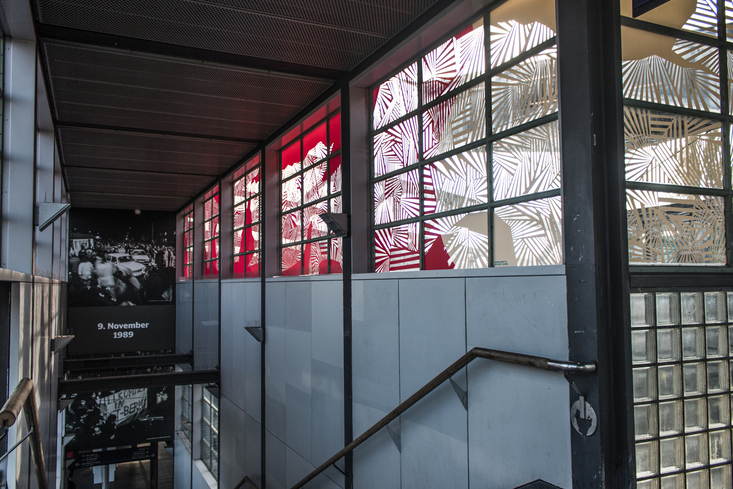
Bornholmer Strasse presented the most historically loaded context: the station was a border crossing between East and West Berlin. Artist Guillermo S. Quintana and Amanda proposed using translucent tape art that responds to the station's natural light — a medium chosen because of how sunlight would interact with it, creating shifts in visual weight across the day. The layering of translucency over a space defined by historical division is not a coincidence. It's the kind of conceptual depth that emerges when artists are invited into a brief early, rather than handed a specification at the end.
Amanda and Guillermo - 2 artists in charge of transforming one of the train stations with tape. Their artwork in the background. Photo by Caeiro.
Bornholmer Strasse's translucent tape installation changes character across the day as sunlight shifts — a formally elegant response to a station defined by historical division and transparency.
What Public Art Activation Actually Delivers
It's worth being direct about outcomes, because the business case for public art brand activation is often made vaguely — through appeals to brand love or community goodwill that don't connect to anything measurable.
The Deutsche Bahn project was designed around three concrete objectives: reducing the fear of space that was affecting commuter experience, representing the cultural character of each neighbourhood, and changing the dynamics around graffiti and vandalism costs. These are not soft objectives. They translate directly into reduced operational spend, improved commuter satisfaction data, and brand perception metrics in the surrounding communities.
Research from urban contexts consistently finds that art installations in shared public spaces generate measurable increases in perceived safety, neighbourhood aesthetic quality, and social cohesion among residents. The mechanism is not mysterious: when a space signals investment and care, the social contract around that space changes. Communities invest in spaces that invest in them.
For brands operating at the scale of Deutsche Bahn — managing hundreds of stations across a national network — that dynamic has direct financial implications. A station that communities feel ownership over is a station that requires less policing, less cleaning, and less reactive maintenance.
The Coordination Argument
One aspect of projects like this rarely discussed in brand circles: the sheer complexity of executing public art at infrastructure scale.
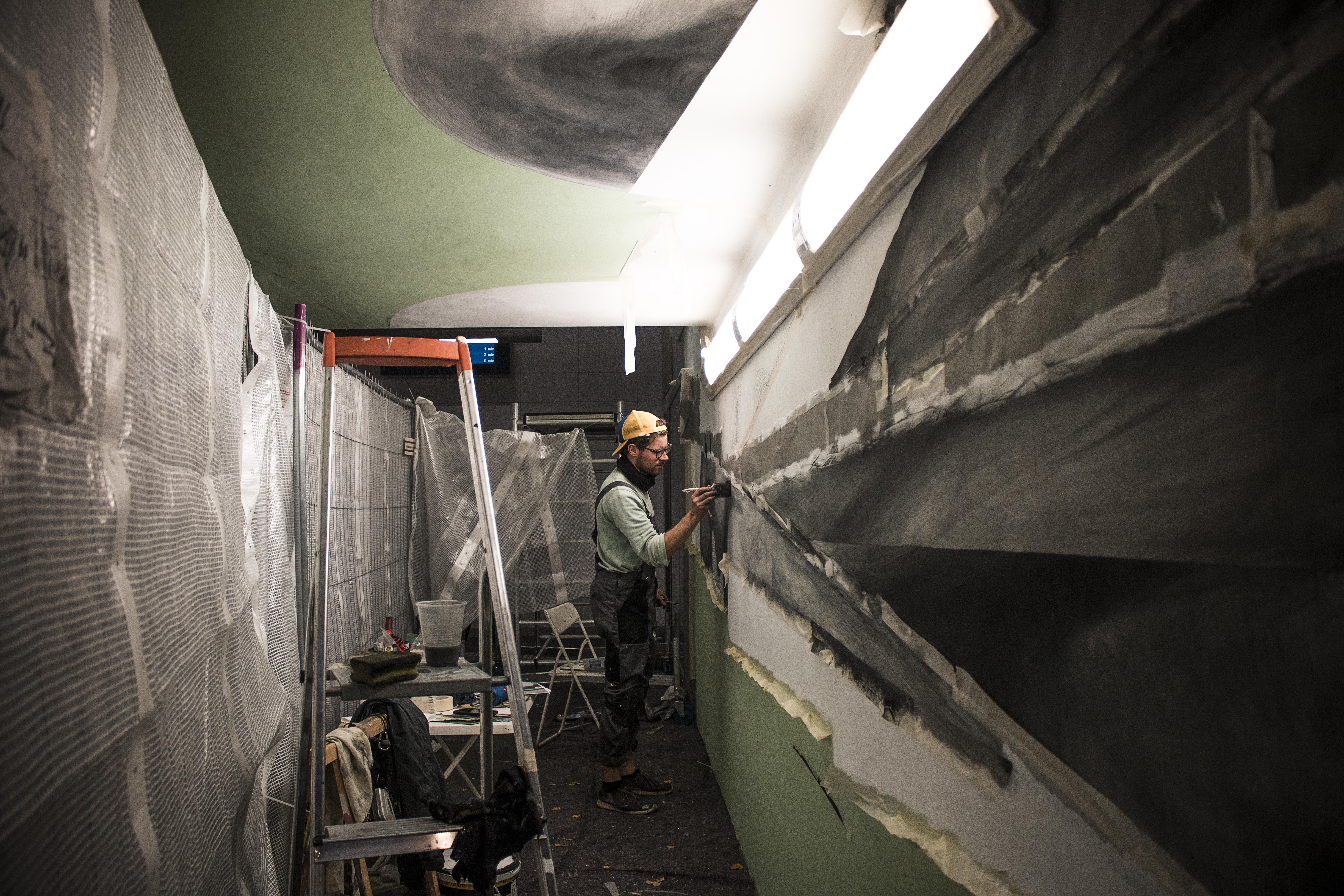
Each of the three Berlin stations required artists to work within strict operational constraints — the stations remained in use throughout — while coordinating with site managers, architects, structural engineers, and building managers simultaneously. The artists were not there simply to paint. They were part of a production system that had to integrate creative decision-making with logistical precision across multiple simultaneous workstreams.
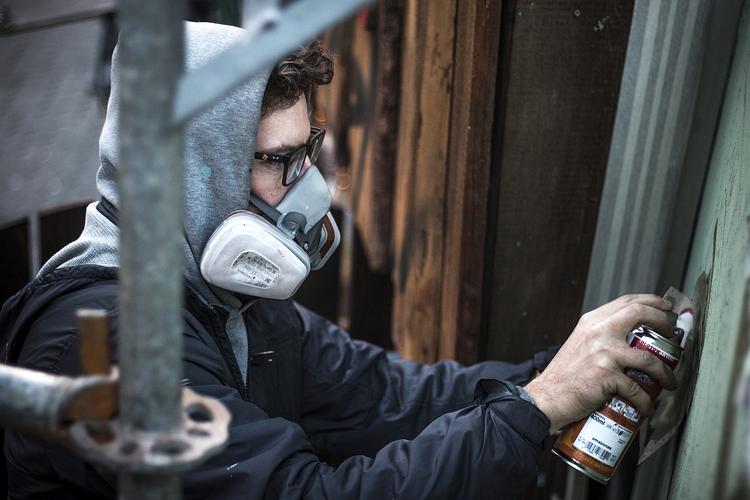
The artist working on his walls, with a protection barrier behind him.
Executing public art brand activation in active transit infrastructure requires coordinating creative decision-making with engineering constraints, safety protocols, and live operational schedules simultaneously.
This is why the model of bringing artists in at the end of a production process — as executors of a pre-decided brief — consistently underperforms. When creative collaborators are embedded from the strategic stage, they develop the contextual understanding that allows them to make fast, informed decisions on-site. Kera's choice not to paint over existing graffiti wasn't a deviation from the brief; it was a culturally intelligent decision made possible by deep project ownership. That kind of judgment cannot be scripted in advance.
Kera's beautiful wall in the Wedding strain station in Berlin.
The Longer Argument
Deutsche Bahn's Quality Offensive project is a useful case study not because it is unusual, but because it makes visible an argument that applies across brand touchpoints far beyond transit infrastructure.
Every space a brand occupies is an opportunity to earn the cultural attention of the people who move through it — or to waste that opportunity on generic decoration that no one remembers. The difference between those two outcomes is rarely about budget. It is about how early strategic and cultural thinking enters the process, and whether the brief is built around solving a real problem or producing a generic asset.
Public art brand activation works when it is treated as a strategic instrument rather than a decorative supplement. The question for brands is not whether to invest in it — it's whether the strategic thinking behind the investment is rigorous enough to earn the return.
Deutsche Bahn's art initiative transforms daily commutes into vibrant cultural experiences. Tape art station by Guillermo and Amanda. Photo: Caeiro.
Related creative stories
Browse through other features, interviews and guides to discover creative brand collaborations, meet innovative artists and creators, find out how new artforms are energizing advertising, & more.
We're excited to hear from you! If you're looking for artistic solutions for your next creative marketing campaign, send us your briefing. We can also help create a killer concept if you're in an early ideation phase. Check out our services for more.
Send your briefing
About you
THANK YOU
Your inquiry has been sent
We have received your inquiry. We'll get back to you within 24-48 hours to discuss your project. If you need urgent assistance, reach us on WhatsApp: +49 176 432 64506. In the meantime, we invite you to explore our insights, case studies, and lessons from building culturally grounded brand experiences.
Please contact us by phone if you're not able to reach us via this form.
THANK YOU
We have received your inquiry. We'll get back to you within 24-48 hours to discuss your project. If you need urgent assistance, reach us on WhatsApp: +49 176 432 64506. In the meantime, we invite you to explore our insights, case studies, and lessons from building culturally grounded brand experiences.
We use cookies to help empower our artists and make them accessible to clients. Check out our Privacy Policy and Terms of Service to see how your data can make a difference.