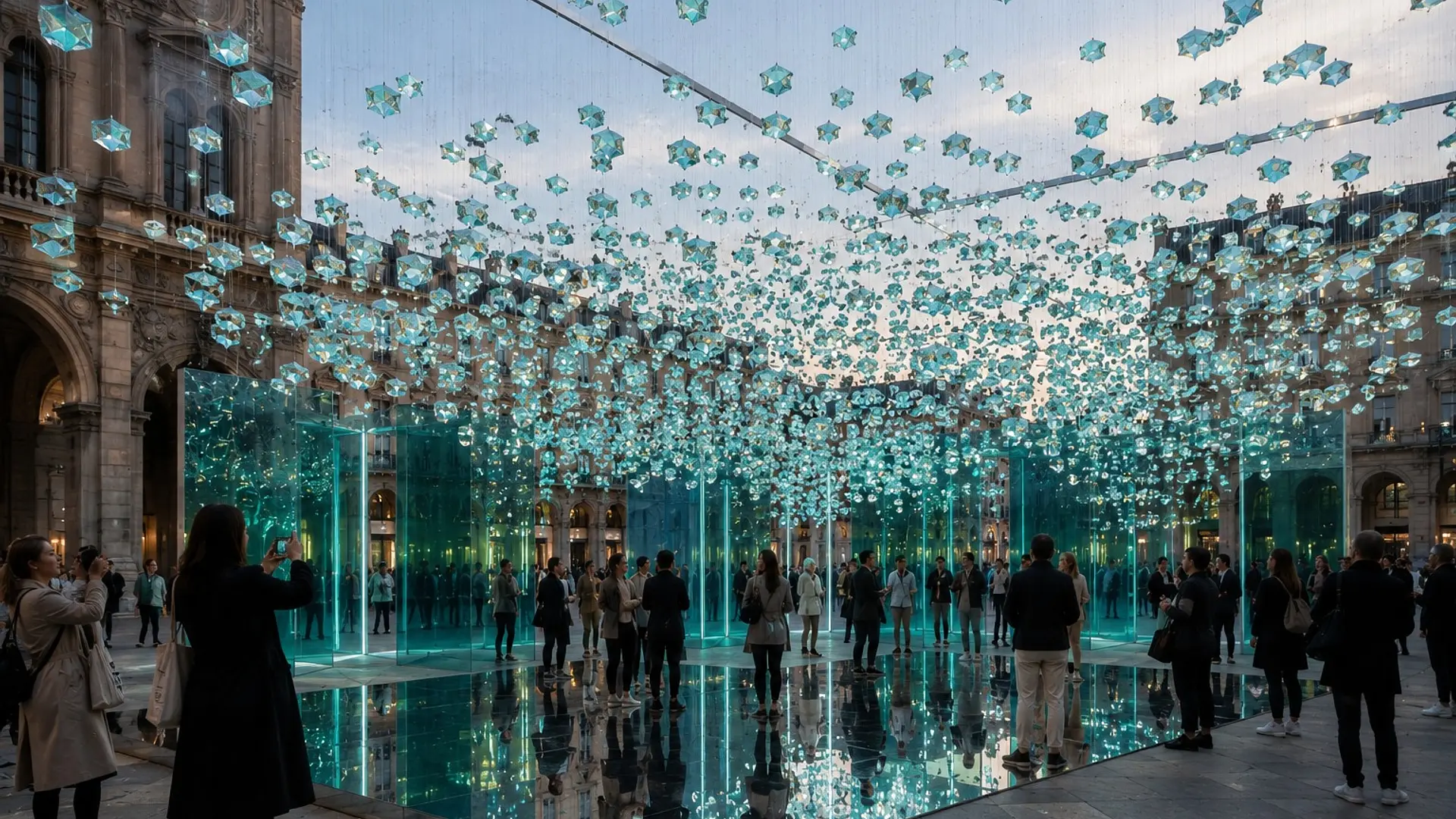
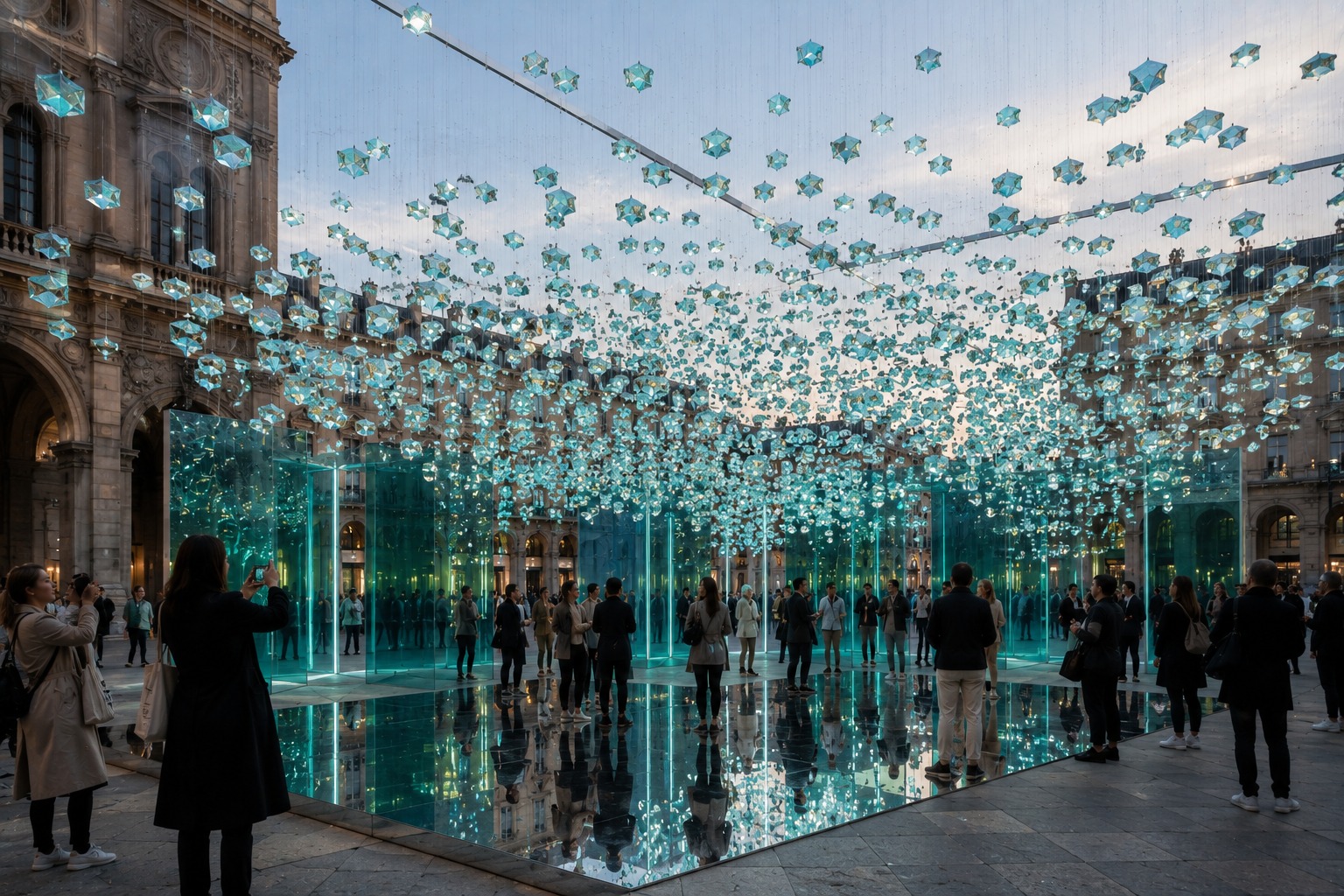
Experiential marketing is evolving fast. Here's what's changing, what's fading, and what it means for brand strategy now.
The era of experiential marketing as a novelty is over. Brands have been staging immersive activations, pop-ups, and live experiences for long enough that audiences no longer react to the format itself — they react to what's inside it. A stunning installation with nothing to say is still nothing. A technically ambitious experience with no cultural reason to exist earns a photo, maybe, and then disappears.
The question facing CMOs today is not whether to invest in experiential. That argument is settled. The question is whether the experiences they commission carry enough cultural substance to cut through a landscape where every brand, in every category, is doing something immersive.
The brands that understand this shift now will lead culture. The ones that don't will keep producing activations that feel expensive and land flat.
The most effective experiential marketing today is indistinguishable from cultural programming — because that's exactly what it is.
From spectacle to substance: the differentiator has shifted
For most of the 2010s, immersion was the metric. If an activation was big enough, surprising enough, or Instagrammable enough, it worked. That logic made sense when the format was still novel. It no longer does.
Audiences today have attended enough brand events, walked through enough pop-ups, and scrolled past enough "experiential" content to develop a finely tuned sense for when an experience is genuine and when it's manufactured. The problem isn't the production quality — it's the absence of cultural depth underneath it.
Cultural depth is what separates a brand experience that earns attention from one that merely demands it. It's the difference between commissioning an artist whose practice is genuinely aligned with a brand's values and hiring a visual style that happens to be trending. It's the difference between a spatial experience rooted in a neighbourhood's identity and a touring activation that's been replicated across twelve cities with the same layout.
The brands winning at experiential right now — in luxury, in automotive, in lifestyle — are the ones treating brand experience strategy as a long-term cultural position rather than a series of one-off moments. Each activation compounds the last. Each collaborator adds credibility to the next.
Technology is context, not content
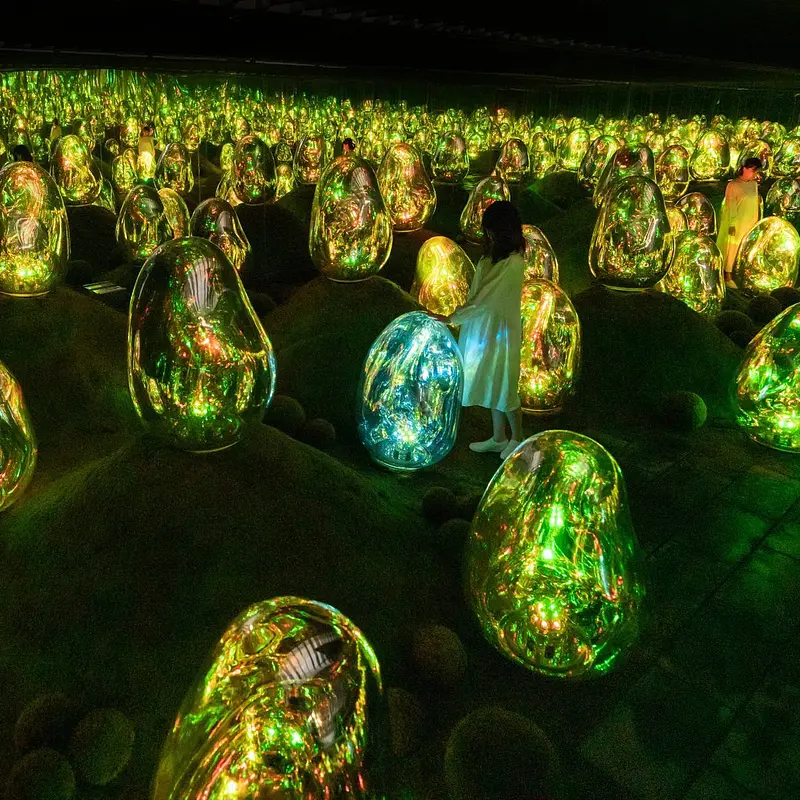
The marketing industry has a persistent tendency to treat new technology as an answer before it has identified the question. VR, AR, projection mapping, generative AI installations — each has arrived with a wave of brand activations that use the technology as the headline, and then struggle to give audiences a reason to care beyond the novelty.
Technology works in experiential marketing when it serves a cultural idea. It fails when it is the cultural idea.
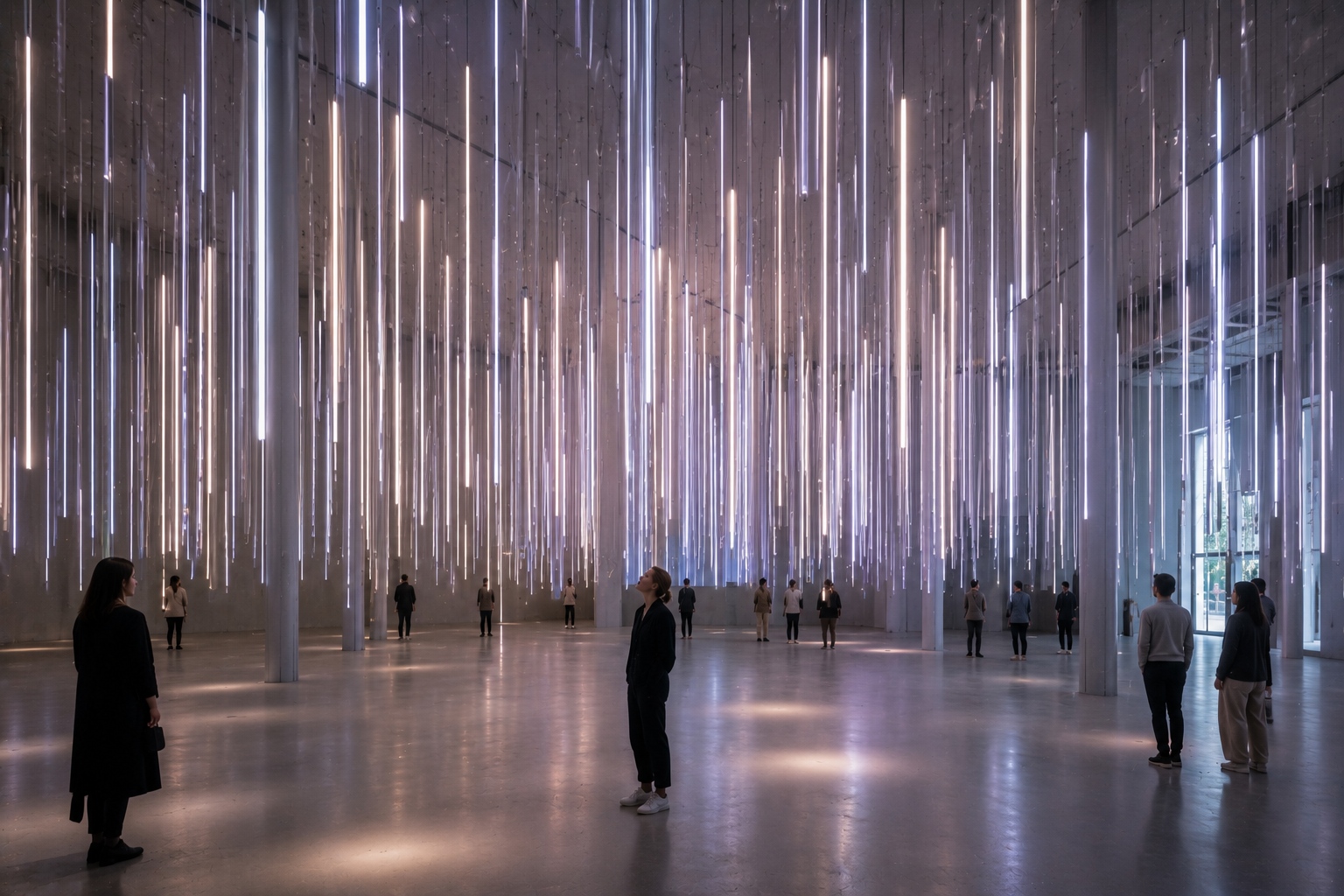
The most compelling technology-led brand experiences share a common structure: a genuine creative or cultural concept at the centre, with technology deployed to make that concept more immediate, more immersive, or more emotionally resonant. The technology disappears into the experience. What the audience remembers is what they felt, not what software was running.
This has a practical implication for brand experience strategy. The brief for a technology-integrated activation should start with the cultural idea — the story, the tension, the moment of discovery — and then ask which tools best serve that idea. Reversing that order, starting with the technology and retrofitting meaning, is still the most common mistake.
When technology serves a cultural idea rather than replacing it, the experience becomes genuinely memorable.
Localisation as strategy, not logistics
One of the more significant shifts in experiential marketing over the past five years has been the growing divergence between brands that globalise their activations and brands that localise them — and the measurable difference in how those activations land.
A standardised activation, replicated across markets with the same creative assets and the same physical build, signals efficiency. It also signals that the brand hasn't thought particularly hard about where it is or who it's talking to. Audiences in Berlin, Milan, and Stockholm have different cultural reference points, different relationships to public space, and different expectations of what a brand experience should feel like. Ignoring those differences doesn't make an activation feel international — it makes it feel generic.
The brands generating the most cultural traction are doing the opposite: treating each market as a genuine cultural conversation, not a deployment opportunity. That means working with artists, artisans, and cultural voices who are embedded in the local context. It means designing activations that could only exist in the place they're in. It means accepting that the São Paulo version of a campaign shouldn't look like the Paris version.
This approach requires more upfront investment in research and collaboration. It also produces significantly stronger outcomes — in earned media, in community resonance, and in the kind of brand perception shift that persists well beyond the activation itself.
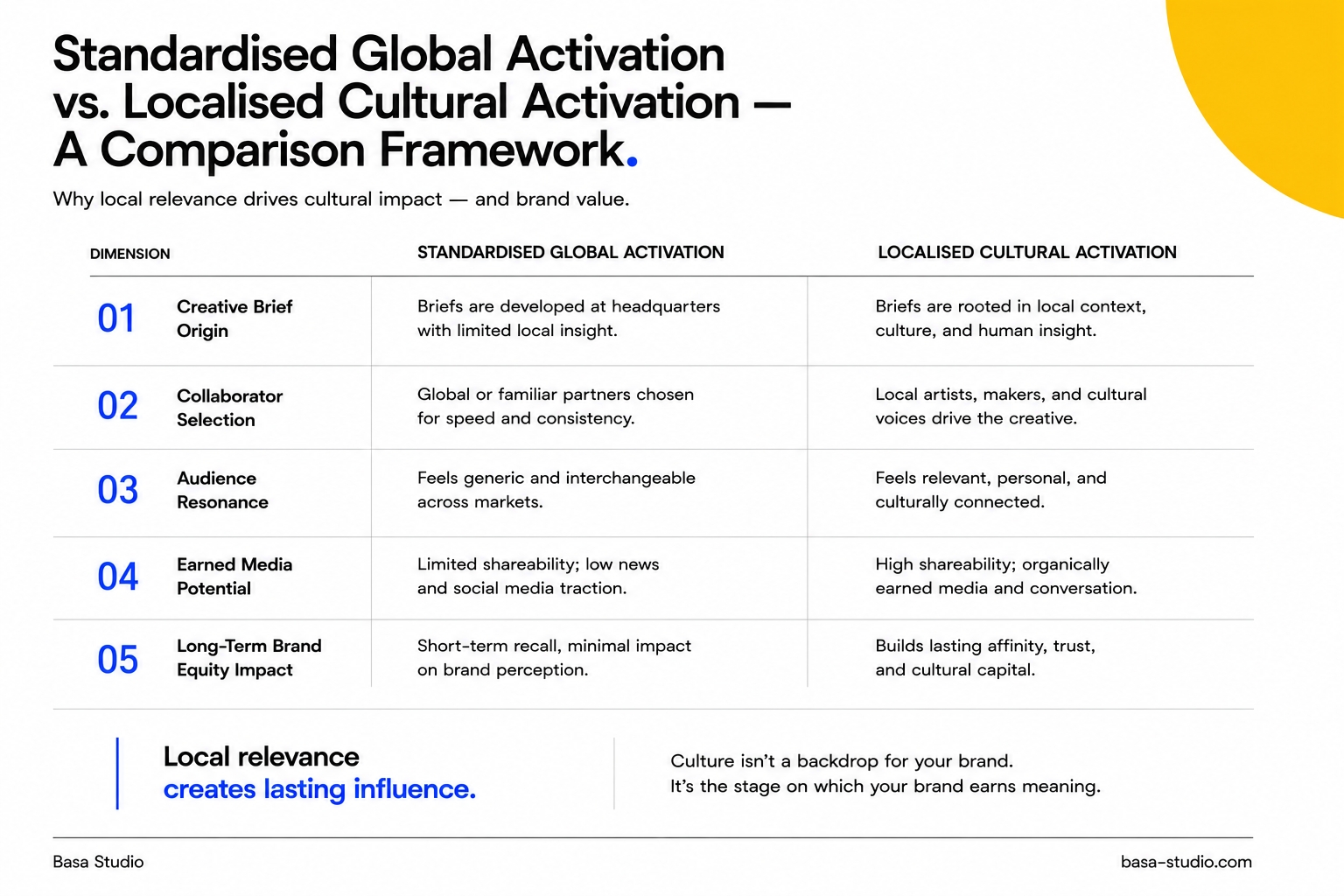
The difference between the two approaches comes down to five dimensions:
Creative brief origin — standardised activations are briefed at headquarters with limited local insight; localised activations are rooted in local context, culture, and human understanding
Collaborator selection — global partners chosen for speed and consistency, versus local artists, makers, and cultural voices driving the creative
Audience resonance — generic and interchangeable across markets, versus relevant, personal, and culturally connected
Earned media potential — limited shareability and social traction, versus organically earned media and conversation
Long-term brand equity impact — short-term recall with minimal impact on brand perception, versus lasting affinity, trust, and cultural capital
Five dimensions that separate a standardised global activation from a localised cultural one — and why the difference shows up directly in brand equity.
Measurement is catching up with ambition
For years, one of the consistent objections to investing seriously in experiential marketing was the difficulty of measuring it. Footfall, impressions, and social shares were the available proxies, but they couldn't capture the thing that actually mattered: whether the experience had shifted how an audience thought and felt about the brand.
That gap is closing. The more sophisticated brands — and the agencies working with them — are now building measurement frameworks that track cultural impact alongside traditional metrics. Brand perception tracking before and after an activation. Sentiment analysis of earned media and social conversation. Longitudinal studies that follow audience attitudes over months, not days. Qualitative research that captures the depth of engagement rather than just its reach.
This matters strategically because it changes the internal case for investment. When the ROI conversation moves beyond cost-per-impression and starts capturing brand equity growth, cultural resonance, and long-term loyalty impact, the experiential budget becomes harder to cut and easier to grow.
According to EventTrack's 2021 survey, 91% of consumers said that participating in brand events and experiences makes them more inclined to purchase — a figure that points well beyond sentiment toward something more strategically significant: purchase intent, brand preference, and long-term advocacy.
The strategic frame: what this means for your next activation
Experiential marketing has not become more difficult — it has become more demanding. Audiences have higher expectations. The tolerance for generic, high-production, low-substance activations is lower. And the bar for what constitutes a "memorable experience" has risen sharply.
That's good news for brands willing to invest in cultural depth rather than surface-level spectacle. When most brands are producing experiences that look impressive but feel hollow, the ones that bring genuine substance — rooted in a real cultural moment, built with credible collaborators, designed for the specific context in which they exist — stand out sharply.
The strategic question for any CMO planning a brand activation is not "how do we make this more immersive?" It's "what cultural substance are we bringing, and why are we the right brand to bring it?" Get that question right, and the technology, the format, and the production will follow naturally.
Brand experiences that earn attention don't do so by being louder or bigger. They do it by being genuinely worth attending — by creating moments that audiences would seek out regardless of the brand behind them. That's the standard. And the brands that hold themselves to it are the ones building lasting cultural authority, not just event attendance numbers.
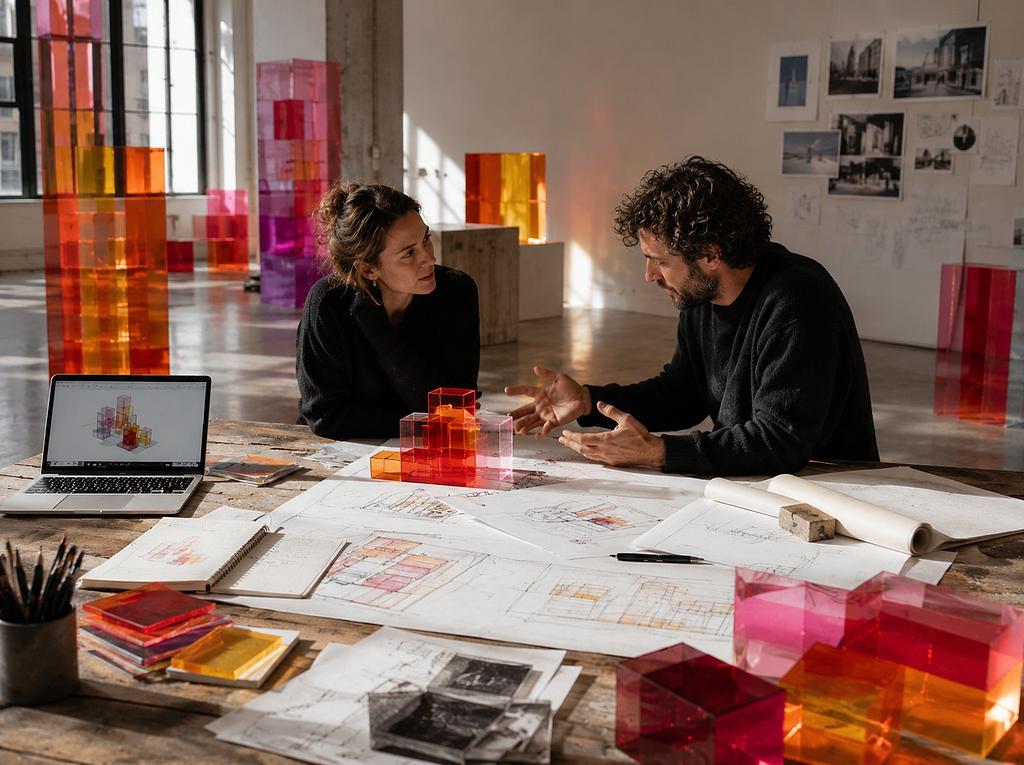
The most effective experiential marketing starts long before the build — in the strategic conversation between brand and cultural collaborator.
If you're working through what this shift means for your brand's next activation or longer-term experience strategy, let's talk.
Related creative stories
Browse through other features, interviews and guides to discover creative brand collaborations, meet innovative artists and creators, find out how new artforms are energizing advertising, & more.
We're excited to hear from you! If you're looking for artistic solutions for your next creative marketing campaign, send us your briefing. We can also help create a killer concept if you're in an early ideation phase. Check out our services for more.
Send your briefing
About you
THANK YOU
Your inquiry has been sent
We have received your inquiry. We'll get back to you within 24-48 hours to discuss your project. If you need urgent assistance, reach us on WhatsApp: +49 176 432 64506. In the meantime, we invite you to explore our insights, case studies, and lessons from building culturally grounded brand experiences.
Please contact us by phone if you're not able to reach us via this form.
THANK YOU
We have received your inquiry. We'll get back to you within 24-48 hours to discuss your project. If you need urgent assistance, reach us on WhatsApp: +49 176 432 64506. In the meantime, we invite you to explore our insights, case studies, and lessons from building culturally grounded brand experiences.
We use cookies to help empower our artists and make them accessible to clients. Check out our Privacy Policy and Terms of Service to see how your data can make a difference.