Cultural Brand Building Cost: Why It's Worth the Investment
Cultural authority can't be bought on a media plan. This is what it takes to build it — and why the investment compounds over time.
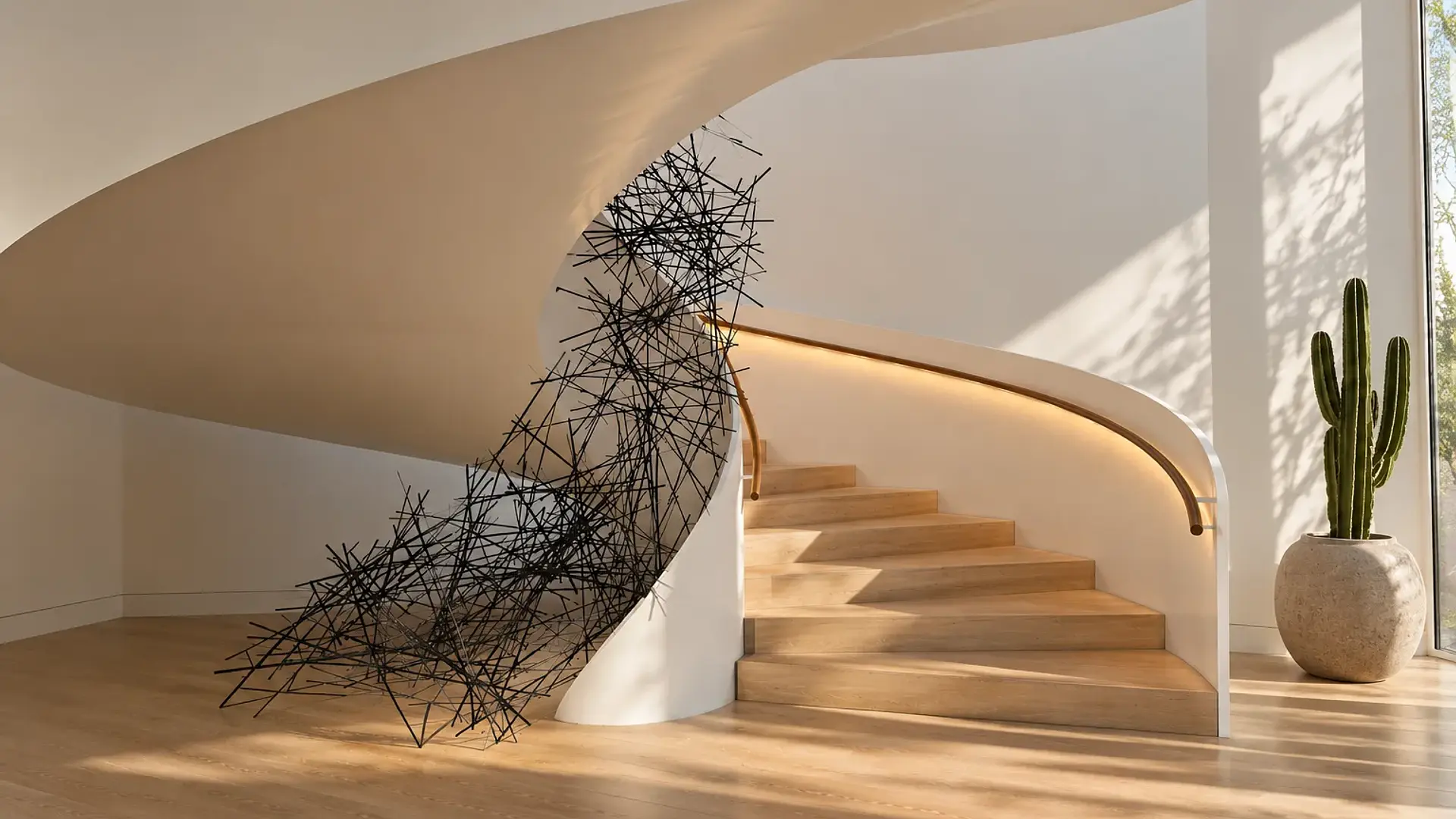
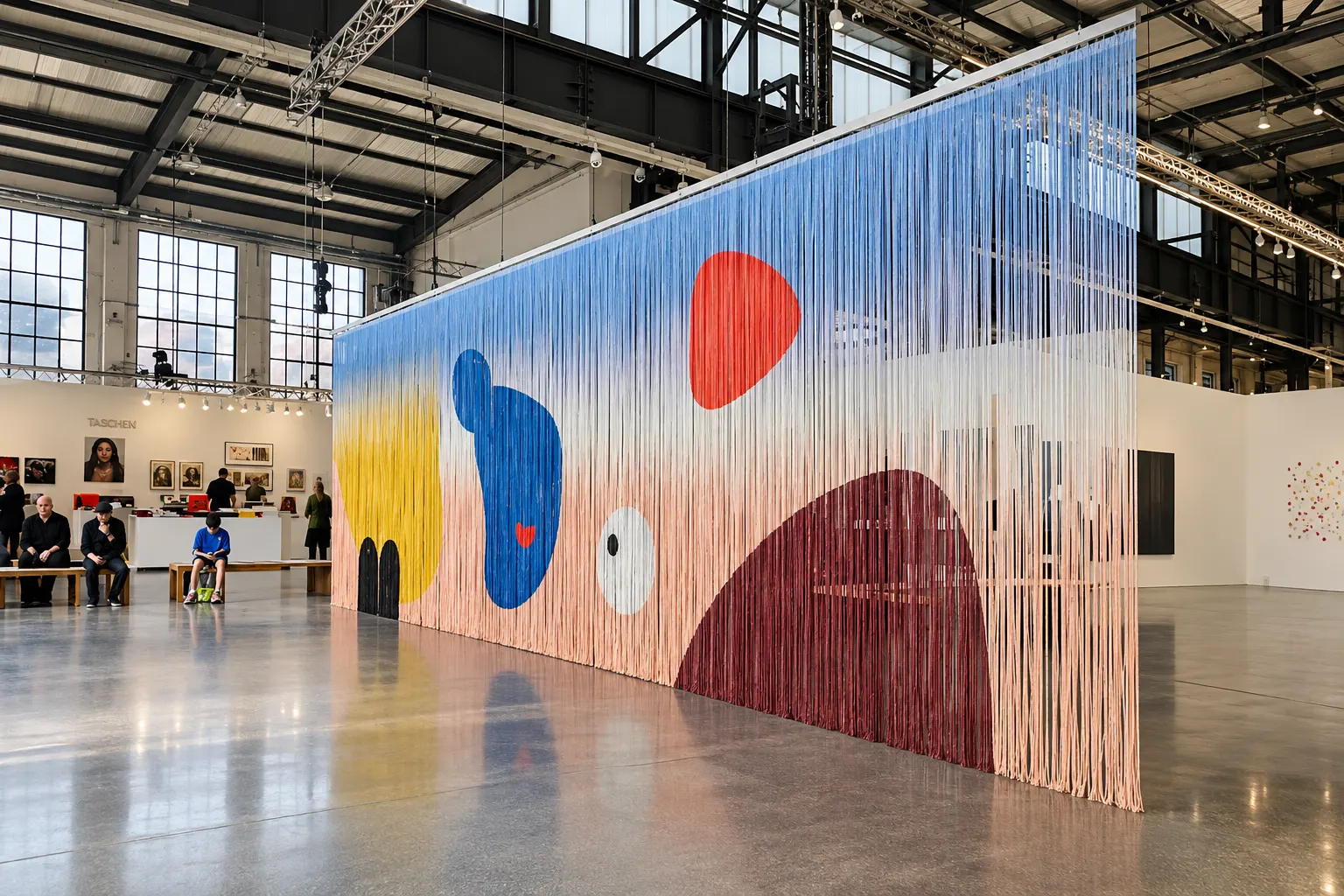
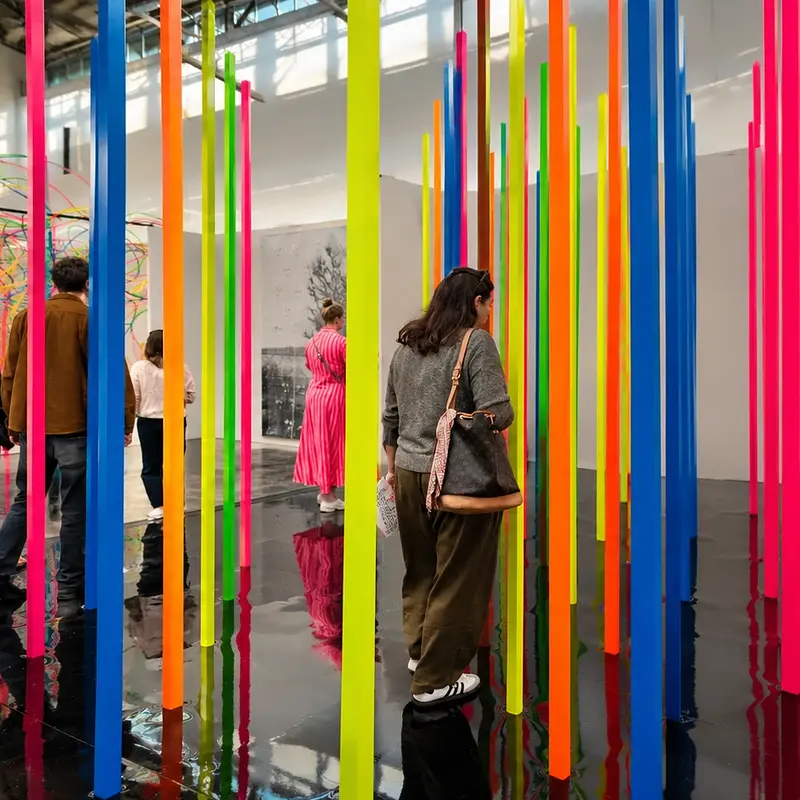
Cultural authority is built through meaningful engagement with culture, not simply through media spend.
Why Cultural Brand Building Costs More — And What You're Actually Buying
The short answer is that it costs more because it is doing more. A standard campaign brief goes to a media agency, a production house, and a creative shop — each executing a defined output. The process is efficient by design, and efficiency is precisely what cultural brand building is not optimising for.
A typical engagement starts with strategic discovery — understanding where a brand sits in cultural space before recommending any direction. That feeds into cultural intelligence research: identifying which collaborators, movements, and references carry genuine authority with the target audience. Then comes collaborator curation, which is not a database search but a judgment call about whose work is credible, not just aesthetically convenient. Concept development integrates the collaborator's voice into the brand story from the start, not as decoration applied at the end. And end-to-end production management covers everything through to delivery — coordination, rights, fabrication, documentation.
This is not a retainer plus a day rate. It is a strategic process with a high knowledge cost embedded in every stage — and that knowledge is exactly what produces results that a standard production playbook cannot replicate.
Investment vs. Expense: The Framing That Changes Everything
The most common mistake brands make is budgeting for cultural work the way they budget for a media buy: as a campaign expense with a defined flight period and a hard end date. That framing is not wrong for paid media. It is the wrong lens for cultural brand building.
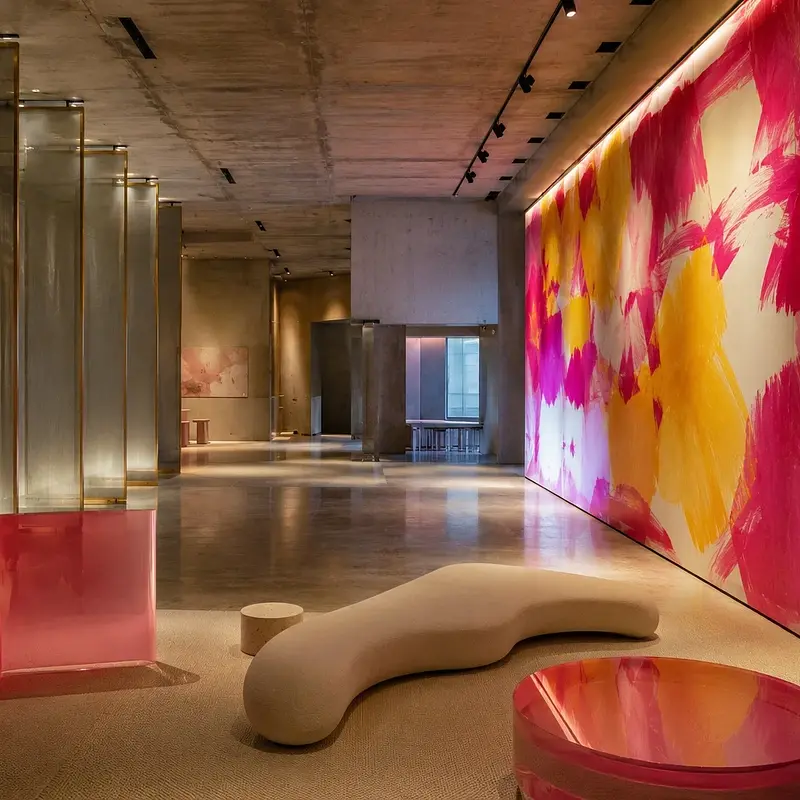
A well-executed cultural activation — a spatial experience, a landmark installation, a product launch built around genuine cultural depth — does not stop generating value when the invoice is paid. The photography lives in editorial coverage. The cultural moment lives in conversation. The brand association — if the work earned it — lives in perception data quarters later. The collaborator's audience becomes aware of the brand through a lens of credibility, not advertising. The story is retold without media spend behind it.
This is the long tail of cultural work. When brands account for earned media, social amplification, and brand equity movements in their post-campaign analysis, the cost-per-impression of a culturally grounded activation often compares favourably with pure paid media — even before accounting for the qualitative difference in how those impressions land. A person who discovers a brand through a cultural moment they genuinely valued arrives with a different disposition than one who scrolled past a pre-roll. That difference shows up in conversion, in retention, and in the kind of word-of-mouth that no media plan can manufacture. The evidence bears this out: Binet and Field's landmark IPA study — drawing on 30 years of effectiveness data across more than 700 brands — found that emotional brand-building campaigns are twice as efficient as rational ones, and deliver twice the profit over the long term.
Cultural brand building is, at its core, emotional brand building — the difference is that the emotion is rooted in genuine cultural substance rather than manufactured sentiment.
The brands that understand this are not asking whether cultural brand building is expensive. They are asking whether the alternative is actually cheaper — once all costs are counted.
The Hidden Cost of Forgettable
An activation that generates no earned media, no social amplification, and no lasting brand association is not an investment. It is an expense that produced nothing but a venue booking and a vendor list — regardless of what was on the invoice.
This is the cost brands rarely put on the balance sheet: the cost of forgettable. And it is more common than anyone in the industry likes to admit. Generic activations — the kind assembled from a standard production playbook, with no genuine cultural substance — look identical to ambitious ones on a pre-campaign media plan. The difference only becomes visible after the fact, when the coverage does not materialise, the content does not travel, and the brand equity metrics do not move.
The hidden costs compound:
Opportunity cost. Think of brand budget the way a CFO thinks about capital allocation: every euro deployed in one direction is a euro not compounding somewhere else. An activation that produces no earned media, no lasting content, and no measurable shift in brand perception is not a neutral outcome — it is a withdrawal from a cultural authority account that was never opened. The next activation starts from zero. Again.
Reputational cost. Premium audiences — the ones worth reaching — are culturally literate. They can tell the difference between a brand that has genuinely engaged with an artist's world and one that has rented their aesthetic for a quarter. When a brand gets this wrong, the audience does not simply ignore it; they remember. And unlike a failed media campaign, which disappears when the budget runs out, a clumsy cultural activation lives in screenshots, in comment sections, and in the kind of quiet industry cynicism that travels faster than any press release.
Internal cost. This one rarely appears in a post-campaign debrief, but it is real. A mid-size brand activation touches a marketing director, a creative lead, a project manager, an agency account team, a legal reviewer, and a board-level stakeholder who wants a readout. Weeks of collective attention, redirected from other priorities. When the result is a vendor-assembled event that generates a handful of branded photos and nothing else, the true cost is not just what was on the invoice — it is everything that was not built while the organisation was busy building Since this.
Worth forwarding to your CFO: forgettable activations aren't expenses — they're capital destruction. Cultural brand building compounds brand equity like a high-yield asset. Time to reallocate.
When brands run the full accounting, the gap between a culturally grounded engagement and a generic activation is rarely as wide as the initial quote suggests.
What Does a Cultural Brand Building Investment Actually Buy?
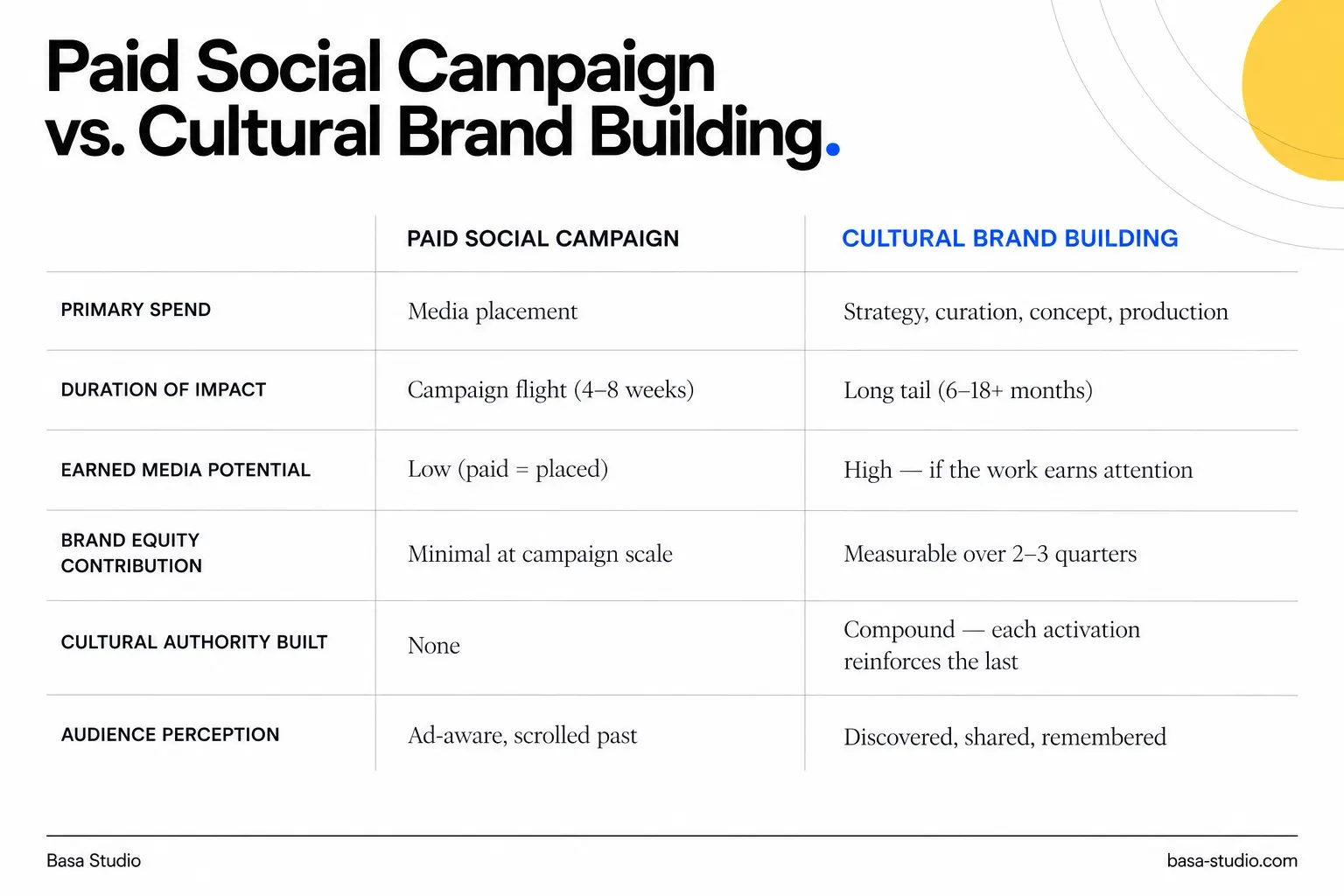
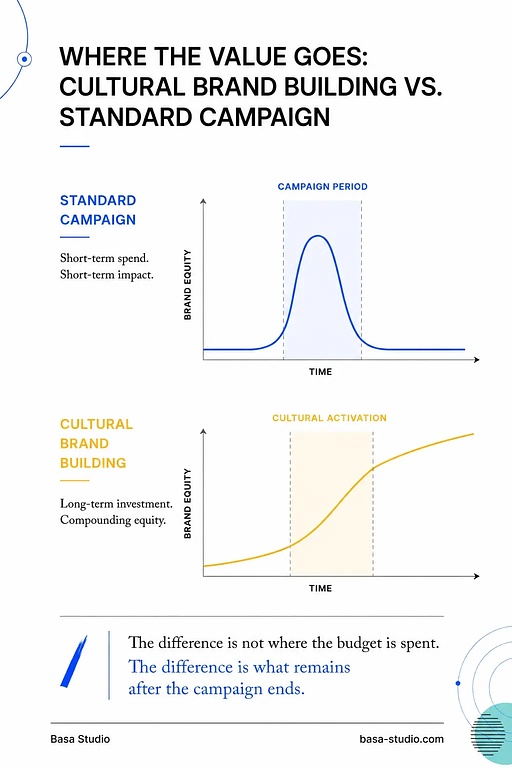
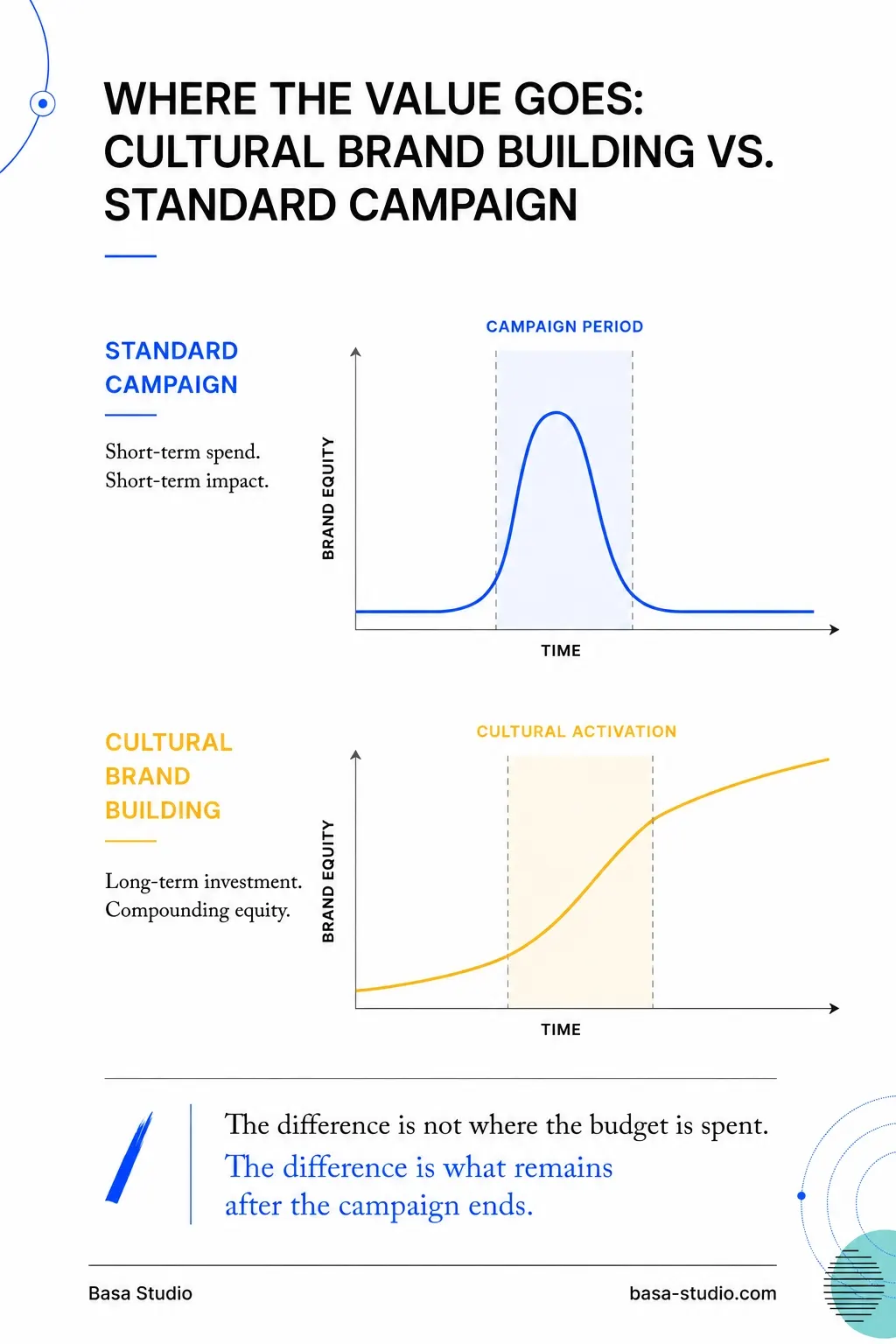
The honest answer is: it depends on what you are measuring and over what timeframe. The table below is not a calculator — it is a framework for thinking clearly about where brand building investment goes, and what comes back. The figures used are illustrative; the dynamics they represent are real, and the gap between them widens the longer the measurement window stays open.
The difference between a campaign and a cultural moment — measured.
This is not an argument against paid media — it has a clear role in any brand strategy. The distinction is what each investment is building. Paid media buys access to an audience for a defined window, and when the budget stops, it stops. Cultural brand building creates something that exists independently of the spend: a story the brand can tell for years, a collaborator relationship that can be extended, an installation that continues to be photographed, an association that premium audiences carry with them without being asked. The value does not switch off at the end of a campaign flight.
The Katjes Berlin campaign illustrates this dynamic at street level. A hand-painted mural opposite the East Side Gallery — produced with Berlin-based artist Nasca Uno for the 30th anniversary of the Wall's fall — generated immediate organic documentation and sharing from the area's culturally engaged audience, with no paid amplification. The activation outlasted its physical run in coverage terms, and directly led to a second commission from the client. That outcome — earned media, lasting brand association, and a client relationship that deepened — does not appear on a standard OOH media invoice.
The investment case for cultural brand building is clearest when you extend the measurement window past the campaign end date.
Cultural Collaboration Pricing: A Budget Framework
Cultural brand building engagements don't lend themselves to a price list — the variables involved are too significant for fixed rates to mean anything useful. But decision-makers need a framework to self-qualify and plan, so what follows is a general orientation.
Entry-level engagements (a focused cultural collaboration integrated into a single touchpoint — packaging, OOH, in-store): a single collaborator, one creative direction, one production arc. The right starting point for brands testing cultural brand building for the first time, or integrating it into an existing campaign framework.
Mid-range engagements (spatial experiences, product launches with integrated cultural programming, multi-touchpoint strategy): the scale at which a fully developed cultural moment becomes possible — with earned media potential, long-tail content, and measurable brand equity movement built in from the start.
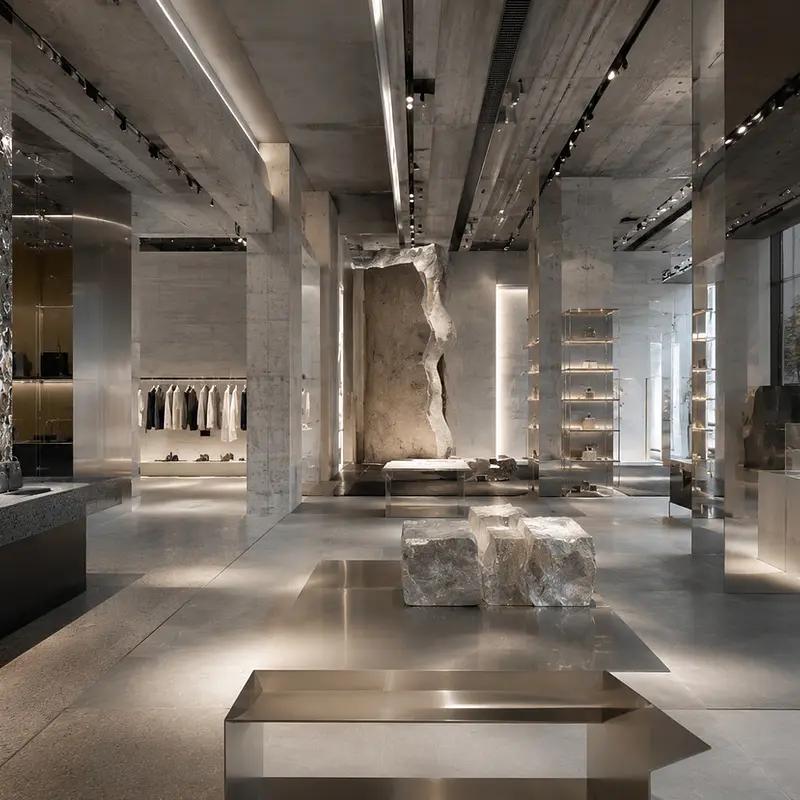
Landmark engagements (multi-year cultural strategy, flagship retail experiences, art installations designed to anchor brand positioning for a decade): investment-grade brand building with compounding returns. At this scale, the question shifts from cost to positioning — what does sustained cultural authority mean for the brand over a five or ten-year horizon.
The brands that engage at any of these levels have typically already reached the same conclusion: that brand building done properly is not a cost centre. It is one of the few things a marketing budget can fund that appreciates over time.
What You're Buying That Doesn't Appear on a Media Invoice
The line items on a cultural brand building engagement look different from a media plan — because the value being created is different. Standard media buys are transactional: you pay for placement, you receive eyeballs, the exchange is complete. Cultural brand building produces assets and associations that compound.
Several things appear on a cultural brand building engagement that never show up on a media plan. The cultural intelligence that ensures a collaboration lands credibly, not cynically. The strategic framing that connects a collaborator's work to the brand's long-term positioning. The curatorial judgment that protects a brand from the kind of cultural misstep that PR cannot fix after the fact. The rights, relationships, and reputational equity built with collaborators who could partner again. The narrative infrastructure — content, documentation, archive — that makes the work reusable and referential for years.
None of this appears as a line item. All of it contributes to the brand's cultural authority. And cultural authority, once built, is one of the few brand assets that genuinely compounds — each credible cultural moment raising the baseline from which the next one starts. A brand with established cultural authority commands higher price points, attracts collaborators who would not otherwise engage, earns editorial coverage that cannot be bought, and occupies a position in the market that competitors cannot simply outspend their way into.
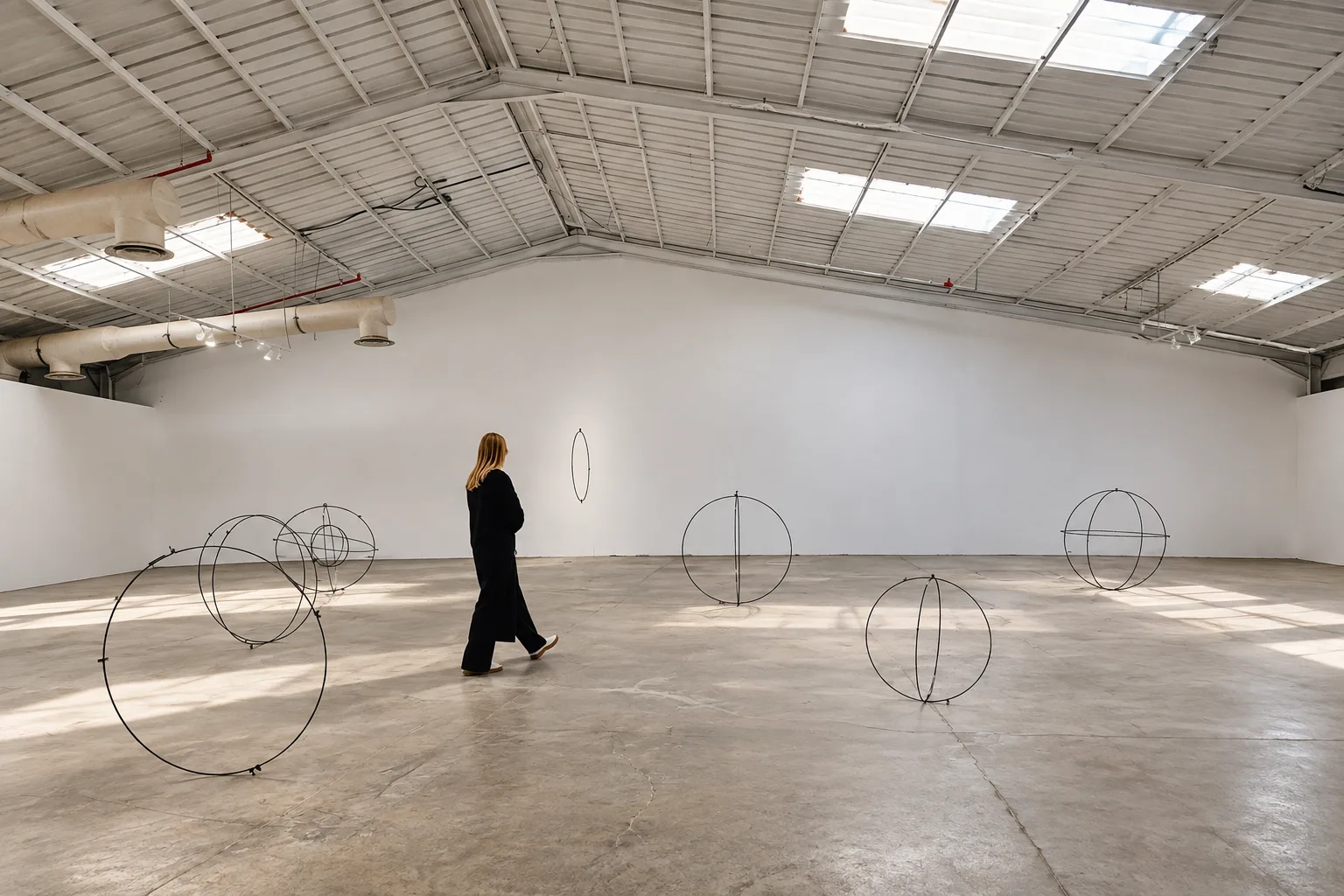
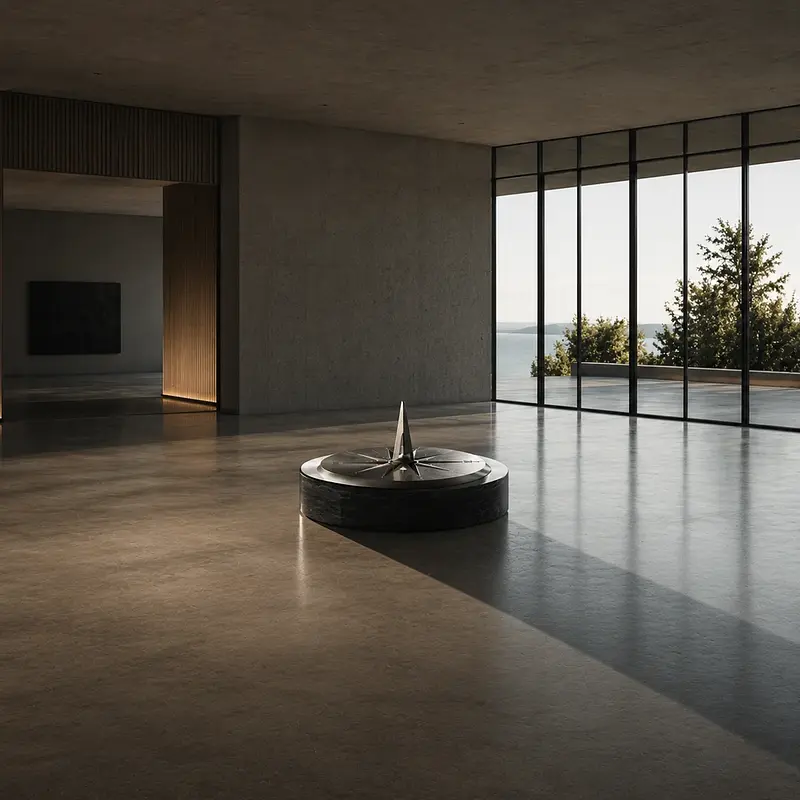
Strong cultural collaborations create assets and associations that outlast the campaign.
The Right Question to Ask
The cost of cultural brand building looks different when the measurement window extends past the campaign end date. The upfront investment is higher. The return — in earned attention, brand equity, and cultural authority that compounds — tends to be, too.
The brands that pursue this kind of work have usually already made the underlying decision: that premium positioning requires premium substance, and that substance cannot be outsourced to a production template. Basa Studio exists for exactly that brief.
Related creative stories
Browse through other features, interviews and guides to discover creative brand collaborations, meet innovative artists and creators, find out how new artforms are energizing advertising, & more.
We're excited to hear from you! If you're looking for artistic solutions for your next creative marketing campaign, send us your briefing. We can also help create a killer concept if you're in an early ideation phase. Check out our services for more.
Send your briefing
About you
THANK YOU
Your inquiry has been sent
We have received your inquiry. We'll get back to you within 24-48 hours to discuss your project. If you need urgent assistance, reach us on WhatsApp: +49 176 432 64506. In the meantime, we invite you to explore our insights, case studies, and lessons from building culturally grounded brand experiences.
Please contact us by phone if you're not able to reach us via this form.
THANK YOU
We have received your inquiry. We'll get back to you within 24-48 hours to discuss your project. If you need urgent assistance, reach us on WhatsApp: +49 176 432 64506. In the meantime, we invite you to explore our insights, case studies, and lessons from building culturally grounded brand experiences.
We use cookies to help empower our artists and make them accessible to clients. Check out our Privacy Policy and Terms of Service to see how your data can make a difference.