Most brands approach cultural collaboration the wrong way. They build mood boards, compare aesthetics, and chase names — then wonder why the partnership didn't land. Choosing the right cultural collaborator is not a creative decision. It is a strategic one, and it requires an entirely different kind of due diligence.
The Question Behind the Question
When a CMO asks "how do we find the right artist or artisan for this project?", they are almost always asking something harder: how do we know the right one when we see them?
Style can be assessed in a portfolio. Cultural credibility cannot. Aesthetic fit can be debated in a briefing room. Strategic alignment requires a different kind of due diligence — one that most brands are not equipped to carry out, and most agencies are not incentivised to provide.
The rise of cultural collaboration across luxury, automotive, lifestyle, and retail has produced a predictable side effect: a surge of partnerships that look like cultural depth and deliver none.
The term "art-washing" now circulates in marketing circles for the same reason "greenwashing" entered the sustainability conversation — because audiences have learned to recognise when cultural association is being used as a veneer rather than as a genuine expression of brand values. The brands that avoid this outcome are not the ones with the biggest budgets. They are the ones that treat collaborator selection as a strategic discipline.
This is a framework for making that decision well.
Why Style Fit Is the Least Important Criterion
Most brand teams start artist selection the wrong way: with a visual audit. They pull references, build mood boards, compare aesthetics. This is understandable. It is also insufficient.
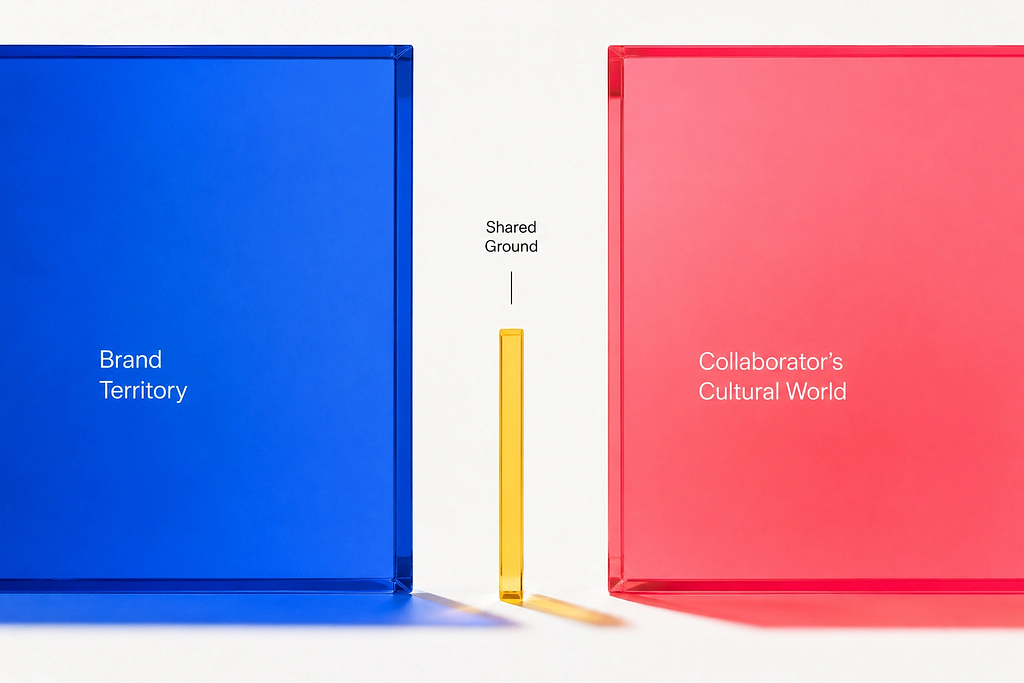
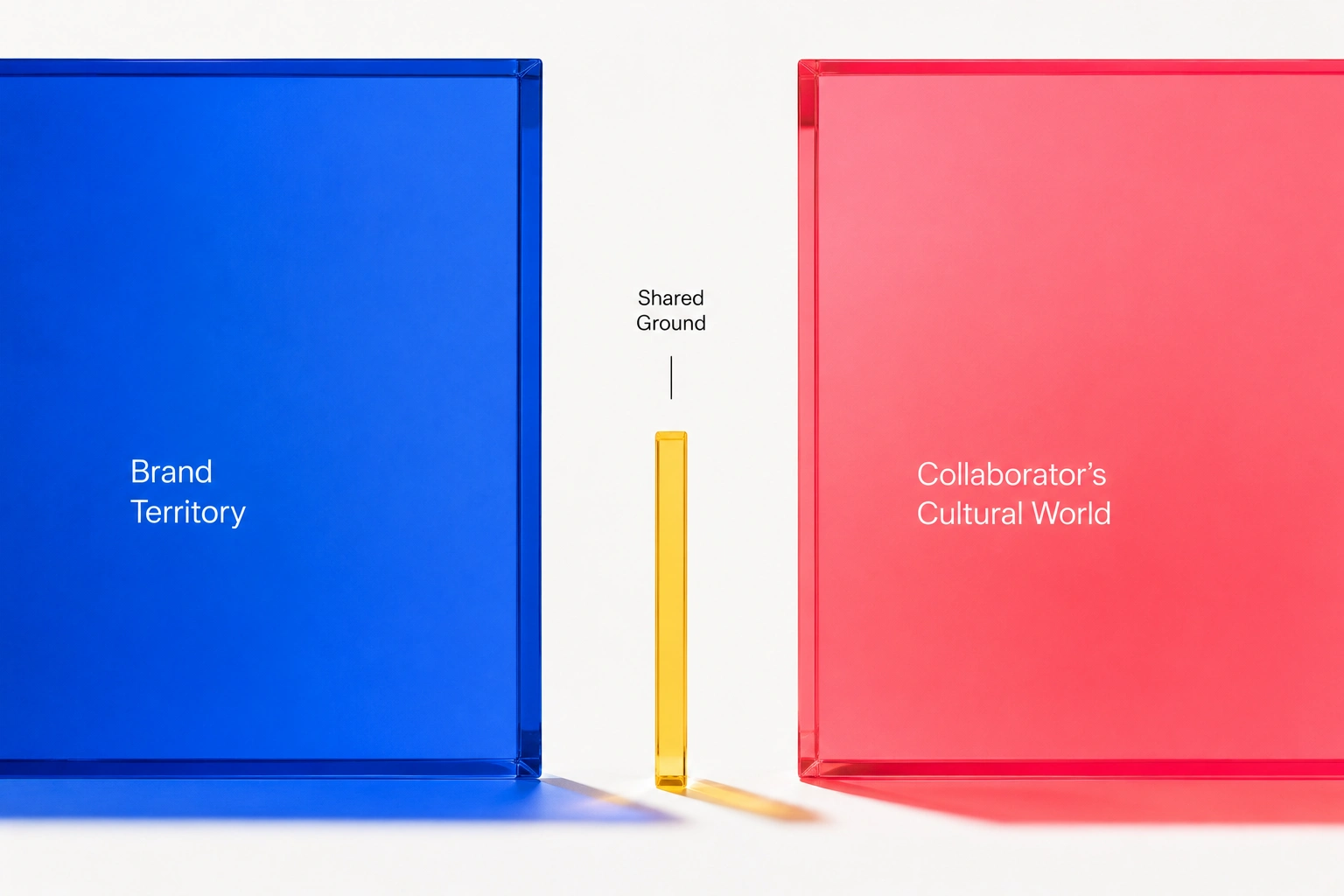
Aesthetic alignment is a baseline, not a selection criterion. A collaborator whose visual language mirrors the brand's existing identity may simply reproduce what the brand already has — confirmation rather than expansion. The most effective cultural partnerships work because there is a productive tension between the collaborator's world and the brand's. Close enough to be coherent. Distinct enough to add something the brand genuinely cannot create alone.
Style should be the final filter, not the first. What comes before it is more consequential.
The strategic sweet spot is not complete overlap. It is meaningful, deliberate intersection — enough shared territory to be coherent, enough difference to add cultural value.
The Five Criteria for Choosing Cultural Collaborators
1. Lived Experience Alignment
Does the collaborator have genuine, embodied connection to the territory the brand is entering? Not a professional interest in it. Not an adjacent project on their CV. A lived relationship with its values, communities, and history.
A heritage watchmaker working with a craftsperson whose practice is rooted in precision and material mastery is a different proposition from working with one whose aesthetic happens to evoke those qualities. Audiences — particularly culturally literate premium audiences — sense the difference. The collaborator should bring something the brand genuinely cannot manufacture internally. That asymmetry is the source of the collaboration's value.
2. Personal Advocacy History
What has the collaborator stood for, publicly and consistently, before the brand entered the picture?
This is not about social media following or press mentions. It is about whether the collaborator has a documented, demonstrable relationship with the values the brand is attempting to associate itself with. A collaborator who has publicly advocated for craft, sustainability, heritage, or community — and done so independently of commercial partnerships — brings that track record into the collaboration as genuine cultural currency. It cannot be briefed into existence.
A collaborator with no such history is a talented creative hire. There is a place for creative hires. They should not be confused with cultural partners. The distinction matters because audiences know the difference, and they will draw their own conclusions if a brand cannot articulate one.
3. Authentic Connection to the Project's Purpose
Every cultural collaboration has a purpose — or should have one. The collaborator should be someone for whom that purpose is personally meaningful, not merely professionally interesting.
When the purpose is real, the work carries it. When a collaborator has been briefed on a brand's values rather than sharing them, the work usually reads as exactly that — competent, sometimes beautiful, but hollow at the centre. The most durable collaborations are ones where the collaborator would have been drawn to the subject matter regardless of the brand's involvement. That pre-existing investment is what gives the work its authority.
4. Audience and Community Fit
Every serious cultural collaborator carries a community — not a follower count, but a cultural ecosystem of institutions, galleries, critics, peers, and dedicated audiences who track and trust their work. That community is part of what a brand accesses through a partnership.
The critical question is not the size of this community but its relationship to the brand's strategic growth ambitions. Is this a community the brand is trying to earn the attention of? Does it represent a cultural conversation the brand has a credible reason to join? A collaborator whose community overlaps entirely with the brand's existing audience delivers reach but not expansion. The goal is to access new cultural territory — not to perform for people who already know who you are.
5. Commercial Return Potential
Cultural credibility is a strategic asset. It still has to pay.
Before committing to a cultural partnership, a brand should be able to answer a straightforward question: can this collaboration justify its budget by lifting the measurable value of a clearly defined group of high-value customers — and can that be demonstrated in numbers, not just in coverage?
This is a different test from asking whether the collaboration will generate buzz or earn press. It is asking whether the right collaborator, structured the right way, can function as a precision commercial lever rather than a one-off brand moment.
The selection implications are specific. Collaborators whose practice already operates inside the spaces where premium buyers make decisions — galleries, institutions, collector networks, curated private events — give the brand access to those audiences through presence and invitation, not paid interruption. That access has commercial value that a standard media buy cannot replicate.
Structure matters as much as selection. A collaboration that produces scarce, premium output — a limited edition, a small series, a tiered experience — creates the conditions for high-value customers to spend meaningfully more. The difference between a €500 entry point and a €1,000+ bundle that includes an object, a print, or an access-layer experience is not just a pricing decision. It is a signal about the collaboration's seriousness, and it is where the commercial return is actually generated.
The measurement approach follows from the structure. Track average order value, repeat purchase rate, and customer lifetime value within the cohort that engages with the collaboration, and compare it against the brand's broader audience baseline. If those customers spend more and return more often, the collaboration is performing as a high-precision growth investment. If they do not, it is a creative project — which is a legitimate thing to commission, but it should not be described or budgeted as a strategic cultural partnership.
The Red Flags: What to Watch For
Experience across the cultural brand space reveals consistent warning signs. None of these is an automatic disqualifier. All of them demand scrutiny before a partnership is confirmed.
The collaborator who works with any brand, at any budget, for any brief. Cultural credibility is partly a function of selectivity. A collaborator with no apparent criteria for who they partner with signals that the arrangement is transactional, not purposeful. This does not mean a collaborator should have an impossibly curated portfolio — it means the brand should be able to understand, from the collaborator's existing body of work and past partnerships, what they stand for and what they will not do.
The collaborator selected primarily for name recognition. Fame and cultural authority are not the same thing. A collaborator who commands significant public attention may bring media value; they may not bring the specific cultural credibility the project requires. The selection decision should be driven by the five criteria above, with name recognition as a secondary consideration at most.
Values that contradict the brand's positioning. This one sounds obvious. It is consistently underweighted in practice. A luxury brand built on restraint, longevity, and material quality partnering with a collaborator whose practice is rooted in disposability, irony, or shock is not creative tension — it is incoherence. Strategic incongruity, when deliberate and purposeful, can be powerful. Accidental incongruity erodes both parties.
The collaborator who takes every brief. The most credible cultural collaborators are selective — not because they are difficult, but because their practice has integrity. A collaborator who has no record of turning down work raises the question of whether the partnership means anything to them beyond the fee. And if it doesn't mean anything to them, audiences will conclude it means nothing at all.
These are not edge cases. They are the most common failure modes in brand activations that looked promising on paper and underdelivered in market.
Artists, Artisans, Cultural Innovators: The Selection Implications
The type of collaborator is not simply a creative category. It determines what the brand can expect from the partnership in terms of cultural depth, community access, production dynamics, and long-term relationship potential.
An artist brings conceptual authority and a defined cultural community — typically most powerful for brand activations, installations, and campaigns where the work itself is the cultural statement. An artisan brings craft heritage, material mastery, and a living connection to making traditions — most valuable where the brand's story is rooted in provenance, quality, and process. A cultural innovator is a practitioner who works fluidly across disciplines — combining, for example, spatial design with technology, or craft tradition with contemporary performance — in ways that resist easy categorisation. Operating at the intersection of practice and idea, they bring the capacity to translate between worlds — particularly effective for brands navigating genuinely new cultural territory.
The five selection criteria apply across all three types. The weight of each criterion shifts depending on which the project calls for, and on what the brand is trying to build in the long term.
Short-Term Execution vs. Long-Term Cultural Partnership
There is a structural decision embedded in every cultural collaboration brief that rarely gets named explicitly: is this a project hire, or the beginning of a relationship?
Both are legitimate. They require different selection criteria, different contractual structures, and different success metrics. The mistake most brands make is applying short-term selection logic to what is structurally a long-term decision — or committing to a long-term partner without the rigour that decision demands.
The brands that have built the most durable cultural authority have consistently chosen the long-term path. Campari is one of the most instructive examples in European brand history — and one that is rarely told with the specificity it deserves.
From the early 1900s, under Davide Campari, the brand engaged the most progressive artists working in Italy not as decorators but as strategic partners. Futurist artist Fortunato Depero's relationship with Campari began in 1924 and continued until 1940 — sixteen years, hundreds of advertising works, and a creative collaboration that culminated in one of the most iconic pieces of packaging in commercial history: the conical Campari Soda bottle, still in production in its original form today. Davide Campari gave his collaborators near-total creative freedom. What he received in return was a visual identity so distinctive that it is now studied as part of the history of European modernism — not just the history of advertising.
More recently, BMW's partnership with Tate Modern — an eight-year collaboration running from 2012 to 2020 — reached audiences in over 90 countries, worked with more than 40 artists, and earned a Webby Award for live event webcast innovation. The partnership worked not because BMW spent heavily, but because the alignment between BMW's commitment to precision, innovation, and creative freedom and Tate's institutional values was genuine and demonstrable over time. A single-season activation could not have produced the same result.
The point is not that either brand found more famous collaborators. It is that they chose partners whose practice was genuinely aligned with what the brand stood for — and gave them the space to express it on their own terms. That decision compounded over years into cultural authority that no single campaign could have built.
Long-term cultural partnerships compound. They create a track record, a body of work, and a community of people who associate the brand with genuine cultural investment. That accumulation is what distinguishes brands that earn cultural authority from brands that borrow it intermittently — and return it having spent it.
The differences between the two approaches are worth being explicit about. A short-term execution hire is scoped to a single deliverable, selected primarily on craft and project fit, measured at campaign end, and carries no expectation of ongoing relationship. A long-term cultural partner is selected against all five criteria above, structured around a shared creative vision, measured over years rather than quarters, and compounds in cultural authority with every successive collaboration. Both are legitimate. The selection logic for each is entirely different — and conflating them is one of the most common and costly mistakes brands make.
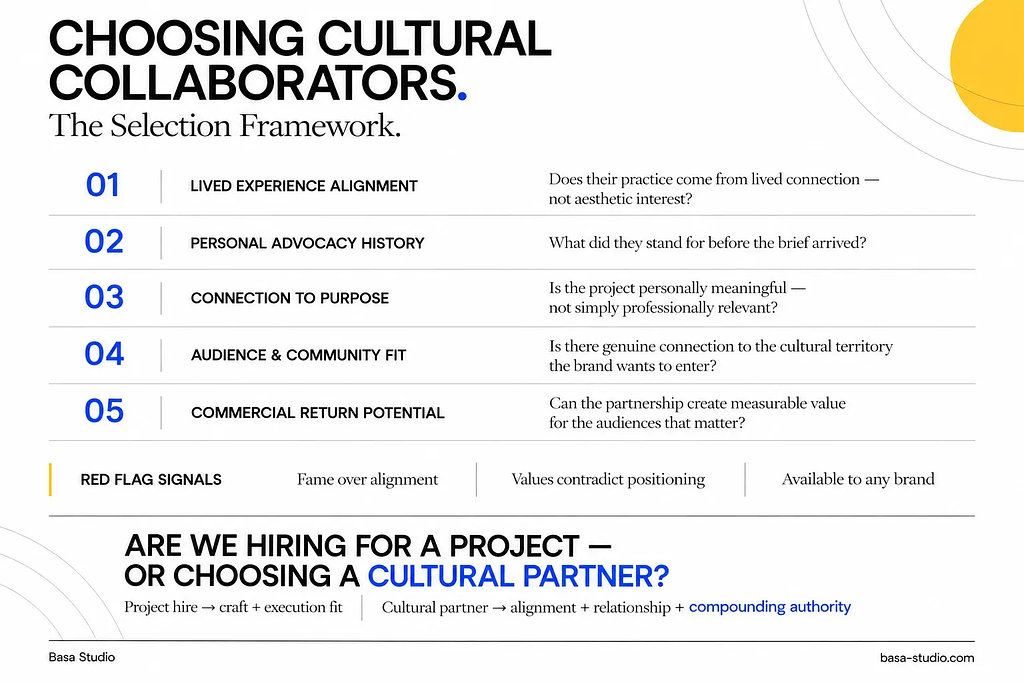
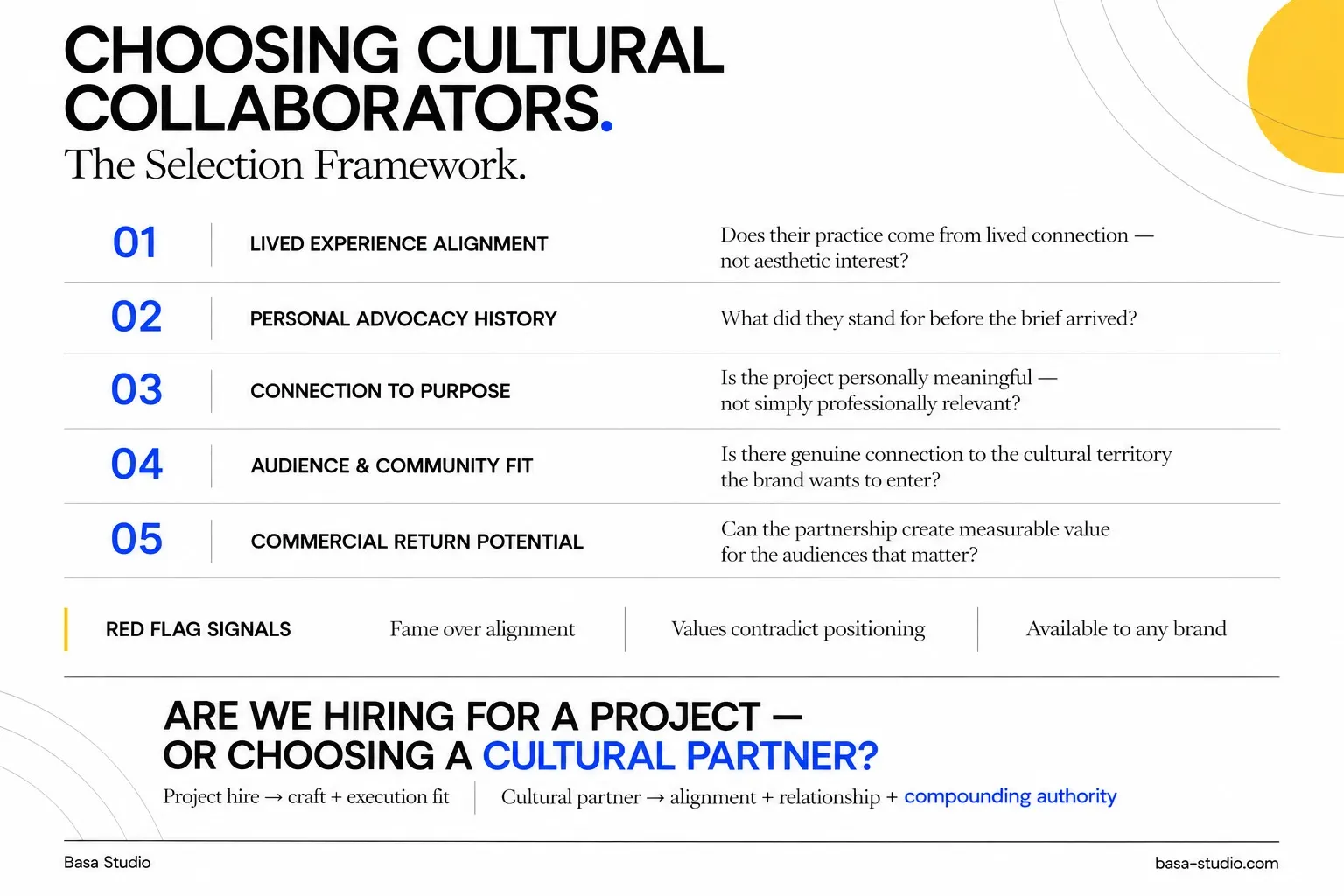
The selection framework for evaluating cultural collaborators — five core criteria, three red flags, and the long-term question every brand should answer before signing.
The Strategic Decision, Not the Creative One
Choosing cultural collaborators is not a creative decision with strategic implications. It is a strategic decision with creative expressions.
The brands that build lasting cultural authority — the ones whose collaborations become reference points rather than footnotes — approach selection with the same rigour they apply to any significant strategic partnership. They ask not just whether a collaborator makes work they admire, but whether that collaborator's world, values, and community amplify what the brand is genuinely trying to stand for. They plan for a relationship, not a transaction. And they accept that cultural credibility cannot be purchased in a single season — it is accumulated through consistent, selective, purposeful choices made over time.
The collaborator you choose sends a signal to the most culturally literate segment of your audience. Make sure it is a signal you can stand behind.
Ready to Choose the Right Cultural Collaborator?
Getting the selection decision right requires deep knowledge of both the cultural landscape and the commercial context. If you are evaluating potential collaborators or building the case internally for a cultural partnership, get in touch with our team.
Related creative stories
Browse through other features, interviews and guides to discover creative brand collaborations, meet innovative artists and creators, find out how new artforms are energizing advertising, & more.
We're excited to hear from you! If you're looking for artistic solutions for your next creative marketing campaign, send us your briefing. We can also help create a killer concept if you're in an early ideation phase. Check out our services for more.
Send your briefing
About you
THANK YOU
Your inquiry has been sent
We have received your inquiry. We'll get back to you within 24-48 hours to discuss your project. If you need urgent assistance, reach us on WhatsApp: +49 176 432 64506. In the meantime, we invite you to explore our insights, case studies, and lessons from building culturally grounded brand experiences.
Please contact us by phone if you're not able to reach us via this form.
THANK YOU
We have received your inquiry. We'll get back to you within 24-48 hours to discuss your project. If you need urgent assistance, reach us on WhatsApp: +49 176 432 64506. In the meantime, we invite you to explore our insights, case studies, and lessons from building culturally grounded brand experiences.
We use cookies to help empower our artists and make them accessible to clients. Check out our Privacy Policy and Terms of Service to see how your data can make a difference.